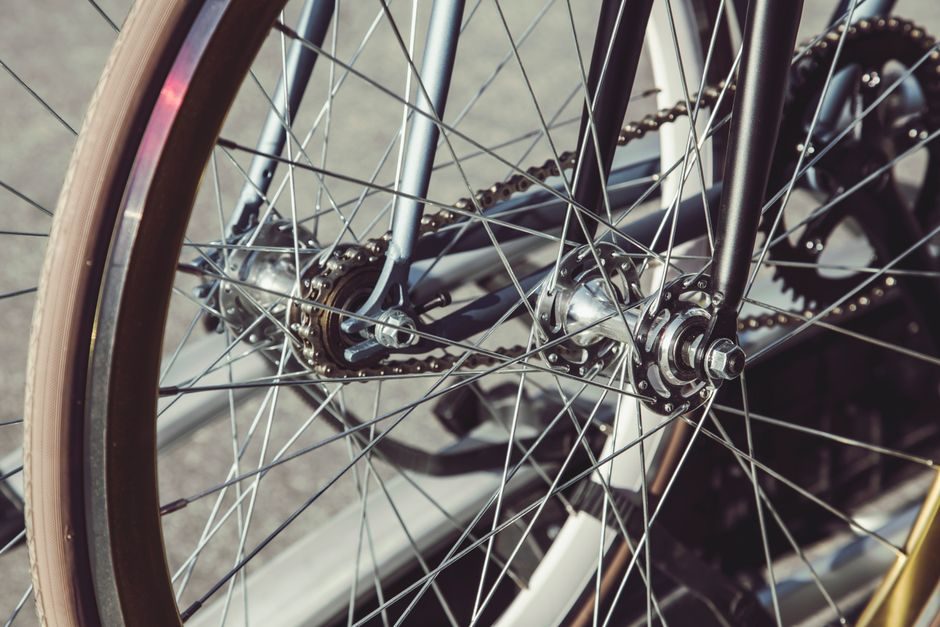
Spec a toothed synchronous belt with a mating sprocket when you need slip-free, ~98% efficient positive drive across the full load range; stick with a V-belt on a sheave when lowest capital cost, slip-as-fuse behaviour, and quiet operation under shock load dominate the trade-off [S1][S2].
The U.S. DOE's Advanced Manufacturing Office puts the efficiency gap at roughly 3 percentage points — 95% for a fresh V-belt installation versus 98% for a synchronous belt — and shows that on a 100 hp fan at 75% load the swap saves 16,130 kWh/yr at $0.08/kWh, or about $1,290/yr per drive [S1]. V-belts in service can drop a further ~5% when slippage goes unchecked, while a notched (cogged) V-belt closes part of the gap and runs about 2% more efficient than a standard wrapped V on the same sheaves [S1][S3].
Engagement Principle and Terminology
A V-belt is a friction device: the trapezoidal cross-section wedges into a V-groove sheave, and torque is carried by sidewall friction generated by installation tension [S1][S3]. The sheave is the wheel; NAFA notes that ISO uses the umbrella term "pulley" for every wheel, while "sheave" stays reserved for V-belt drives and "sprocket" is reserved for synchronous (timing) belt drives and chain drives [S3]. A synchronous belt replaces friction with form-fit: moulded teeth on the belt mesh with machined grooves on a dedicated sprocket, so the drive is positive — no slip, fixed ratio, no slip-related efficiency loss at high torque [S1][S2].
For chain drives, sprockets are toothed wheels cut to mesh with the chain pitch, typically machined from steel, cast iron, or engineering plastic depending on load, speed, and operating environment [S4]. The same word — sprocket — therefore covers two physically different jobs: a chain-drive sprocket pulls pins, while a synchronous-belt sprocket pushes belt teeth, and the two are not interchangeable.
Efficiency, Speed and Torque Windows
Industry data lines the three industrial options up as: V-belt typically 92–96% efficient at install, synchronous belt 97–99%, and a lubricated roller chain 96–98% dropping toward ~90% if lube is neglected [S2]. V-belts are usually capped at a belt surface speed of ~30 m/s, synchronous belts reach ~60 m/s, and roller chain is generally held to ~15 m/s for long service life [S2]. On torque, the synchronous-belt family spans light fractional horsepower up to heavy-duty Poly Chain GT-style polyurethane belts on steel sprockets, and chain still leads for the highest shock-loaded torque densities [S2].
The efficiency delta is not constant: a DOE worked example on a 100 hp supply-air fan running 527,000 kWh/yr at 75% motor load shows 16,130 kWh/yr (3.06%) saved by moving from a 95% V-belt to a 98% synchronous belt [S1]. At smaller drives the absolute kWh is smaller, but the percentage stays roughly the same, so V-belt-to-synchronous retrofits are typically justified first on continuously running, high-duty-cycle equipment rather than intermittent loads [S1].
Environment, Noise and Maintenance Reality
Synchronous belts run slip-free in wet and oily environments, need only minimal retensioning, and tolerate misalignment better than chain, but they transfer more vibration to the shafts due to their stiffness and are noisier than V-belts because of the tooth meshing frequency [S1][S2]. V-belts stay quiet, absorb vibration, need no lubrication, and tolerate small misalignment because the wedge self-centres in the groove, but they are sensitive to oil, heat, and abrasive contamination on the sidewalls [S2][S3]. A chain drive handles dust, heat, and contamination best, but demands ongoing lubrication and is the loudest of the three [S2].
Typical service-life ranges quoted by the same trade reference are 12,000–18,000 hrs for V-belts, 18,000–25,000 hrs for synchronous belts, and 15,000–25,000 hrs for chain — but chain's range collapses fast if lubrication slips [S2]. On V-belts, DOE recommends re-checking tension every 3 to 6 months after break-in: undertension causes slip and wear, overtension loads the bearings and can shear a shaft [S1]. A 2025 NAFA HVAC-R primer recommends a notched or raw-edge V-belt where the drive is expected to run near peak torque continuously, since the exposed rubber sidewall grips the sheave better than wrapped construction [S3].
Selection Criteria and Application Fit
Use V-belt drives when lowest capital cost, quiet operation, and inherent overload protection dominate: fans, small pumps, light conveyors, HVAC blowers, and any drive where a sudden jam should make the belt slip rather than snap a shaft or strip a gearbox [S2][S3]. A typical V-belt replacement takes 15–30 minutes per drive — slacken the belt tensioner, slip the old belt off the sheaves, fit the new one, retension — which keeps spares cheap and downtime short [S2].
Move to a synchronous belt and sprocket when the load is continuous, the speed ratio must be fixed, the environment carries oil or moisture, or you are designing a new belt conveyor line where the 2–4 percentage point efficiency gain compounds across many drives [S1][S2]. Specify chain on the sprocket when torque density, shock tolerance, and dust tolerance matter more than noise and lubrication cost — heavy mill drives, dirty aggregate conveyors, large-ratio slow-speed heads [S2][S4]. Avoid synchronous belts on shock-loaded applications where the tooth shear limit can be reached, and avoid raw-edge V-belts where abrasive contamination will chew the exposed sidewall [S1][S3].
Standards, Sourcing and What to Verify on the Datasheet
Belt-drive geometry and section designations (A, B, C, D, E classical; SPZ, SPA, SPB, SPC narrow wedge) are published by ISO, with the term "pulley" used as the umbrella word for the wheel whether V-belt or synchronous per ISO convention [S3]. When you compare supplier data, anchor on three numbers: efficiency at the operating load point, maximum belt surface speed, and the service-life hours rating — not on catalogue peak efficiency measured at ideal alignment and brand-new belt [S1][S2].
On synchronous-belt datasheets, confirm the tooth profile (HTD, STD/RPP, or GT), the belt width in mm, the number of teeth on each sprocket, the centre distance, and the manufacturer's torque rating at the actual driven speed; the same physical belt on a smaller sprocket drops torque capacity sharply because tooth-bending stress rises with smaller radius [S2]. On V-belt datasheets, confirm the section (classical vs narrow wedge), the construction (wrapped vs raw-edge vs notched), the matching sheave groove angle, and the recommended belt tensioner deflection force — a notched belt can reuse existing V-belt sheaves, but a synchronous drive always needs new toothed sprockets matched to the belt pitch [S1][S3]. For new installations, DOE's standing recommendation is to default to synchronous belts because the price premium over a wrapped V-belt is small relative to the energy delta [S1].
Track these two signals over the next planning cycle: (1) utility and motor-system rebate programmes that pay for V-belt-to-synchronous retrofits on continuously running fans and compressors, and (2) supplier-side extensions of Poly Chain GT-style high-torque polyurethane synchronous belts into smaller pitch sizes, which keep eroding the case for a V-belt on any new build. For process engineers sizing replacement flat belt or specialty drives, the same friction-versus-positive-engagement logic applies: friction drives slip under overload, positive drives do not — pick the failure mode you want [S1][S2][S3].
For related coverage, see Top Electrolyzer Manufacturers 2026: Capacity, Chemistry Mix and Spec Gates.