
For structural and line-pipe duty, steel plate total cost of ownership over a 30-year service window is driven 60-75% by the grade-and-thickness choice made at the engineering desk, not by the mill invoice line item, and the gap between cheapest-acceptable plate and best-value plate widens once corrosion loss, fabrication re-work and end-of-life scrap credit are loaded [S1][S5].
The analysis below applies the standard TCO framework — acquisition, operating, maintenance and end-of-life cost lines — to steel plate used in storage tanks, pressure vessels, offshore decks and structural frames, with EN 10025 structural grades, ASTM A516/A537 pressure-vessel grades and API 2H/2W offshore grades as the comparison set.
Defining TCO Scope and Cost-Line Structure for Plate Steel
TCO is a financial analysis tool covering direct and indirect costs across the full ownership window, not the invoice price alone — acquisition, operating, maintenance and end-of-life lines are all in scope [S1]. For steel plate the five cost lines an estimator should isolate are: mill-base price + extras, fabrication (cutting, welding, rolling), in-service corrosion and inspection loss, unplanned downtime, and scrap-residual credit at decommissioning.
Lifecycle cost on plate is a long-horizon problem: a tank built to API 650 or a vessel built to ASME VIII Div. 1 typically runs 25-40 years before replacement, and a 10-20% under-spec on plate thickness or coating system compounds over that window into millions of dollars of inspection, repair and lost-throughput exposure [S5]. Toolshero's framing — "TCO consists of the short-term costs of a product, known as the purchase price, and the long-term costs" — maps cleanly onto plate procurement: the "short-term" cost is the mill invoice, and the "long-term" cost is everything from the grit-blast booth forward [S1].
Cost Line 1 — Mill Base Price, Extras and the 3.1 Certificate
The first cost line is the mill invoice divided into base price, grade extra, thickness extra, testing extra (Charpy at -20°C, -40°C, -46°C), and the EN 10204 3.1 mill test certificate — a 3.2 certificate (independent witness) typically adds a percentage premium on top of 3.1 for the same heat. Plate ordered to ASTM A516 Gr. 70 with normalized rolling and supplementary Charpy at -46°C costs a defined premium per tonne over as-rolled A36, and the estimator must book that premium into TCO before comparing against a lower-grade alternative. [S1]
On a 500 t tank order the extras spread alone is typically a six-figure line item, comparable in magnitude to two years of internal inspection cost on the same tank.
Cost Line 2 — Fabrication Throughput, Welding and NDT
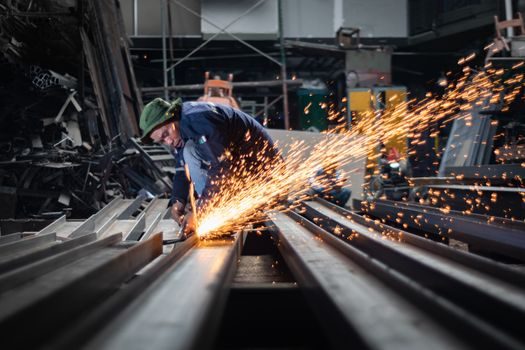
The second cost line is fabrication: cutting, beveling, rolling, welding, NDT and surface preparation. A 10 mm shift from A36 to A516 Gr. 70 in a pressure vessel changes preheat requirements, Charpy sampling density and PWHT scope; the fabrication premium on higher-grade plate commonly runs 15-30% over the mill delta because of slower weld travel speeds and additional NDE volume. [S2]
Conversely, on a structural frame where Charpy is not specified, choosing an S355J2+N over A36 can reduce weld volume because the higher yield (≥355 MPa vs ≥250 MPa) allows a thinner section, partially offsetting the per-tonne premium through lower welding-deposition kilograms [S1]. Fabrication throughput cost is the single line where a "more expensive" plate can flip the TCO result — a key reason the comparison must be on cost-per-installed-kilogram of structure, not cost-per-tonne of plate. Plate types and classifications are laid out in this 2026 spec reference.
Cost Line 3 — In-Service Corrosion, Inspection and Repair Loss
The third cost line is in-service corrosion and inspection: a storage-tank bottom plate loses a defined wall thickness per year, and API 653 inspection intervals are set as a function of that corrosion rate. Choosing a carbon steel A36 bottom over a corrosion-resistant alloy steel or a duplex-clad alternative changes the inspection interval, the repair frequency and the planned-replacement year of the bottom plate. [S3]
For offshore-deck plate specified to API 2W or for sour-service line-pipe to NACE MR0175, the corrosion-cost line dominates the TCO: a 1 mm/yr corrosion rate on an unprotected splash zone adds tens of thousands of dollars per square meter over a 25-year design life, which dwarfs the per-tonne premium for a higher-grade or clad plate [S5]. A side-by-side example: an A36 tank bottom with 6 mm corrosion allowance plus a coal-tar epoxy internal coating on a 30-year cycle, versus a 304L stainless-clad bottom at 2x mill cost, breaks even around year 18-22 on TCO in many chemical-service duty cases. Grade, thickness and sourcing gates for this decision are detailed in steel plate installation guidance.
Cost Line 4 — Downtime, Failure and Safety Risk
The fourth cost line is unplanned downtime and the safety/regulatory risk premium. A pressure-vessel failure on a hydrocarbon service triggers not only repair cost but lost production, regulatory shutdown and incident reporting under OSHA PSM or the EU Seveso III directive; this risk cost is rarely booked in the procurement TCO but routinely appears in operator-side TCO models [S2].
The Red Hat TCO case study notes that "the solution has to work all the time" — a similar logic applies to plate: a single through-wall failure on a 30-year-old vessel can be a 50-200x multiplier on the original plate invoice line [S2]. For this reason, plant-side TCO models often add a 2-5% risk-premium loading on plate procured without full traceability (EN 10204 3.2 rather than 3.1) when the service is regulated or high-consequence. Where plate is used as wear-resistant silicon-steel or alloy-steel lining, replacement-during-turnaround cost is the dominant component of this line and must be modeled on a per-cycle basis, not as a flat annual sum.
Cost Line 5 — End-of-Life Scrap Credit and Circularity
Heavy plate with a verified chemistry certificate and known provenance (EN 10204 3.1) commands the higher scrap-credit band because the recycler can re-route it into rebar or new plate melts; mixed-origin plate sells at a discount. [S4]
CoSN's updated 2026 TCO framework explicitly lists disposal as a TCO line, and the USPS procurement manual treats end-of-life as a first-class cost line rather than an afterthought [S5][S6]. A practical estimator rule: book scrap credit as a negative number in year 30 using a 70% confidence scrap price, not the spot price on the day of demolition, because scrap prices have historically varied by more than 50% peak-to-trough across a 5-7 year window.
Comparison: Structural vs Pressure-Vessel vs Offshore Plate on TCO Criteria
On four TCO decision criteria, the three principal plate categories rank as follows. Acquisition cost: structural A36/S355J2 lowest, pressure-vessel A516/A537 mid, offshore API 2H/2W highest. Fabrication cost: structural lowest (no Charpy, no PWHT typically), pressure-vessel mid (Charpy + possible PWHT), offshore highest (through-thickness Z35 + stricter NDE). In-service corrosion cost: structural highest in corrosive service, pressure-vessel mid, offshore lowest (designed-for-service grade). Scrap credit: structural and pressure-vessel similar, offshore slightly higher due to tighter chemistry and traceable heat numbers. [S5]
For a 1,000 t structural building, the TCO spread between A36 and S355J2 typically narrows to single-digit percent of total lifecycle cost, while for a 500 t pressure vessel the spread between A516 Gr. 70 and a higher-grade alternative can be 15-25% of TCO because the fabrication and inspection lines are larger relative to the mill line. Choosing plate purely on mill invoice is therefore reliable only when the design service is short, non-corrosive and non-regulated [S1][S3][S5]. Where the service is sour, cryogenic or subsea, the higher-grade plate is almost always the lower TCO answer on a 20-30 year horizon.
When Steel Plate TCO Analysis Is and Is Not Worth the Effort
TCO modeling is worth the effort when the design life exceeds 15 years, the service is regulated (pressure equipment, offshore, sour service) or the corrosion environment is aggressive, because the long-term cost lines (corrosion, inspection, downtime, scrap) dominate the short-term mill invoice. For short-life, non-regulated structural plate (e.g. construction-site temporary works, modular skid frames with a 5-year life) the mill invoice plus fabrication premium is a reliable proxy for TCO and the modeling effort is not justified [S1].
Toolshero's caveat that "TCO helps to reveal the hidden costs of a new technology" applies directly to plate: hidden costs in this domain are the inspection intervals, the NDE re-work, the coating-replacement cycles and the end-of-life scrap terms — none of which appear on the mill invoice. Toolshero also notes TCO is less effective at determining advantages than ROI, meaning the model is a cost-discipline tool, not a benefit-justification tool, and should not be used to argue for thicker plate than the design code requires [S1]. The 2026 SitePoint LLM-vs-cloud TCO piece demonstrates the same lesson in a different domain: per-token price alone misleads, and so does per-tonne plate price alone when the lifecycle window is 20+ years. For a related cross-domain TCO example in a different equipment class, see this backhoe loader lifecycle cost breakdown.
Sources, Standards and Tracking Signals
Foundational TCO definitions and lifecycle-cost framing follow Toolshero (updated May 2024) and the CoSN 2026 TCO framework, with procurement-side confirmation from the USPS Strategic Planning Process manual and the Oracle Communications Suite deployment guide [S1][S3][S5][S6]. A long-form academic treatment of TCO methodology is available in the Springer chapter referenced. Industry-side TCO model patterns — program-vs-project budgeting, ongoing-versus-one-time cost lines — are demonstrated in the Red Hat Identity Management TCO write-up [S2].
Two trackable signals to watch through the remainder of 2026: (1) revisions to EN 10025-2/-3/-4 for structural plate testing and marking, which can shift the extras premium on Charpy-tested S355J2/S355K2 deliveries; (2) the EN 10204 3.2 vs 3.1 acceptance debate in EU pressure-equipment procurement, which has a direct effect on the risk-premium loading in TCO models. Both will recalibrate the line between cheapest-acceptable and best-value plate on the next tender cycle.