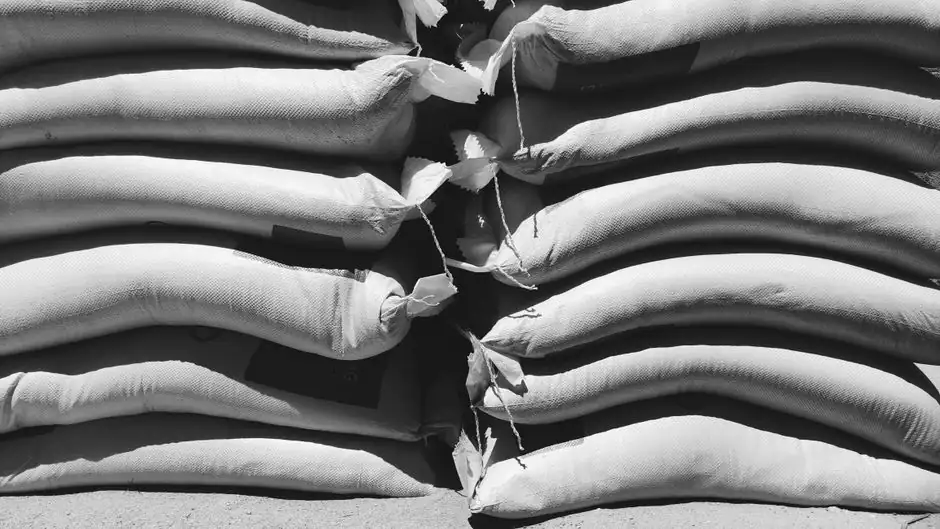
A 1,000 kg batch with a measured loose bulk density of 400 kg/m³ requires 2.5 m³ of product volume before adding hopper headspace or a fill factor.
Hopper volume, batch weight, bulk density, material behavior, and weighing accuracy must be treated as one design problem rather than separate calculations.
Core hopper sizing equation and units
The governing relationship is <strong>required product volume = batch weight ÷ bulk density</strong>. Bulk density is the measured mass divided by the occupied volume, including spaces between particles [S2][S7]. If mass is expressed in kilograms and density in kilograms per cubic metre, the result is cubic metres.
For example, a 750 kg batch at 300 kg/m³ occupies 2.50 m³. A 250 kg batch at 500 kg/m³ occupies 0.50 m³. Both calculations are valid, but they describe different products and cannot share a hopper-volume assumption without checking material density, flow behavior, and batch size.
Bulk density is the weight of a material divided by the total volume it occupies, including void spaces between particles [S2].
Choose the density condition the hopper will contain
Loose bulk density describes material poured under gravity, while tapped bulk density describes material after defined tapping or vibration reduces void space [S3]. A hopper filled and held without deliberate compaction should be sized from the condition expected in service, not from a laboratory value chosen without qualification.
Loose bulk density of 350 kg/m³ and tapped bulk density of 420 kg/m³ demonstrate why the method matters. The same 840 kg batch would occupy 2.40 m³ at the loose value but 2.00 m³ at the tapped value. The first calculation better represents a freely poured charge; the second may represent material after vibration or settling.
“If you don’t measure bulk density, every volume in your plant is a guess” [S3]. Bulk density should be measured using a representative sample, a known container volume, and a defined fill and compaction procedure. Particle size, shape, moisture, handling, and milling can change the result even when the solid material’s true density has not changed [S2].
Convert working volume into installed hopper volume
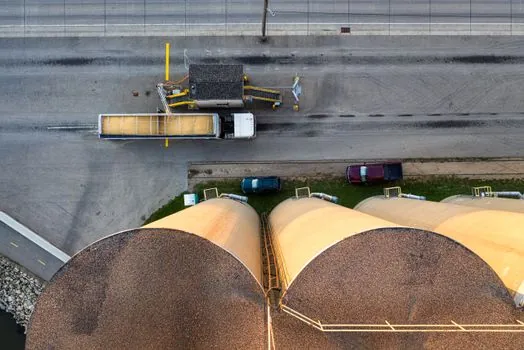
The calculated product volume is not the purchase volume. Mechanical volume must also accommodate the usable working range, discharge clearance, and safety margin.
For illustration, applying a 0.80 working fill factor to 2.50 m³ of product gives 3.125 m³ of internal geometric volume. The fill factor is an engineering allowance, not a bulk-density measurement, and must be checked against surge capacity, discharge behavior, and the chosen vessel supplier. A hopper should not be selected merely by nominal capacity.
Keep two volume figures separate: the product volume required for one complete batch and the vessel volume available to hold that batch. Bulk density affects material flow, storage capacity, and the space required for packaging and storage [S2][S5]. A batch controller should receive the validated target weight rather than a volume-derived guess.
Compare volumetric and gravimetric weighing methods
Volumetric dosing is appropriate when bulk density remains consistent and dosing precision is less critical [S1]. Its accuracy depends on repeatable filling of the dosing device and consistent material packing. Gravimetric dosing uses weight measurements to dispense accurate amounts of dry products required by downstream processes [S4].
Against four decision criteria, volumetric dosing offers simpler equipment and lower dependence on load-cell instrumentation, but its mass accuracy declines as density varies. Gravimetric weighing uses more weighing hardware, yet directly controls batch mass and handles density drift more effectively. A hybrid arrangement can combine the cost advantages of volumetric feeding with gravimetric correction where material value and required accuracy justify it [S1].
Continuous loss-in-weight feeding provides the highest accuracy among the feeding methods described for critical or expensive ingredients [S1]. A weigh hopper and platform scale or load cells are direct alternatives for batch-point weighing, while loss-in-weight systems measure the declining mass of the vessel as product leaves [S4]. A hopper scale can be integrated into either architecture.
Match the vessel to material flow and weighing performance

Density determines capacity, but it does not determine whether the hopper will empty reliably. Fine powders often have more void space and lower bulk density, while granules or pellets pack closer together and typically have higher bulk-density values [S2]. A vessel that holds the calculated batch but retains heel product after discharge may deliver repeated batches short of target.
Common sizing and operating checks include the stated batch weight, the measured loose and tapped density, the full hopper height, the outlet dimensions, and the required discharge rate. Product-contact geometry must also be compatible with the material’s flow behavior. Higher density does not automatically mean better flow, and lower density does not automatically mean easier discharge [S5].
Verify the load-bearing arrangement, tare range, vibration effects, and hopper support. For applications where mass loss is measured continuously, use a loss-in-weight feeder arrangement suitable for the material and rate. If weighing is performed on a supported platform, the structure must not introduce parasitic forces from piping, agitators, or material bridging.
Test and update the sizing basis
Bulk density testing should specify container volume, fill method, tap count or vibration method, environmental condition, and sample identity [S3]. Repeat testing when particle size distribution, moisture, supplier, formulation, or process handling changes [S3]. This creates a traceable density basis for hopper capacity, feeder calibration, packaging, and inventory calculations.
For a production hopper, compare the calculated batch volume with the vessel’s usable internal volume, then perform empty-weight, test-weight, and discharge checks. The test should confirm that the required mass can be introduced, weighed, and released without loss of the complete charge. For a 1,000 kg batch at 400 kg/m³, a 3.125 m³ geometric vessel based on a 0.80 fill factor is a starting configuration, not a validated final selection.
Close with a control plan that records actual batch weight, bulk density test method, and any observed residual material after discharge. If density shifts from 400 to 450 kg/m³, the same 1,000 kg batch needs 2.22 m³ instead of 2.50 m³ [S2]. If it falls to 350 kg/m³, the product volume rises to 2.86 m³. Those changes are trackable signals for revising hopper capacity, feed-rate settings, and the batch controller.