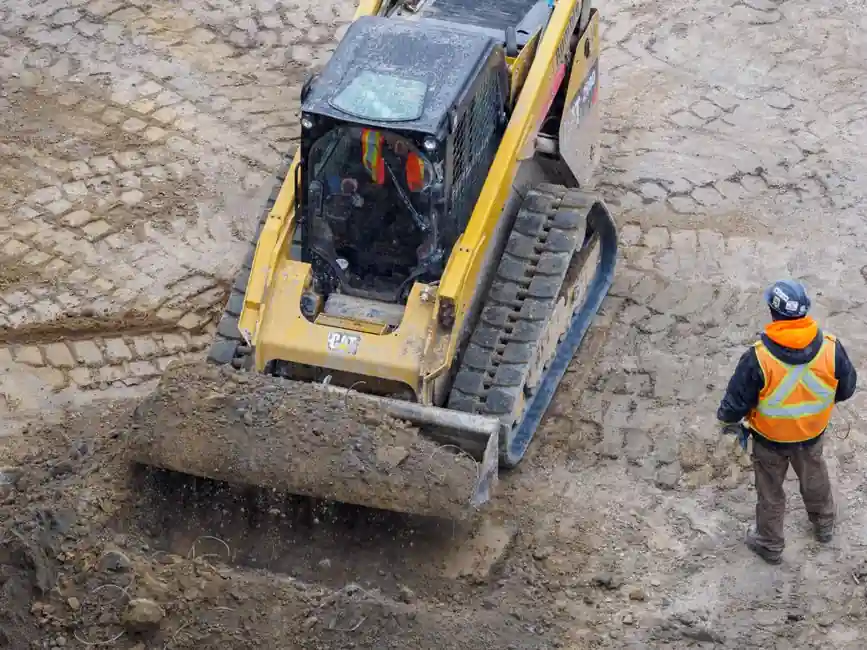
Underground tunneling restricts a skid steer to a tight envelope: low-profile cab, narrow overall width, and the ability to run a high-demand attachment like a drum cutter or planer on a confined hydraulic circuit [S1][S3].
Frame size is the first hard filter, because rated operating capacity (ROC), operating weight, and lift geometry decide whether the machine physically fits and lifts in the heading [S6]. For a tunneling-rated skid steer, the practical sweet spot sits inside the small-frame and lower medium-frame bands, with ROC typically between 1,000 and 2,200 lbs, where compactness still leaves room for the hydraulic flow a planer needs [S2][S6].
Why Tunneling Is a Special Selection Case
Tunnel headings force three constraints a surface jobsite does not: limited cross-section, regulated ventilation for diesel particulate, and one-way haul routes that punish under-sized buckets [S3]. A skid steer loader chosen for tunneling must be spec'd primarily against tunnel geometry and emissions class, not against general ROC tables.
Diesel particulate in a confined heading is the reason many underground specifications require a factory Tier 4 Final engine with a diesel oxidation catalyst (DOC) plus diesel particulate filter (DPF), or an aftertreatment package equivalent to the EU Stage V envelope referenced in underground construction equipment guidance [S2][S3]. Methane-prone headings add a separate layer: the machine should be built to a recognized engine and electrical safety standard for Group I (mining) or, where the heading is classified as a gassy tunnel, to an MSHA / ATEX equivalent for non-flameproofed diesel, with hot-surface suppression on the exhaust [S3].
Frame Size and ROC Bands That Fit a Tunnel
ROC remains the single most useful selection filter, and the industry rule of thumb treats ROC as roughly 50% of the wheeled loader's static tipping load, used as a baseline safety guideline under normal operating conditions [S6]. Three ROC bands cover most underground work: under 1,750 lbs (small frame), 1,750-2,200 lbs (medium frame), and over 2,200 lbs (large frame) [S6].
For tunneling, small frame is the default, with selected medium-frame machines acceptable where the cross-section allows. Reference points from manufacturer spec sheets: the Gehl R105 at 33.1 HP, 4,000 lbs operating weight, 1,050 lbs ROC, 2,800 lbs breakout; the Case SR130 at 45.8 HP, 5,180 lbs, 1,300 lbs ROC, 4,180 lbs breakout; the Wacker Neuson SW16 at 56 HP, 6,170 lbs, 1,600 lbs ROC, 5,300 lbs breakout; the Kubota SSV65 at 64 HP, 6,790 lbs, 1,950 lbs ROC, 4,839 lbs breakout [S2]. Each of these is narrow enough for typical metro or utility headings, and ROC sits inside the 1,000-1,950 lbs band that lines up with muck-car loading cycles.
Lift Geometry: Radial vs Vertical in a Low Heading
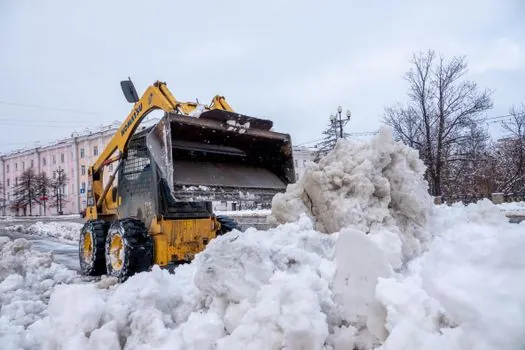
Vertical-lift machines keep more usable capacity at mid-to-upper lift heights because their ROC curve is flatter, while radial-lift geometries give higher breakout at ground level, which is where a planer or drum cutter actually works [S5][S6]. The decision in tunneling is usually a trade between truck-loading height and floor-level planing force, not headline ROC.
For planer work, the load sits at floor level and the radial arm geometry delivers the better breakout feel, while a vertical-lift machine is the right call when the cycle ends with the bucket tipped over a muck car or conveyor at full hinge-pin height [S5][S6]. The hinge-pin heights in the data set run from 108.1 in (Gehl R105) up to 134 in (Wacker Neuson SW 28), and tunneling cycles typically need at least 110-125 in to clear a standard muck car, so the candidate pool needs to be filtered by hinge-pin height, not just ROC [S2].
Hydraulic Flow and Attachment Matching
A drum cutter or wheel planer is the workhorse attachment in tunnel scaling and profiling, and the TF 200 from Simex is a representative example: recommended carrier weight 2.5-7 ton (5,500-15,500 lbs), weight without bracket 300 kg (660 lbs), drum width 565 mm (22 in), and it mounts on a skid steer loader bracket as well as a mini excavator [S1]. The PLB 200 planer sits in the same bracket family for surface finishing and scaling work where a smoother wall is required [S1].
Standard hydraulic flow in the small-to-medium ROC band runs from about 14.5 gpm (Gehl R105) up to 24.2 gpm (Case SR210 / SR240), and high-flow options on selected models push to the 30-40 gpm range needed for continuous milling [S2]. If a planer or drum cutter demands more than the base circuit, the machine must be ordered with a factory high-flow package, or the attachment must be run on a separate power pack, because retrofit kits rarely meet the cooling duty cycle of a continuous tunnel cut. Engine power scales with this: from 33.1 HP at the small end to 84 HP at the Case SR270 and SV300, which is the headroom needed when a high-flow attachment is loaded against a 24 gpm auxiliary circuit [S2].
Comparison: Three Candidate Frames Against Tunneling Criteria

Comparing representative frames on the four criteria that actually matter underground: small (Gehl R105, Case SR130), compact medium (Wacker Neuson SW16, Kubota SSV65), and larger medium (Case SR210, Yanmar S220R-1 at 70.7 HP, 7,980 lbs, 2,200 lbs ROC, 5,600 lbs breakout, 23.5 gpm). On ROC, small frames deliver 1,050-1,300 lbs, compact medium 1,600-1,950 lbs, larger medium 2,100-2,200 lbs; the underground rule is to stay at the lowest ROC that still handles the heaviest attachment, because every extra pound of machine is one less pound of payload per muck cycle [S2][S6]. On hydraulic flow, only the larger-medium group comfortably exceeds 20 gpm standard, so a drum cutter usually forces the spec to that class or a high-flow retrofit on the compact-medium class [S1][S2]. On hinge-pin height, small frames at 108-112 in can struggle to clear taller muck cars, compact medium at 118-128 in covers most metros, and larger medium at 123-130 in matches conveyor-fed systems [S2]. On engine and emissions, the 70+ HP compact-medium and larger-medium machines are where Tier 4 Final / Stage V aftertreatment is most readily available, which is the practical floor for many underground authorities [S2].
Selection Traps Specific to Underground Work
Track loaders win on traction in soft or muddy headings, but a wheeled skid steer wins on hard, shotcreted or paved tunnel floors because rubber tires cause no damage to the finished surface and the machine moves faster between work fronts [S3]. That trade is the reason wheeled skid steers dominate metro finishing and MEP fit-out, while tracked carriers are preferred in NATM or drill-and-blast headings before the final invert is poured [S3].
Demolition-rated ROC and hydraulic envelopes overlap with tunneling, and a demolition-oriented skid steer spec map is a useful cross-reference when the cycle is breaking concrete rather than cutting rock. Underground trenching support, especially for cable and drainage runs in service tunnels, is closer to a small utility backhoe loader envelope than a high-flow skid steer, and is worth checking before locking in the carrier. The two fail cases seen on real headings are ROC over-rated for the bucket weight, where the operator ends up double-cycling every muck car, and under-rated hydraulic flow on a planer, where the attachment stalls under continuous load and overheats the work circuit [S1][S5].
What to Verify Before Spec Sign-Off
Before locking the carrier, cross-check four items against the tunnel's actual conditions: tunnel minimum clear width and height against the machine's width with the chosen tire set and cab height, ROC at 50% of static tipping load against the heaviest expected attachment plus bucket [S6], standard hydraulic flow against the attachment's published gpm and pressure, and emissions / flameproofing package against the project's diesel-particulate and gas-classification rules [S2][S3].
Two signals to track over the next planning cycle: the spread of factory high-flow options reaching into the 1,500-1,900 lbs ROC small-frame band, which would let a planer run on a smaller carrier than today's spec allows [S2]; and the inclusion of Stage V / Tier 4 Final aftertreatment as standard rather than optional on compact-medium frames, which keeps the underground compliance case inside a single BOM line [S3].
The underlying component specifications are covered under wheel loader.