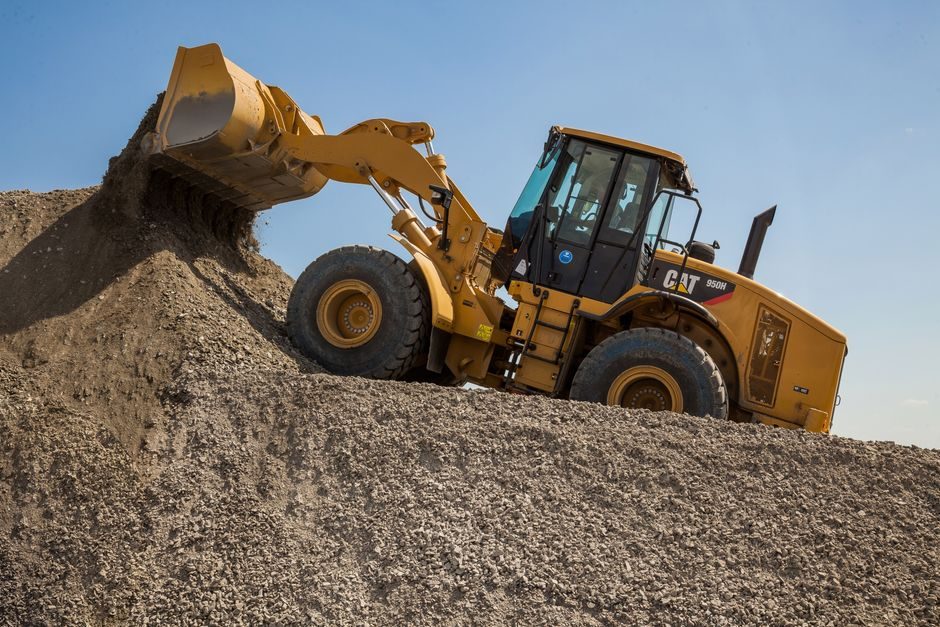
Rated operating capacity (ROC), not operating weight, is the single number that decides whether a skid steer loader can run the attachment you intend to buy — and Bobcat's diesel S770 sits at the upper end of the small-frame market with 92 hp (ch) and a 4,224.8 kg (9,314 lb) operating weight [S1].
For a first-time buyer, the practical envelope is 20-50 kW (roughly 27-67 hp) of engine power and ROC bands that ladder from 350 kg (sub-compact) through 1,500+ kg (large-frame), with rubber-tyre machines dominating hardscape work and compact track variants taking over on soft or finished surfaces. Selecting the right platform means reading three specs together — ROC, tipping load and hydraulic flow — not chasing the highest horsepower on the data sheet [S2][S5].
Definition and Frame Classes
A skid steer loader (SSL) is a rigid-frame, four-wheel-drive (or twin-track) machine that steers by braking the wheels on one side, allowing zero-radius turning in tight work zones [S5]. Frames fall into four commercial bands tied to ROC: sub-compact under 450 kg, small-frame 450-900 kg, mid-frame 900-1,350 kg and large-frame above 1,350 kg, with the 4,224 kg S770 sitting in the diesel "large-frame / high-flow" niche rather than the small-frame mainstream [S1].
For a fleet buying its first machine, the SSL/CTL fork is a ground-condition decision before it is a spec decision.
Selection Criteria: ROC, Tipping Load, Hydraulic Flow
Three specs decide 80 % of skid steer loader applications. (2) Engine net power from 20 kW (27 hp) for sub-compacts up to 75 kW (100 hp) for large-frame diesel — the S770's 92 ch rating places it in the top quartile of small-frame diesel offerings [S1][S5].
(3) Auxiliary hydraulic flow determines whether the machine can run high-demand attachments: standard flow sits at 60-90 L/min, high-flow (HF) at 100-150 L/min, and super-high-flow (sometimes called extreme flow) above 150 L/min for cold planers and trenchers. A cold planer or tree puller that needs 130 L/min will simply stall the aux circuit on a standard-flow chassis, regardless of the engine's headline horsepower [S3].
Who It Is For — and Who Should Pick a Different Machine
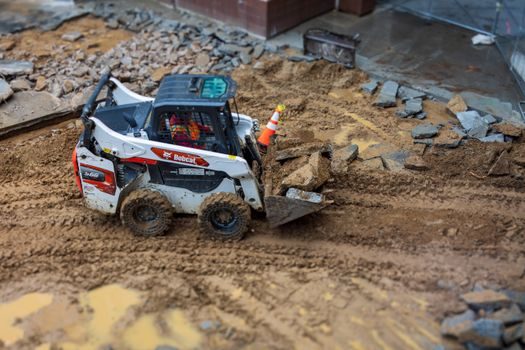
Skid steer loaders fit contractors who need one chassis to mount 50+ attachments — buckets, brooms, augers, planers, mulchers, snow blowers, pallet forks — on jobs where turning radius matters more than long-distance travel [S3]. Landscapers, light demolition crews, rental fleets, and dairy or equine operations handling manure and bedding buy SSLs because the machine replaces two or three dedicated tools.
Long horizontal travel also argues for a wheel loader instead.
Tyre vs Track, Lift-Path and Operator Station
Tyre machines (S770-class on 12 × 16.5 or 14 × 17.5 rubber) deliver higher roading speed and lower purchase cost; tracks deliver lower ground pressure and better slope holding. Lift-path choice matters as much as ROC: vertical-lift paths give more reach at max height (pallet forks to truck bed), while radial-lift paths deliver higher breakout force at ground level (excavation, grading) [S1].
Cab options range from open-station (ROPS/FOPS canopy) to sealed, heated, AC cabs with joystick controls; noise inside the cab at the operator's ear is typically 78-85 dB(A) on mid-frame diesels, so spec hearing-protection-rated cabs on long-shift rental units. A maintenance-free chaincase, like the one Bobcat lists on the S770, is a real labour saver over 5,000-hour ownership [S1].
Rental vs Purchase: When Each Path Pays
Big-box rental pricing for a mid-frame SSL runs roughly 250-450 USD/day, 1,000-1,600 USD/week and 2,500-4,000 USD/month, with the compact track variant priced 15-25 % higher than the wheeled equivalent on the same date window [S4]. A contractor logging fewer than 400 hours per year generally saves money renting; above 600 hours per year the depreciation curve crosses over and ownership wins.
Rental also makes sense for first-time buyers validating which attachment mix they will actually use — buying a machine, then discovering that 70 % of the hours go to one auger, is a common 200,000-USD mistake. For comparison, used 1,000-2,000-hour mid-frame SSLs trade in the 25,000-55,000 USD band depending on year and high-flow spec, while new mid-frame diesel units from Cat, Bobcat, Case, John Deere and Kubota sit in the 55,000-90,000 USD range without attachments [S2][S4].
Limitations, Failure Modes and Standards to Insist On
Skid steer loaders have three structural failure modes. (1) Chaincase and final-drive wear from high-duty cycles — insist on a maintenance-free chaincase and easy-to-access final-drive oilers. (2) Hydraulic-hose abrasion in the lift-arm pivot; routing and hose-protection guards separate durable builds from cheap ones. (3) ROPS/FOPS structural cracking from side-impact collisions on tight sites; the cab must be certified to ISO 12117 (earthmoving machinery — tip-over protection) and ISO 3471 (ROPS), with the FOPS option to ISO 3449 for falling-object work like demolition. [S1]
For engine emissions, EU builds after 2014 must meet Stage V per EU 2016/1628 (which replaced Stage IIIB/IV), and US Tier 4 Final is the equivalent EPA line — buying a machine that does not meet the current tier in your market can create export and resale problems. Hydraulic quick-couplers should be ISO 16028 flat-face for clean coupling under residual pressure. Hydraulic quick-couplers should be ISO 16028 flat-face for clean coupling under residual pressure.
Specifications Side-by-Side: Small-, Mid- and Large-Frame SSLs
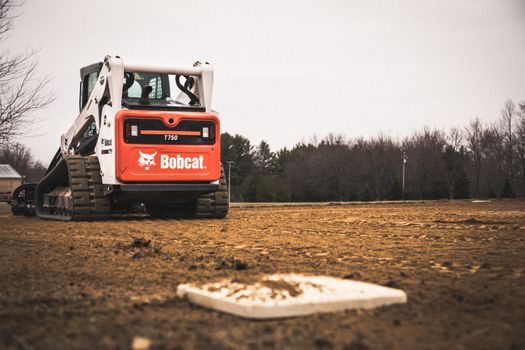
Use this criteria comparison when shortlisting chassis for a single application.
- Sub-compact (e.g. Bobcat S70-class): ROC 340 kg, engine 17-23 kW (23-31 hp), operating weight 1,100-1,400 kg, tyres 10 × 16.5. Fits 600-900 mm buckets; landscape and rental entry.
- Mid-frame (e.g. S650/S770 neighbourhood): ROC 900-1,360 kg, engine 50-70 kW (67-92 hp), operating weight 3,200-4,250 kg, tyres 12 × 16.5 or 14 × 17.5 [S1]. Fits 1,800-2,400 mm buckets; general construction and high-flow attachments.
- Large-frame (S850/S86-class): ROC 1,500-1,800 kg, engine 75-95 kW (100-130 hp), operating weight 4,500-5,500 kg, tyres 14 × 17.5. Fits 2,400-3,000 mm buckets and the heaviest cold planers, mulchers and tree pullers.
- Compact track loader (same chassis, rubber tracks): add 10-15 % to operating weight, 15-20 kPa lower ground pressure, 15-25 % higher price, 20-30 % higher undercarriage service cost over 5,000 hours.
Decision Tree for the First-Time Buyer
Step 1 — list the top three attachments by projected hours. Step 2 — pull the ROC and hydraulic-flow requirement of each attachment (manufacturer publishes these). Step 3 — the chassis ROC must equal or exceed the heaviest attachment-plus-payload combination. Step 4 — the chassis hydraulic flow must equal or exceed the highest-flow attachment; if the highest-flow attachment is used less than 10 % of the time, consider renting it instead. Step 5 — match lift path to the work: vertical-lift for loading/feeding, radial-lift for grading/excavation. [S2]
Step 6 — pick tyres on hardscape, tracks on soft ground or finished surfaces. Step 7 — buy from a dealer with a 24-48 hour field-service guarantee and a parts counter that stocks filters and hose assemblies in stock, not on 2-week back-order. The total cost of ownership over 5,000 hours is dominated by fuel, filters and undercarriage service — acquisition is roughly half the lifetime number [S2][S4].
For buyers cross-shopping a skid steer loader against a small backhoe loader for the same site, the deciding question is roading distance: a backhoe wins above 5 km of daily travel, the skid steer wins below. Field engineers sizing a compact loader against a small wheel loader for stockpile work should expect the SSL to cycle in roughly 60 % of the time but cap at 1,500 kg ROC. Track candidate articles such as the Backhoe Loader Sizing & Selection Guide sit naturally next to this one when a buyer's duty cycle already spans trenching and loading.