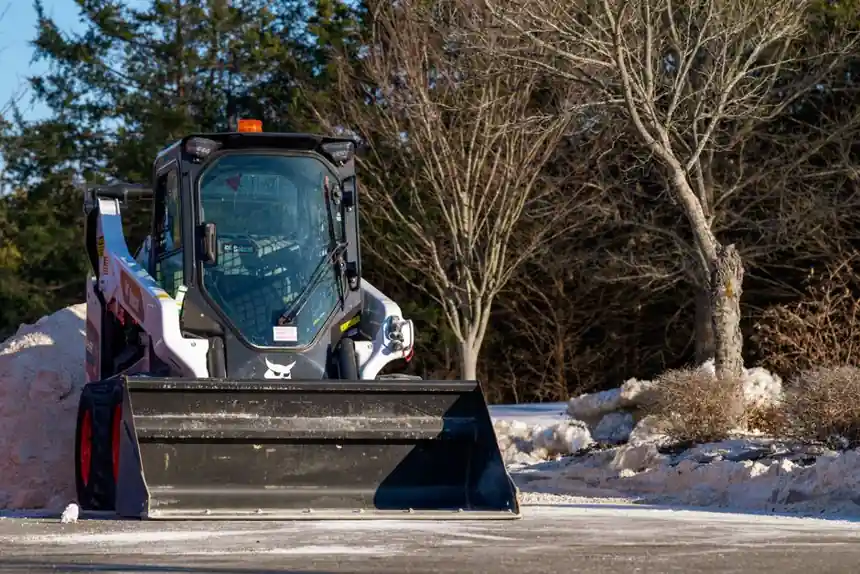
Skid-steer loaders used in mining see 2 to 3 times the dust, shock load, and continuous-shift duty of a typical construction unit, which is why hour-based service tiers (250 h engine service, 500 h hydraulic and belt service) and a strict control-interlock discipline are the two non-negotiable pillars of any site maintenance program [S2][S6].
OSHA's SHIB 01-12-2009 cites 100 skid-steer accidents recorded in IMIS between 1997 and 2007, with fatalities tied to bypassed or poorly maintained seatbelts, seat-bar interlocks, ROPS, and FOPS, the very safety systems that a dusty mine environment tends to degrade fastest [S1]. Combined with daily fluid and undercarriage checks, those two pillars decide whether a skid-steer loader is an asset or a liability in a mining fleet.
Hour-Based Service Tiers for Mining Duty Cycles
Service intervals are anchored to engine hours, not calendar days, because mining loaders commonly run 1,500 to 2,500 hours per year versus 800 to 1,200 hours in general construction, so a calendar-only schedule lets wear compound unnoticed [S2][S6]. Every 250 hours the engine oil and both filters (oil and fuel) are replaced; every 500 hours the hydraulic fluid, hydraulic return and pressure filters, drive belts, and the electrical harness are inspected, and a hydraulic-sample draw is taken for spectrographic wear-metal analysis [S6]. The 250/500-hour ladder is the consensus pattern across manufacturer guidance, dealer service bulletins, and independent maintenance guides, which is why a single hour-meter, not a wall clock, should drive the work-order system in any mine dispatch [S2][S4][S6].
Lubrication sits on its own micro-cycle: grease points on lift-arm pivots, tilt cylinders, and quick-coupler pins typically need 8 to 10 strokes of NLGI #2 lithium-complex grease every 10 operating hours, and any grease point that fails to take grease or shows purge at the seal is flagged for bushing replacement at the next 500-hour window [S3][S4]. Skipping the grease cycle is the most common root cause of lift-arm bushing and pin wear reported in field service data, and a worn pin in a mining loader will slam-dunk the bucket into the haul-truck box with expensive consequences for the mining dump truck tray.
Daily Checks Tailored to Mine Conditions
The 10-item daily walk-around (oil and coolant levels, tire or track condition, hydraulic level and leak sweep, radiator and engine bay debris, all grease points, lights and signals, filter condition, battery terminals, safety devices, and a general visual scan) is the same list used on a construction site, but each item carries extra weight in a mine [S4]. Radiator cores must be blown clean with low-pressure air at every shift change because coal dust, silica fines, and diesel particulate clog fins fast, and a 10 deg C jump in coolant temperature under load is the standard trigger to pull the machine and clean the cores before continuing [S2][S4]. Tire inspection in a mine must include sidewall cuts from sharp rock, not just pressure, and tracked units need tension checked against the manufacturer's gauge rather than by feel, because over-tightened tracks chew idlers and sprockets in under 200 hours [S2][S8].
The safety-device portion of the daily check is the one that gets shorted most often on tired shifts, and it is also the one most likely to kill someone: the operator must confirm that the seat belt latches, the seat bar or presence switch drops hydraulic and travel functions when raised, the park brake holds on a slope, and the FOPS/ROPS structures are free of cracks or bent members [S1][S4]. A 30-second functional test of the control interlock, with the seat bar up and the engine running, is the single cheapest piece of safety maintenance on the site, and per OSHA it directly addresses the bypass scenarios that drove the fatalities in the IMIS dataset [S1].
Hydraulic System: The Highest-Cost Failure Domain
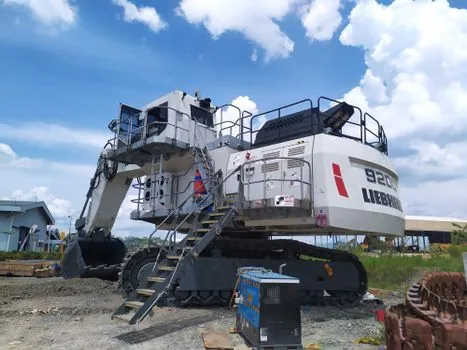
Hydraulic-system failures account for the largest share of unplanned downtime on mining skid-steers, and they are driven by three controllable factors: fluid cleanliness, hose and coupling integrity, and thermal management [S2][S3][S4]. ISO 4406 particle counts on a 500-hour sample should stay at or below 22/18/13 for normal duty and 20/17/14 for heavy mining duty, and any upward drift of two code classes between samples is the trigger to change the hydraulic return filter and investigate the suction strainer. Hydraulic hoses on mining units should be replaced at 24 months or 4,000 hours, whichever comes first, and any abrasion mark, blister, or fitting weep means immediate tag-out, because a high-pressure hose failure at 3,000+ psi will cut through a limb in milliseconds [S3][S4].
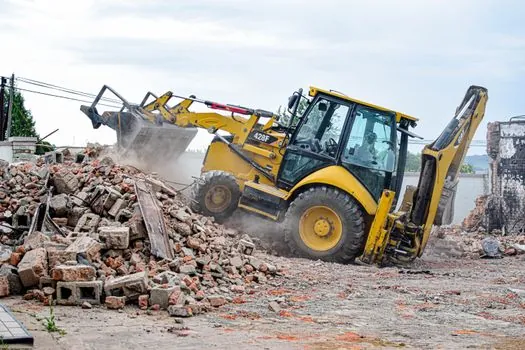
A short comparison against the parallel compact-loader choices is useful here, because the spec decision shapes the maintenance load. A standard skid-steer loader has the simplest daily routine and the lowest parts cost, but the lowest ground clearance and the most tire wear on rocky terrain; a wheel loader trades a larger footprint and higher fuel burn for articulated steering, longer wheelbase stability, and tires that survive haul-road abuse; a backhoe loader adds a rear-excavator stick that doubles the daily grease points and the hydraulic-hose count, which raises the hourly maintenance load roughly 30% but gives the mine a single machine that can dig, load, and trench without a second unit on site. For a pure shovel-and-haul cycle the skid steer wins on cycle time; for mixed dig-load-trench work the backhoe is usually the lower total-cost option despite the higher upkeep.
Attachments, Telematics, and Tire or Track Decisions
Attachments multiply the machine's utility but also its maintenance load, so the coupling pins, hydraulic quick-connect faces, and auxiliary-circuit pressure should be checked on the same 10-hour cycle as the lift-arm grease points, and any attachment that is leaving metal on the host machine is oversize or misconfigured [S2][S5]. Hydraulic-driven attachments (augers, brooms, snow blowers, hammers) draw continuous flow from the auxiliary circuit, which raises hydraulic-fluid temperature 8 to 12 deg C over baseline and shortens fluid life by roughly 30%, so a mine running hydraulic attachments daily should drop the hydraulic service interval from 500 hours to 350 hours [S2][S5].
Telematics is the second-biggest productivity lever after the service schedule: a telematics modem that streams engine hours, fault codes, fluid temperatures, and GPS position lets a planner convert the 250/500-hour ladder into automatic work orders and flag fault-code repeats before they become roadside repairs, and fluid sampling turned into a quarterly trend is what separates a guessing maintenance culture from a specification-driven one [S7]. On tire-versus-track, the call in mining is almost always rubber-tracked units over wheeled ones, because tracks spread the machine's ground pressure below 4 psi and shrug off the sidewall cuts that would scrap a pneumatic, but tracks add an undercarriage inspection at every 10-hour check and a track-tension adjustment every 50 hours that a wheeled unit does not need [S2][S8]. When the undercarriage inspection shows idler or sprocket wear past the manufacturer's wear limit, the correct call is full undercarriage replacement, not partial, because mixing new and worn components accelerates the wear of the new parts.
Safety-Device Discipline: The OSHA-Recorded Failure Mode
OSHA's review of IMIS data between 1997 and 2007 recorded 100 accidents specifically involving skid-steer loaders, with bypassed or improperly maintained seat belts, seat-bar interlocks, ROPS, and FOPS systems appearing as recurring root causes across the fatality narratives [S1]. The SHIB is advisory, not a standard, but the General Duty Clause lets OSHA cite an employer when a recognized hazard is not abated, and a documented bypass of the control interlock on a mining site is exactly that pattern [S1]. The minimum viable safety-device program on a mine is a written daily functional test of the interlock (engine start with operator belted and seat bar down, then repeat with the bar up to confirm no lift or travel function), a monthly visual inspection of ROPS and FOPS for cracks or deformation, and an immediate tag-out of any machine that fails either test until the safety device is repaired by a qualified technician using OEM parts [S1][S4].
Operator training is the other half of the SHIB recommendation: every operator must be retrained at hire and at minimum annually on the specific make and model's interlock logic, because a seat-bar-down machine and a presence-switch-only machine behave differently, and a habit learned on one will get an operator killed on the other [S1]. Records of the daily interlock test, the annual training, and any repair to a safety device should be kept for the life of the machine, because in the event of an incident these records are what separate a defensible maintenance program from a negligent one [S1].
When to Repair vs When to Retire Components
The decision tree on repair-versus-replace for high-wear parts is mostly mechanical and well-documented. Engine oil at 250 hours is always replaced, not topped up; a hydraulic hose with any external damage, blister, or fitting weep is replaced on the spot, not patched; a lift-arm bushing that fails to hold grease or shows more than 0.5 mm of pin play is replaced at the next 500-hour service, not on the next failure [S2][S4][S6]. Tires with sidewall cuts, exposed ply, or tread depth below the manufacturer's minimum are replaced as a set of four to avoid mixed-traction faults on the haul road, and a single underinflated tire that goes flat within a shift usually means a rim or valve-stem issue that warrants a full inspection rather than a refill-and-go [S8].
Two signals to track between scheduled services: a sustained rise in fuel consumption above the unit's established baseline, which usually points to air-filter restriction, injector wear, or a hydraulic load that has crept up due to a binding cylinder, and any repeat hydraulic-fault code within a 50-hour window, which is the early indicator of a pump or control-valve problem that will escalate from nuisance to failure inside one more shift. Either signal should trigger a planned teardown at the next 250-hour service rather than a run-to-failure posture. For related spec work on adjacent equipment, see the spec map for thickness gauges in mining, which covers the wear-monitoring instrumentation that feeds this kind of trend data.