
Forestry-grade overhead bridge cranes for sawmills, planer mills, and lumber storage yards most commonly operate between 1 and 10 tons of rated capacity, with single-girder top-running units dominating green-chain and trim-line applications [S7]. For heavier log-handling cells, double-girder configurations push capacity past 30 tons and span past 90 feet, while still running inside the same CMAA duty envelope [S2].
Because wood dust, bark, offcut chips, and ice are constant in a sawmill, the crane must be specified to a recognized duty classification and protected by rail sweeps that satisfy three overlapping standards: OSHA 1910.179(e)(4), ASME B30.2 section 2-1.9, and CMAA Specification 70 sections 3.6.3 and 3.9.2 [S4]. Forestry buyers should treat those four clauses as non-negotiable line items on any RFQ.
Forestry Capacity and Span Ranges by Application
Lumberyard bundle and trim-line cranes typically run 1 to 10 ton capacity, with a minimum 1 ton unit used for lighter timber bundles and downstream grading stations [S7]. Standard single-girder top-running bridge cranes from North American builders are offered up to 35 tons and 90 foot span, with higher values available on engineered units [S5]. Heavy sawmill log decks, cant-handling cells, and chip-bin feed cranes more often use double-girder top-running designs that lift 100 tons or more and span 100 feet and beyond [S2][S6].
Underhung (under-running) cranes, a third option for tight-headroom planer buildings, are limited to roughly 25 tons and 75 foot span and ride on the bottom flange of the runway beam [S2]. For an outdoor log sort, top running remains the default because the bridge rides on the top of the runway beam and tolerates weather exposure on the runway surface [S1].
CMAA Duty Class Selection for Sawmill and Lumberyard Service
CMAA Class C (Moderate Service) covers most sawmill trim lines and planer infeed, with operation at 50 percent of rated capacity, 5 to 10 lifts per hour, and an average lifting height near 15 feet [S3]. Modular, off-the-shelf bridge cranes aimed at sawmills sit in CMAA Class A, B, or C with 5 to 10 lifts per hour at roughly 40 percent of rated capacity, while process cranes used in continuous lumber flow lines step up to Class D, E, or F with 10+ lifts per hour at 50 to 75 percent of capacity [S5].
Class D (Heavy Service, 10 to 20 lifts per hour at 50 percent) and Class E (Severe Service, 20+ lifts per hour near rated capacity) are the right starting point for high-throughput edger and green-chain operations; undersizing duty class is the single fastest way to burn out a mill-duty hoist in a chip-and-sawdust environment [S3][S5].
Girder Construction and Runway Configuration
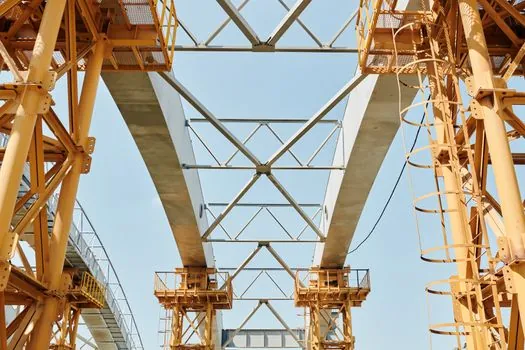
Single-girder cranes use one bridge beam with the trolley and hoist mounted on the bottom flange, giving a reduced hook height but the lowest installed cost for capacities up to about 30 tons [S2][S3]. Double-girder cranes carry the hoist on top of two bridge beams, freeing hook height and allowing capacities above 100 tons with no practical span ceiling [S2]. Girder stock is typically a structural I-beam for short spans and lighter loads, or a CMAA-spec engineered box girder where spans stretch and capacity climbs [S2][S5].
Top-running systems transfer wheel loads through the top of the runway beam and are the standard for forestry because they tolerate higher capacities and the kind of rough, debris-loaded aisle floors found in log yards [S2]. Underhung systems hang from the bottom flange of the runway and are typically chosen only when the building has no headroom for top-running girders, which is rare in purpose-built sawmill construction [S2].
Forestry-Specific Safety and Debris-Control Requirements
Bark, ice, and offcut debris that lands on the runway rail is the most common cause of bridge-end-truck derailments in lumber facilities, which is why OSHA 1910.179(e)(4) requires bridge trucks to be equipped with sweeps extending below the top of the rail and projecting in front of the truck wheels [S4]. ASME B30.2 section 2-1.9 mirrors that requirement for both bridge and trolley end trucks, while CMAA Spec 70 section 3.6.3 calls for sweeps in front of each outside bridge-truck wheel projecting below the top of the runway rail, and section 3.9.2 applies the same rule to trolley frames on the bridge rail [S4].
Annual inspection of the sweep itself, plus its mounting hardware, is part of the OSHA-aligned maintenance cycle; a bent, broken, or misaligned sweep is a documented defect that must be reported and corrected before the crane returns to service [S4]. In a sawmill this matters more than in a clean-room assembly plant, because wood waste accumulates between shifts faster than housekeeping crews can clear it.
Comparison of Bridge Crane Types for Forestry Service

Three configurations dominate forestry RFQs. A single-girder top-running unit is the cost-optimized choice for 1 to 15 ton service with spans to roughly 65 to 90 feet and CMAA Class A through C duty, the configuration most sawmill trim lines actually order [S1][S5][S9]. A double-girder top-running crane is the heavy-haul option, lifting 30 to 100+ tons across 90 to 150 foot spans at CMAA Class D, E, or F for process-style green chains and large log decks [S2][S5][S6].
An underhung single-girder crane fills a narrow niche: capacities up to about 25 tons, spans to roughly 75 feet, light to moderate duty, and installations where the existing building steel can carry bottom-flange runway loads but cannot accept a top-running girder [S2]. The relevant selection criteria, capacity, span, hook height, and duty class, are the same ones every spec-first buyer should score on the RFQ before pricing drives the decision.
Hoist, Power, and Controls Considerations for Wood-Dust Environments
Open lumber yards and dry-kiln rooms are dusty, corrosive, and often humid, so hoist enclosures, pendant stations, and motor brake compartments need gasketed covers and sealed bearings as a baseline. Wire-rope hoists paired with double-girder bridges remain the most common forestry fit because they deliver higher lift speeds and longer rope service life under frequent start-stop cycles than light-duty chain hoists can sustain [S1][S3]. VFD-controlled trolley and bridge drives, increasingly standard on CMAA Class C and above units, allow soft acceleration that protects green-chain loads from swinging, which directly reduces dropped-bundle incidents [S5].
Festooned or pendant control on a forestry bridge is the default; radio control is gaining ground in larger mills because the operator can stand clear of falling debris while running a log lift, and modern forestry specs often call for both pendant and radio as a redundancy [S1][S2]. For a buying workflow that runs from spec to vendor shortlist, the filter-procurement playbook in this spec-first buying guide applies the same RFQ discipline, even though the equipment is unrelated, because the sourcing logic is identical.
Selection Checklist Before Issuing the RFQ
Lock in four numbers first: rated capacity in tons, span in feet, lift height in feet, and the CMAA duty class derived from lifts per hour and average load as a percent of rating [S3][S5]. Add girder configuration (single or double), runway type (top running or underhung), power feed (festoon or conductor bar), and control type (pendant, radio, or both) before any vendor is asked to quote [S1][S2][S5].
On the compliance side, write OSHA 1910.179(e)(4), ASME B30.2 section 2-1.9, and CMAA Spec 70 sections 3.6.3 and 3.9.2 into the purchase spec so the rail-sweep clause cannot be value-engineered out during negotiations [S4]. Buyers who want a deeper comparison of bridge, gantry, and mobile lifting equipment classes can review the overhead bridge crane reference page and the related gantry crane and mobile crane entries to confirm they are specifying the right equipment family before committing budget.