
Slewing ring bearings are large-diameter assemblies that simultaneously transmit thrust, radial, and overturning-moment loads between two structures while permitting 360° rotation around a single open center, with raceway diameters in field service ranging from under 10 inches to over 180 inches; thrust bearings carry axial load only and have no hollow structural center [S1][S2][S4].
For maintenance planning, the practical contrast is not load capacity but access geometry: slewing rings sit on bolt circles that can run several meters in diameter with internal or external gear teeth, integrated seals, and grease passages routed through the race rings, while thrust bearings usually mount inside a housing bore, sandwiched between shaft shoulders and a cover [S1][S2][S5][S6].
Load spectrum and shaftless geometry: what defines the two categories
Slewing ring bearings are designed as a complete structural joint: a single unit carries every combination of axial thrust, radial force, and tilting moment that a rotating superstructure can impose, with no kingpost or spindle through the center [S1]. The hollow raceway geometry leaves a clear internal bore that runs hydraulic lines, encoder cables, servo motor leads, and PLC I/O back to the cab [S1][S6]. Thrust bearings, by contrast, are sized to react axial force on a shaft; they may use angular-contact geometry to absorb a small radial component, but they are not specified to react an overturning moment, and they do not provide a structural mounting surface for a slewing superstructure [S4].
Maintenance access geometry: bolt circle, grease passages, and seal layout
On a slewing ring, the bolt circle is the maintenance interface. Both rings are drilled with through-holes or tapped holes on a common PCD, and torque is applied at that circle, not at a central nut [S2][S5]. Grease fittings are typically located on the inner or outer ring at intervals around the circumference, so relubrication is a walk-around task with the boom parked at a fixed angle, provided the supplier has marked the raceway loading zone [S2]. On a thrust bearing, access is dictated by the housing: end covers, locknuts, and shaft shoulders must be removed to extract the bearing, and the bore is usually smaller than the working envelope of any tool, so reach and puller geometry drive service time more than the bearing itself [S3][S5].
Who a slewing ring is for, and who it is not for
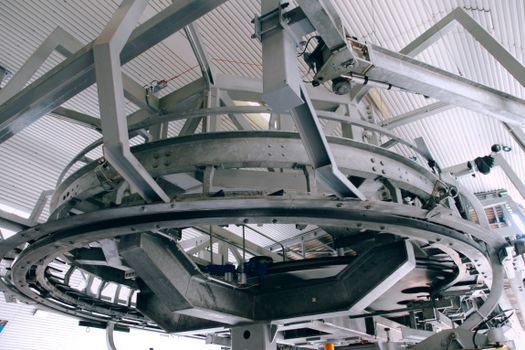
A slewing ring is specified when the application needs 360° rotation, structural support of an offset load, and a hollow center for routing — mobile cranes, crawler cranes, excavators, wind turbine nacelles, and stacker-reclaimers are typical cases [S1]. A slewing ring is the wrong choice when the structure is rigidly mounted, when the load is purely axial on a short shaft, or when the budget cannot absorb the cost of gear cutting, drilling a large bolt circle, and installing a servo-driven or hydraulic slew drive. A thrust bearing is the right choice for valve stems, vertical pump shafts, and propeller shafts where rotation is incidental to axial reaction, and where the housing already defines the bearing envelope [S4].
Four criteria, side by side: which bearing to plan maintenance around
Maintenance access on a slewing ring is set by the bolt circle on both faces, while maintenance access on a thrust bearing is set by the shaft withdrawal path past a locknut or end cover [S2][S5]. On load spectrum handled, a slewing ring handles thrust, radial, and moment in one unit, while a thrust bearing handles axial only. On access interface, a slewing ring is serviced at the bolt circle with grease fittings distributed around the race [S2][S5]; a thrust bearing is serviced by withdrawing the shaft axially past a locknut or end cover. On lubrication routing, slewing rings are typically relubricated in situ through raceway fittings, while thrust bearings share the oil bath of the gearbox or housing [S3]. On removal tool envelope, slewing ring extraction needs a lift sized to the race diameter; thrust bearings usually come out with a hand puller. The decision is not which category is better but which access pattern the surrounding structure was built around — and that pattern is fixed at original design, not retrofittable without major rework.
Real maintenance scenarios: crane reach, bolt torque, and contamination

On a mobile crane, the slewing ring bolt circle is the maintenance plane. Re-torque passes are scheduled by bolt count, not by central-shaft torque, and the operator's manual normally calls out torque values per bolt circle diameter [S2]. On a wind turbine yaw or pitch bearing, the bolt circle is reached through the nacelle or hub, which dictates lift planning before a technician can touch a fastener. A thrust bearing inside an industrial valve actuator is a different problem: the bearing is hidden behind the yoke, and a stem puller, not a crane, is the right tool. In both cases, contamination control is identical — a clean raceway at install is the largest single factor in slewing-ring life — but the route to that raceway is geometric, not procedural [S3].
Limits, failure modes, and service intervals common to both
Slewing rings fail in characteristic ways: brinelling from impact during installation, raceway corrosion from seal leakage, and false brinelling when the bearing sits idle under load for long periods [S3]. Allowable raceway flatness is plotted against raceway diameter in the Kaydon installation chart, with deviation values from roughly 0.000" at the smallest raceways up to 0.040" at the largest, across ball sizes from 0.75" to 3.0" [S2]. Thrust bearings fail from axial overload, lubrication starvation, and skidding during start-up under combined load. The common point: both categories depend on lubricant reaching every loaded contact, and both lose life quickly once contamination enters the raceway.
Sourcing, documentation, and engineering reference to keep on file

Kaydon catalog 390 documents installation, torque, and flatness limits for slewing rings, and SKF's product literature covers mounting patterns, gear options, and seal choices — these are the documents that resolve a maintenance-access question once the equipment is in the field [S2][S6]. As the Kaydon white paper puts it, "slewing bearings serve as a connection between two adjacent structures, allowing rotation and transmission of load between them," and that connection is exactly what the maintenance plan must preserve [S5]. For wind applications, pitch and yaw bearing service intervals are set by the turbine's own O&M manual rather than by a generic standard, and the bearing supplier's guidance is normally incorporated by reference.
On the next maintenance review, the verifiable signals to track are the torque-table revision date inside Kaydon catalog 390 and the seal-design change log on the SKF slewing-bearings product page; both govern the bolt-circle and grease-passage assumptions used above, and both have been updated within the past 12 months [S2][S6].