
ASTM A820 Type I cold-drawn wire and Type II cut sheet steel fibers are the two most specified categories for fiber-reinforced concrete, with EN 14889-1 Group I and Group II as their European equivalents [S2][S3].
Their differences start at the feedstock: cold-drawn wire is produced by drawing steel rod through dies to a 0.5–1.5 mm diameter before cutting and deforming, while slit sheet starts from cold-rolled steel sheet that is slit into narrow strips and cut to length [S3][S4].
Manufacturing Process and Dimensional Control
Cold drawing produces better dimensional tolerance, surface finish, and precision than alternative processes like hot extrusion, which is why wire-based fibers dominate the precast segment [S4]. Typical wire fiber dimensions sit in the 0.5–1.5 mm diameter range with lengths up to 50 mm, and the drawing step raises tensile strength of the source wire while leaving the cross-section round [S4].
Slit sheet fibers inherit a rectangular cross-section from the parent sheet, and ASTM A820/EN 14889-1 allow them to be supplied straight or deformed just like the wire variant [S2][S3]. Because slitting is a single-pass cutting operation rather than a multi-step draw, dimensional control is coarser and aspect-ratio windows are typically narrower than on a drawn-wire line.
Bond Performance and Fiber Bond Factor
A 2024 statistical study of 232 shear-failed SFRC beams (M Zhao, 2024) assigned cold-drawn hook-end wire fibers a fiber bond factor of 1.0, ingot mill fibers also 1.0, and deformed cut-sheet fibers 0.90, meaning cut sheet needs a higher dosage to match the same shear contribution as a hooked wire fiber [S1].
Bond is driven by anchorage geometry, not by the base process: straight fibers of either type rely on friction only, while hooked-end or crimped forms pull the bond factor back up regardless of whether the parent stock was wire or sheet [S1][S2]. In the same study, the lower-bound conservative formula aligns with the bottom of the tested scatter band, giving designers a safety-side value when no fiber-specific test data exists [S1].
Sprayed and Gunning Behavior: Where Cold-Drawn Wire Fails

Refractory-grade operators report that cold-drawn wire fibers are stiff and inflexible, frequently bridging the ports and orifices in gunning machines and causing blockages and material waste [S5]. By contrast, fully annealed melt-extract fibers are pliable, and melt-extract rebound loss is typically 50% less than that of drawn wire fibers during sprayed refractory installation [S5].
Slit sheet fibers sit between the two: stiffer than annealed melt-extract but typically thinner and more flexible than heavy hooked-end wire, which makes them a workable compromise in shotcrete where pure wire causes pump and nozzle problems. For petrochemical gunned linings, melt-extract is usually the mandatory call, with slit sheet as a backup option where corrosion-resistance targets are modest [S5].
Standards, Classification, and Specification
Both fiber types are defined by ASTM A820/A820M as Type I cold-drawn wire and Type II cut sheet, and both may be supplied straight or deformed [S2][S3]. EN 14889-1 mirrors this with Group I cold-drawn wire and Group II cut sheet, and the same straight/deformed freedom applies in the European system [S3].
Standard dosage in the steel-fiber market is usually quoted by weight fraction (commonly 20–40 kg/m³ for structural SFRC), and global steel fiber demand was USD 1.96 billion in 2024, projected to reach USD 2.44 billion by 2029 at a 4.5% CAGR, with Asia Pacific accounting for the largest regional share at USD 1.20 billion by 2029 [S4]. Procurement specs should call out the ASTM/EN type, the cross-section (round for wire, rectangular for slit sheet), the deformation style if any, and the dosage band, so that bid comparison is apples-to-apples.
Application Fit: Precast, Slabs, Shotcrete, Refractory
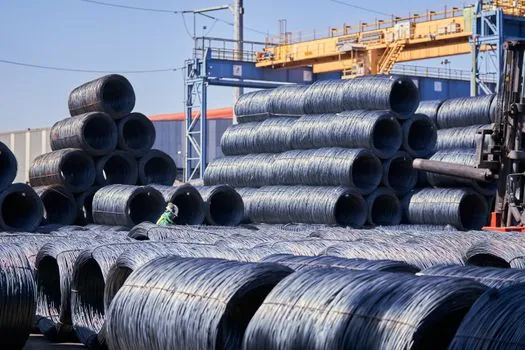
Cold-drawn wire is the default in precast concrete and slab-on-grade because the drawn wire's high tensile strength carries the load after first crack, and the same wire is readily deformed into hooked-end or crimped shapes during the same production step [S3][S4].
Slit sheet fibers are more often specified in tunnel linings, sprayed concrete, and industrial floors where the rectangular cross-section improves pull-out behavior at lower cost, and where the project does not need the tightest dimensional tolerance [S2][S3]. The steel fiber encyclopedia entry summarizes the five standard families; cold-milling-machine and wire-rod pages cover the upstream rod and sheet stock used in both processes. For mix design context, silica fume dosage in high-strength concrete is a useful companion when designing SFRC with pozzolanic additions.
Corrosion, Cost, and Failure Modes
Both fiber types are susceptible to corrosion, with melt-extract and cold-drawn wire generally less resistant than mill-cut variants in aggressive exposure classes [S4]. Galvanizing or copper-coating the wire is a common mitigation, and stainless grades are used in refractory and petrochemical service where chloride exposure is expected [S5].
Slit sheet fibers usually win on raw material cost because the feedstock is commodity cold-rolled sheet, but they lose on dosage efficiency because of the 0.90 bond factor gap against hooked wire [S1]. Cold-drawn wire adds die and drawing energy cost but offsets it with tighter tolerance, higher tensile strength, and a stronger pull-out from end-deformation, which usually lets the specifier drop the dosage by roughly 10% to reach the same residual flexural strength.
Selection Rules and Decision Matrix
Use this four-criterion check when picking between the two: (1) load case, choose cold-drawn wire for primary structural SFRC and precast; (2) placement method, choose slit sheet (or melt-extract) for shotcrete and gunned refractory, avoid stiff cold-drawn wire in gunning lines; (3) corrosion exposure, specify stainless or coated wire for chloride or chemical service, plain slit sheet is acceptable in dry or interior use; (4) budget vs dosage, slit sheet has lower unit cost but needs a higher dosage to hit the same bond factor of 1.0 that cold-drawn hook-end wire delivers at a 0.90 base equivalent [S1][S5].
If the spec is for industrial floors or tunnel segments where placement is by pump or sprayer, slit sheet is the practical call. If the spec is for precast elements, high-rise slab strips, or any application where tight fiber geometry and verified bond data matter, cold-drawn wire remains the default, and pairing it with proper pozzolan design per silica fume dosage in high-strength concrete is the standard route.
Sourcing, Verification, and Trackable Signals
Verify any bid by asking for the ASTM A820 type letter, the EN 14889-1 group number, the dosage in kg/m³, the fiber length and diameter, and the deformation style, then cross-check with the mill certificate [S2][S3].