
Smoke detection splits into three principal sensing classes: ionization, photoelectric, and high-sensitivity aspirating (HSSD), each responding to a different combustion signature and each carrying a documented weakness under the wrong fuel load [S2][S3].
A smoke detector is defined as a device that senses smoke, typically as a fire indicator; commercial, industrial, and mass-residential units issue a signal to a fire alarm control panel, while household smoke alarms generally produce a local audible or visual alarm from the unit itself [S3]. Choosing among them is a function of fuel profile, ceiling geometry, ambient dust, and the governing code cycle.
Operating Principles and Sensing Boundaries
Ionization smoke detectors use a small radioactive source (typically americium-241) to ionize air in a sensing chamber; smoke particles disrupt the ion flow and trip the alarm. They respond faster to flaming, low-particle fires but are more prone to nuisance trips from cooking aerosols. [S3]
Photoelectric (optical) smoke detectors use a light scattering chamber; smoke entering the chamber scatters light onto a photodiode. They are demonstrably faster on smouldering, high-particle fires and are less sensitive to cooking aerosols, which is why many codes now require photoelectric in residential sleeping-room paths. For aspirating systems, the High Sensitive Smoke Detector (HSSD) class samples air through a network of pipes and can detect sub-micron particles at obscuration levels several orders of magnitude below conventional point detectors, which is why HSSD is specified in data halls, cold stores, and cleanrooms [S2].
Advantages Across the Three Classes
Across all three classes, smoke detection offers a low capital cost per square metre, a 24 V DC or battery operating envelope, and an output compatible with conventional or addressable fire alarm loops. The HSSD variant extends coverage to heights above 18 m, high-airflow spaces, and environments where early-warning minutes translate directly to asset protection, because the pipe network can be routed into cabinets, under raised floors, and across plenums [S2].
Compared with a heat detector, smoke detection reacts earlier on most solid-fuel fires; compared with a gas detector, it is the correct choice for flaming and smouldering combustion of ordinary combustibles rather than for invisible gas leaks, and the two technologies are complementary, not substitutable. The SDCU (Smoke Detector Control Unit) integrates detector loops, sounder circuits, and cause-and-effect logic, allowing one panel to coordinate evacuation, HVAC shut-down, and fire-service signalling [S4].
Disadvantages and Documented Failure Modes
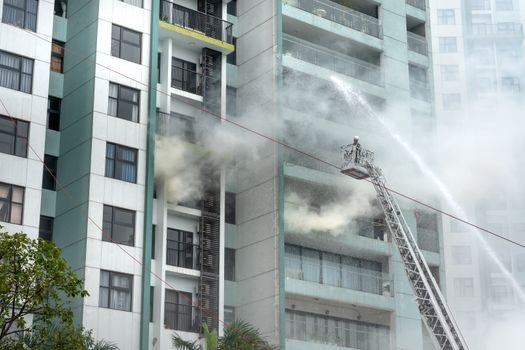
No smoke detector class is universal. Ionization units nuisance-trip on cooking and steam; photoelectric units lag flaming liquid fires; HSSD units carry higher first cost, require pipe integrity testing, and need periodic blower and filter service. Stray light entering an optical chamber, dust fouling the photodiode, and insect ingress into the chamber are documented failure modes for any non-aspirating design, which is why NFPA 72 calls for functional testing at acceptance and at defined intervals. [S1]
A second disadvantage is ceiling-height dependence: conventional point detectors lose sensitivity when stratification keeps smoke above the sensing height. Aspirating systems solve stratification by drawing air from multiple sampling holes, but at the price of a piped network that must be leak-tested at commissioning. False alarms, when aggregated, drive both building-occupant habituation and code-mandate penalties, so detector-class choice has a direct operational cost beyond capital purchase.
Selection Criteria and Class Comparison
The decision matrix is short: identify the dominant fire type, the ceiling height, the airflow regime, the cleanliness class, and the code path. For residential corridors and offices under 4 m, photoelectric is the default. For kitchens and garages, ionization or a rate-of-rise heat detector is preferred because the smoke signal is dominated by either invisible aerosols or a fast thermal rise. [S3]
A compact comparison across three decision criteria: sensitivity (obscuration threshold), nuisance-alarm resistance, and installed cost. Ionization scores low on nuisance resistance and moderate on cost; photoelectric scores high on nuisance resistance and low to moderate on cost; HSSD aspirating scores very high on sensitivity and high on cost. For smoke-propagation in HVAC ductwork, a duct smoke detector sampling tube is specified by code, with a pressure differential switch to shut down the air handler on alarm.
Standards, Sourcing, and Integration
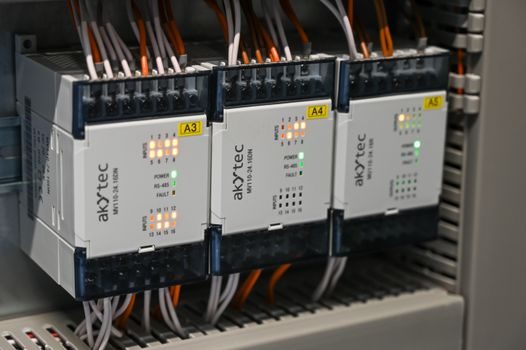
Detectors carrying listings to UL 268, EN 54-7, and AS 3786 satisfy the dominant jurisdictional code paths for point smoke detection; aspirating systems are listed under UL 268A and EN 54-20 with four sensitivity classes (A very high through C normal). When the protected space also contains oxygen-sensitive processes, a complementary oxygen detector is layered onto the same fire panel via addressable modules rather than wired back to the SDCU on a dedicated line [S4].
For high-value assets where early-warning minutes matter, an aspirating HSSD system with at least Class A or B sensitivity is specified; the Smoke Detector Control Unit (SDCU) then routes cause-and-effect to suppression, evacuation, and the building management system. For data-driven specs on adjacent dust-handling risk, the dust detector category covers opacity and particulate monitors used where combustible dust accumulation is a separate ignition source.
Use-Case Map and Application Boundaries
Photoelectric point detectors fit hotels, offices, dormitories, and classrooms. Ionization units are typically retained in legacy installations and in jurisdictions that still prefer them. HSSD aspirating is specified in semiconductor fabs, telecom rooms, museums, and cold-storage warehouses where conventional detectors are too slow or too prone to condensation faults. For atriums above 9 m, optical beam detection is the third path alongside the point and aspirating classes, chosen for its linear coverage and reduced detector count. [S3]
The smoke detector family is the wrong tool for invisible combustion products such as hydrogen or methane leaks; in those services, a combustible gas detector or a gas detector certified to IEC 60079-29-1 is the correct instrument, and the two layers (smoke plus gas) are integrated at the panel rather than substituted.
Track the next two signals for sourcing: (1) the revision status of UL 268 and EN 54-7 sensitivity thresholds, which govern point-detector listing and which tightening of the nuisance criteria changes the photoelectric versus ionization balance; (2) the release cadence of new EN 54-20 Class A aspirating panels, because higher sensitivity at lower air-handling cost shifts the HSSD class into mid-market projects that today specify conventional photoelectric.
Related analysis: Floor Grinder Advantages and Disadvantages: Spec, Use-Case, and Selection Map.