
SPC flooring for industrial facilities is a rigid core vinyl composite built from 70–75% natural stone powder (limestone), 20–25% PVC resin, and 5–8% stabilizers and processing aids, with a UV coating and a separate wear layer on top, manufactured by extrusion at roughly 200°C and calendered into sheets [S3].
It is the dominant choice in 2026 commercial specifications because the limestone-filled core delivers high indentation resistance, full waterproofing, and a click-lock format that goes down over imperfect subfloors, while the global SPC commercial segment is forecast to grow at a 9.5% CAGR from 2025 to 2030 [S3][S5].
Composition: What 70–75% Limestone, 20–25% PVC, 5–8% Stabilizer Actually Buy You
SPC's core is roughly 70–75% calcium carbonate (CaCO3) from ground natural marble, 20–25% PVC resin powder, and 5–8% stabilizers and processing aids; the stone mesh is specified at 400–600 fineness, with finer mesh producing a smoother extrusion and fewer internal voids that later telegraph as surface defects [S3]. Industrial buyers should treat 400-mesh or finer as the floor, not the ceiling, because coarser stone powder is the most common root cause of brittle cores that crack under pallet jack or forklift static loads.
The PVC fraction must be 100% virgin resin with no heavy metals; recycled-content SPC is widespread in residential channels and shows up as inconsistent internal stress, weak click profiles, and a tendency to chip at the locking tabs during installation in cold warehouses [S3]. The 5–8% additive package is typically a lead-free calcium-zinc thermal stabilizer plus a phthalate-free plasticizer such as DOTP, which keeps the formulation stable up to extrusion temperatures near 200°C and avoids the heavy-metal leaching issues that disqualify some low-cost imports in food and pharma plants [S3].
5-Layer Stack: UV Coat, Wear Layer, Print Film, Rigid Core, Underlayment
An industrial-grade SPC plank is a 5-layer stack: UV-cured topcoat, transparent wear layer, printed color film, the SPC rigid core itself, and an attached underlayment pad, with the UV and wear layers added after calendering of the core [S1][S3]. The wear layer is the single most important number on the spec sheet, with 0.3 mm (12 mil) as the practical minimum for warehouse and back-of-house use and 0.5–0.7 mm (20–28 mil) for forklift aisles and pallet jack turnaround zones.
Commercial SPC is typically delivered with a factory-applied underlayment in IXPE, EVA, or cork, with IXPE the most common because it gives the best balance of sound reduction, moisture barrier, and compressive recovery under rolling loads [S3]. For plants with frequent chemical exposure, check that the UV topcoat is a true ceramic-bead or aluminum-oxide-filled polyurethane and not a thin acrylic, because the latter degrades under repeated alcohol and quaternary-ammonium sanitizer use and shows visible gloss loss within 6–12 months [S1][S2].
SPC vs LVT vs Epoxy: Decision Matrix for Industrial Spaces

SPC and LVT are both resilient vinyl floors, but SPC's limestone-filled rigid core gives it higher indentation resistance and lower thermal expansion than LVT, while LVT retains an edge in embossed texture depth and warm underfoot feel [S2][S4]. Where the facility has heavy rolling loads, frequent temperature swings between dock and production floor, or subfloor moisture that rules out wood laminate, SPC is the right call, whereas LVT dryback still wins in upscale retail where acoustic comfort and embossed-in-register wood texture matter more than load rating [S4].
For comparison on three decision criteria that actually drive industrial selection, first, indentation resistance: SPC's limestone core outperforms LVT and is roughly comparable to 2–3 mm epoxy mortar bed under static point load, but it loses to 6 mm+ polyurethane cement screed under sustained point loads from parked racks. Second, install speed: SPC click-lock installs at 25–40 m² per man-hour on a flat slab and can return a zone to service the same shift, while epoxy needs 24–72 hours of cure before foot traffic and 5–7 days before forklift traffic, so SPC dominates fast-track plant fits and tenant-improvement work. Third, chemical resistance: standard SPC is rated for common sanitizers and dilute acids, but prolonged exposure to ketones, aromatic solvents, or concentrated sodium hydroxide will swell the print film layer; a polyurethane-cement or vinyl ester system is the correct choice in those chemical-exposure zones.
Where SPC Earns Its Slot: Warehouses, Light Manufacturing, Pharma and Retail Back-of-House
Wear-resistant SPC has been adopted across three industrial archetypes: corporate and tech offices replacing carpet for IAQ reasons, hospitals and clinics replacing linoleum in corridors and patient rooms, and retail chains standardizing on SPC for visual consistency across global stores [S5]. In one Singapore tech-company 3-floor headquarters retrofit, SPC was credited with a 30% reduction in cleaning costs and visible improvement in indoor air quality versus the prior carpeted floors, while a German pediatric hospital renovation used SPC over epoxy and linoleum because it met the hygiene brief and supported rolling loads from wheelchairs and beds [S5].
For industrial facilities specifically, the practical use cases are dry-process assembly, electronics test and pack-out, light warehousing with pallet jack and light forklift traffic, back-of-house retail, cleanroom-adjacent gowning and air-lock corridors, and mezzanine office decks over production. For an industrial buyer weighing whether SPC fits the build, the same rules used in the residential selection map SPC Flooring Selection for Residential Builds: Spec, Format, and Failure-Mode Map apply, but with the wear-layer thickness dialed up by one notch and the underlayment compressed-load rating verified against the heaviest expected rolling load. SPC is not the right call for hot process floors above ~50°C surface temperature, for outdoor loading docks with UV-only exposure, or for any zone that sees aromatic solvent or concentrated acid splash, where resin-based screeds or stainless grating are the correct specification [S5].
Common Industrial Failure Modes: Brittle Cores, Edge Curl, Locking Tab Chip-Out
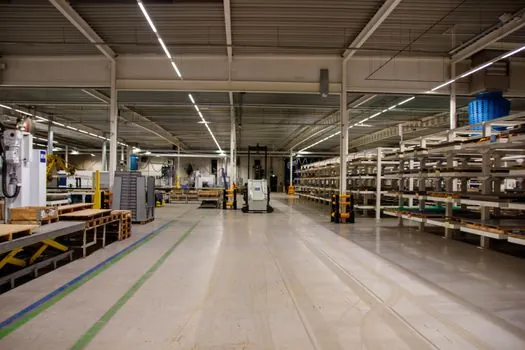
The four failure modes that show up in industrial SPC installations are core cracking, broken locking mechanisms, curled edges, and surface buckling, and the cause in nearly every case is upstream material choice, not installer error [S3]. A brittle core that cracks under pallet-jack impact traces to either coarse-mesh stone powder (less than 400 mesh) or a high recycled-PVC fraction; broken click tabs trace to low virgin-PVC content and cold-installation temperatures below the manufacturer's stated minimum, typically 15°C substrate temperature [S3].
Edge curl and buckling trace to two distinct errors: missing perimeter expansion gap (SPC needs 6–10 mm gap at walls and fixed obstacles, even though it is more dimensionally stable than LVT), and subfloor moisture either as a damp slab with no proper vapor barrier or as HVAC swings that drive a slab into negative vapor pressure. A quick QA protocol for incoming material is to ask the mill for the 400-mesh stone powder certificate, the virgin-PVC declaration, the calcium-zinc stabilizer SDS, and the EN 16511 or ISO 10582 wear-layer thickness certificate, and to keep a 0.5 m² reference sample from each lot in a file for future claims [S1][S3].
Standards, Specification Anchors, and Sourcing Checklist
Industrial SPC should be specified against a documented standard rather than marketing claims, and the three most useful reference points are EN 16511 for multilayer rigid-core flooring, ASTM F1700 for solid vinyl tile, and ISO 10582 for heterogeneous vinyl composition tile, all of which define wear-layer classes and dimensional tolerances in measurable terms [S1][S3]. For site QA, the in-house specifier should require a wear-layer thickness certificate per lot, a residual indentation test result per EN 433 (target less than 0.1 mm at 24 h recovery for warehouse duty), a castor chair test result to EN 425, and a slip-resistance rating, typically R10 or R11 for industrial use.
For sourcing, Chinese mills dominate global SPC production capacity, with formulation expertise in 400–600 mesh limestone-PVC extrusion and the largest catalog of IXPE-attached underlayment options, but the responsible industrial buying route is to anchor on a small set of verifiable data points rather than brand reputation: virgin PVC percentage, Ca-Zn stabilizer SDS, 0.3–0.7 mm wear layer, IXPE underlayment density, and EN 16511 or ISO 10582 lot certificate [S3]. Industrial buyers building a multi-product facility can fold the same spec-first logic they already use on instrumentation such as Gas Detector Sizing and Selection: A Spec-First Guide for Industrial Buyers and on mechanical anchors such as Expansion Anchor Selection for Commercial Concrete Builds into the floor spec, treating the floor as a long-life asset with measurable wear, load, and chemical parameters rather than a finish-trade commodity.
Trackable signals in the next 6–12 months: the rollout of anti-bacterial and anti-static SPC topcoats into cleanroom-adjacent and electronics-assembly zones, the publication of revised EN 16511 wear-class tables covering 0.7 mm-plus commercial wear layers, and the first 2026 commercial-segment sales data points that will confirm or revise the 9.5% CAGR forecast for SPC through 2030 [S5].
The underlying component specifications are covered under spc flooring, industrial flooring, and industrial adhesive.