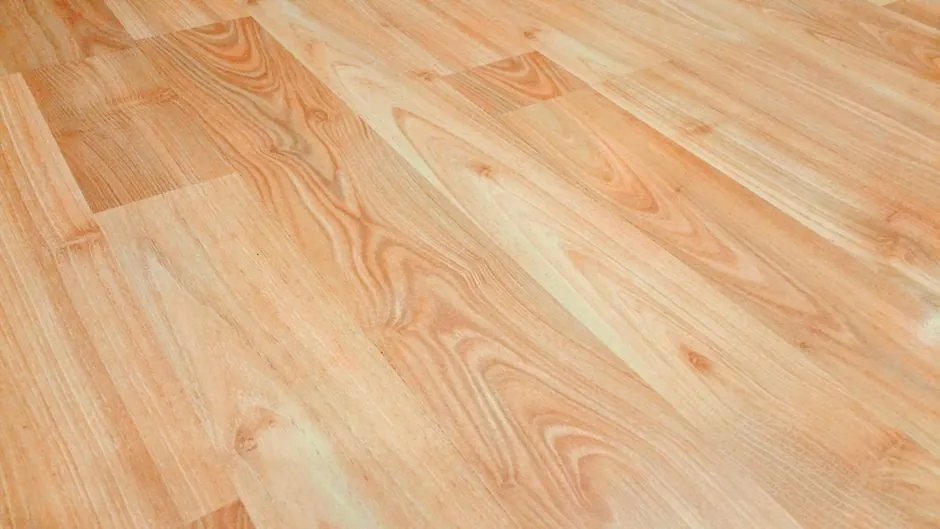
SPC (Stone Plastic Composite) flooring is a rigid-core vinyl plank manufactured from natural limestone powder, polyvinyl chloride, and stabilizers, typically sold in 4-6mm thicknesses for residential rooms and 0.3-0.7mm clear-coat wear layers (often aluminum-oxide-cured) for abrasion resistance [S1][S2][S4]. It costs roughly half of solid wood while matching wood on indentation resistance, and the product family splits into five distinct formats by surface and pattern: SPC Horizon Plank, EIR (Embossed in Register) SPC, Chevron SPC, SPC ceramic-texture, and Herringbone SPC [S2][S3].
For a residential build, the spec is driven by room function: living rooms and bedrooms favor Horizon Plank and EIR for their realistic wood-grain texture and acoustic comfort underfoot, while kitchens, bathrooms, and laundry rooms call for ceramic-texture SPC because of its waterproof construction and easy-clean surface [S3][S5].
Core Construction: What Is Inside an SPC Plank
An SPC plank is a four-layer composite: a clear wear layer (acrylic or aluminum-oxide-cured) on top, a printed vinyl design layer that carries the wood or stone visual, a high-density rigid core of limestone-PVC composite, and a backing layer (often IXPE or EVA foam) that adds acoustic damping and mold resistance [S4]. The rigid core typically runs 3.5-5mm in residential stock, with the total plank thickness (including attached pad) landing at 4-6mm for most homeowner-grade SKUs [S5][S6].
Manufacturing runs the raw mix through a five-zone extruder, with the first two zones held near 200 degrees Celsius for plasticization, then calendered into a sheet, hot-embossed for texture, and UV-coated before cutting [S4]. The mix itself is pre-heated to 125-130 degrees Celsius inside the mixer to strip residual water vapor before extrusion, a step that prevents voids in the finished core [S4].
Format Comparison: Horizon Plank vs EIR vs Chevron vs Ceramic-Texture vs Herringbone
Selection for a residential build hinges on matching format to room traffic and visual intent, and the five formats differ sharply on cost, pattern, and best-fit room [S3]. Horizon Plank uses wide, long boards (commonly 180-228mm wide) that mimic traditional hardwood and suits living rooms, bedrooms, and dining areas with high foot traffic; EIR SPC adds a registered-embossed surface that aligns the texture with the printed grain for a higher-fidelity wood look, at a 10-20% cost premium over flat Horizon Plank [S3][S5].
Chevron and Herringbone SPC deliver a 45-degree or 90-degree zigzag pattern respectively, and are specified for foyers, hallways, and open-plan living areas where pattern, not wear, drives the design choice [S3]. SPC ceramic-texture flooring replicates the visual and slip-resistance of stone or porcelain tile without grout joints, and is the format of record for wet zones (kitchens, bathrooms, laundry) where waterproof construction and cleanability outweigh wood aesthetics [S3][S6].
Thickness, Wear Layer, and Acoustic Underlay: Selection Criteria
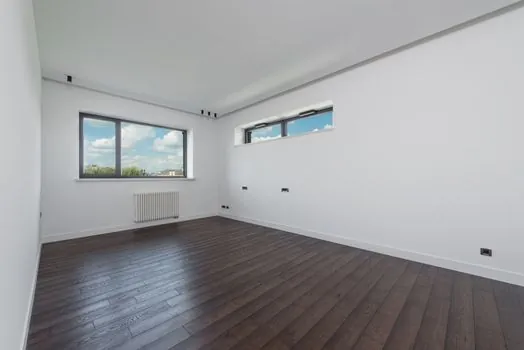
For a residential build, the minimum spec floor is 4mm total thickness with a 0.3mm wear layer; for high-traffic zones and homes with large pets, the spec climbs to 5-6mm total with a 0.5-0.7mm wear layer [S5]. Wear layer thickness is the dominant lifespan variable because it carries the aluminum-oxide or ceramic-bead clear coat that resists abrasion, with a 0.3mm layer rated for roughly 10-15 years of residential use and a 0.5mm+ layer rated for 20+ years under the same conditions [S4][S6].
Acoustic performance is a secondary but often-missed criterion: SPC alone transmits roughly 8-12 dB more impact noise than engineered hardwood, so an attached IXPE underlay of 1-1.5mm, or a separate underlayment, is the standard fix for multi-level residential builds and condo applications where the local building code enforces an IIC (Impact Insulation Class) or STC (Sound Transmission Class) rating on floor-ceiling assemblies [S4][S5]. When underlay selection crosses into broader construction tools and equipment workflows, installers should verify the SPC maker's compatibility list rather than mixing generic foam pads.
SPC vs WPC vs Sheet Vinyl: Who It Is For and Who It Is Not
SPC sits in a three-way comparison with WPC (Wood Plastic Composite) and traditional sheet vinyl, and the choice depends on whether the priority is indentation resistance (favor SPC), underfoot softness (favor WPC), or low material cost (favor sheet vinyl) [S2]. SPC is denser and harder than WPC because the SPC core is mineral-loaded (limestone) while the WPC core uses a wood-pulp foaming agent, which makes WPC warmer and quieter but more vulnerable to heavy static loads from furniture or appliances [S2].
SPC is NOT the right call for every residential scenario: on upper-story floors with strict IIC 50+ codes, bare SPC without acoustic underlay often fails the impact-noise test, and WPC or engineered hardwood with attached cork is the better specification [S2][S5]. On long, sun-exposed south-facing rooms, a UV-resistant topcoat is mandatory because PVC cores and printed vinyl layers yellow under sustained UV without an inhibitor package, a problem Horizon Plank and EIR share with sheet vinyl but that ceramic-texture SPC handles better because of its stone-tile visual [S3][S6].
Residential Room Map: Which Format Goes Where
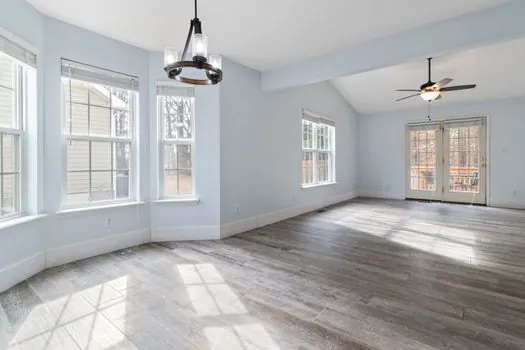
The room-to-format map is straightforward once the wear-layer and waterproof criteria are set: Horizon Plank and EIR SPC cover living rooms, bedrooms, and dining rooms, where the realistic wood-grain texture and acoustic warmth matter most [S3]. Kitchens, bathrooms, laundry rooms, and entryways from wet climates should spec ceramic-texture SPC exclusively because the product is fully waterproof through the rigid core, not just at the surface, and tolerates standing water without swelling [S3][S6].
Pattern-driven formats, Chevron and Herringbone SPC, belong in feature rooms: foyers, hallways, and open-plan living areas where the visual itself carries the design [S3]. For whole-home single-spec builds (a common developer and production-builder approach), Horizon Plank in a 5mm/0.5mm configuration is the safest universal spec because it handles all dry interior rooms and matches the same installation click-lock profile across the entire floorplate [S3][S5].
Installation, Subfloor Prep, and Failure Modes
Most residential SPC uses a click-lock profile (often marketed as "Uniclic" or "5G") that floats over the subfloor, which removes the need for adhesive in dry interior zones and cuts install time to roughly 50 sqm per day for a two-person crew [S5][S6]. The subfloor still must be flat to within 3mm over a 2m straightedge; deviations larger than that telegraph through the thin plank and create visible ridges at the click joints, a common failure mode in retrofit residential builds where the original slab was not laser-screeded [S5][S6].
Failure modes specific to residential SPC: peaking at doorways when the expansion gap (typically 6-10mm around the perimeter) is forgotten, telegraphing from a subfloor hump, and joint separation in rooms with sustained direct sunlight if the planks are pinned at the edges. For renovation work where the existing slab is questionable, the same spec discipline that governs industrial flooring selection for renovation projects applies: moisture-test the slab first, and reject any SPC install over a reading above 75% relative humidity (or 3.0 lb/1000 sqft/24h by calcium chloride) without a moisture-barrier underlayment.
Budget, Sourcing, and Trackable Signals for the Next 6 Months

SPC pricing in mid-2026 sits in a wide band: builder-grade 4mm/0.3mm Horizon Plank runs roughly 2.50-4.00 USD per sqft FOB, mid-grade 5mm/0.5mm EIR runs 4.50-7.00 USD per sqft, and pattern-driven Chevron or Herringbone commands 6.00-10.00 USD per sqft before installation labor [S1][S2]. Two trackable signals for the next six months: a tightening of phthalate-free plasticizer certifications across Chinese-origin SPC exports, and a shift toward 0.7mm wear-layer stock as the new default in the 5-6mm tier, both visible by reading updated spec sheets on major OEM catalogs and watching for FloorScore or CE-EN 16511 documentation updates on residential-grade planks.
The underlying component specifications are covered under spc flooring, and industrial flooring.