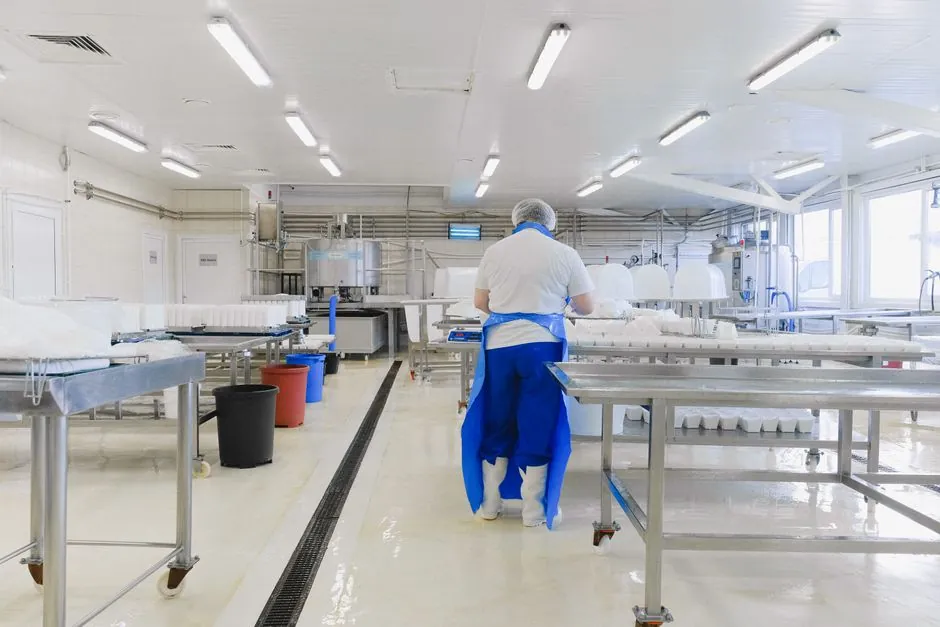
PPR pipe is now a default pick for cleanroom purified water (PW) and water-for-injection (WFI) distribution when the spec calls for a non-leaching, chemically inert loop, with service life routinely quoted above 50 years in factory water service [S2].
PP-R (polypropylene random copolymer) is a thermoplastic whose ethylene-comonomer chain structure raises thermal resistance versus homopolymer PP, which is why a correctly rated PP-R pipe holds 95°C short-term and stays dimensionally stable through repeated hot sanitization [S1]. For cleanroom owners the practical question is not whether to use PPR pipe at all, but which PN class, which joining method, and which cleanliness evidence the supplier can actually hand over [S2].
Cleanroom Service Profile and What the Pipe Must Survive
Cleanroom water loops are not generic hot/cold plumbing: a single 90°C PW recirculation cycle, followed by a chemical sanitization with H2O2 or peracetic acid at 60-80°C, hits the pipe wall every day, and the joint has to outlast that cycle without crevice, biofilm nucleation, or extractable release [S2]. The working envelope most PP-R datasheets anchor to is -10°C to +95°C short-term with a continuous service ceiling near 70°C at PN 20-25, which is the band cleanroom PW loops sit inside [S1].
Particle shedding, not pressure, is the typical failure mode: rough inner walls raise biofilm risk, so a cleanroom-grade PP-R line is specified with an inner surface finish that minimizes bacterial adhesion, and with a socket-fusion joint whose fused bead leaves no annular gap [S2]. Pharmaceutical-class PP-R suppliers also quote no heavy-metal leaching (no lead, no copper release) versus legacy copper or galvanized steel, which is a direct response to the contamination pathway that has historically killed cleanroom loops [S2].
Material and Pressure Class: Picking PN 16, PN 20, or PN 25
Selection between PN 16, PN 20, and PN 25 is set by three numbers on the data sheet: design stress at 20°C (typically 6.71-10.0 MPa depending on service factor), continuous operating temperature, and peak temperature during sanitization [S1]. For ISO 14644-classified cleanrooms running PW loops at 60-80°C with periodic 90°C excursions, PN 20 PP-R SDR 7.4 is the common baseline; PN 25 SDR 6 is used where the sanitization ceiling is pushed to 95°C or where the design factor is tightened to 1.25 instead of 1.5 [S1][S2].
Wall-thickness choices track SDR: SDR 11 (PN 10) is rejected for cleanroom hot loops because the 95°C derating cuts the allowable stress too far; SDR 7.4 (PN 20) and SDR 6 (PN 25) keep the 50-year creep envelope intact at the temperatures the loop actually runs at [S1]. For the air- and gas-handling side of the cleanroom, the same resin family shows up as plastic pipe for low-pressure exhaust, but the pressure-class logic is identical.
Cleanliness Evidence: What Suppliers Have to Show Before You Accept the Pipe
A cleanroom-suitable PP-R line is documented on three independent evidence tracks: (1) resin certification covering ISO 9001 / ISO 14001 / ISO 45001 quality and traceability, (2) fusion-joint procedure qualification showing a homogeneous fused bead with no annular gap, and (3) chemical-resistance data against the actual sanitization agents the loop will see (H2O2, peracetic acid, sodium hydroxide, hot deionized water) [S2]. Without those three, the pipe is a commodity plumbing part, not a cleanroom component [S2].
The fused-socket joint is the reason PP-R beats threaded stainless or glued PVC for cleanroom service: pipe and fitting are melted into a single piece at around 260°C, so the joint tensile strength approaches the parent-pipe value and there is no thread sealant, no solvent cement, and no gasket to outgas or shed particles [S1][S2]. For a pipe fitting buy, that is the single biggest differentiator versus a clamped mechanical joint. Where the line is hung or bracketed, PP-R's own low thermal conductivity (~0.24 W/m·K) reduces condensation load on the cleanroom envelope, so insulation spec can usually drop a class [S1].
PPR vs Stainless vs PVC for Cleanroom Water
For a hot PW / WFI distribution loop, the shortlist narrows to three materials, and the decision is driven by four criteria: extractables, sanitization temperature ceiling, joint type, and installed cost per meter [S1][S2].
Stainless 316L (orbital-welded) is the gold standard for WFI loops above 80°C, but installed cost runs roughly 3-5x an equivalent PP-R PN 20 line and weld qualification adds schedule. PVC-C and PVC-U are limited to about 60°C and solvent-cement joints, which is a hard reject for any loop above ambient cleanroom service. PP-R PN 20-25 with socket fusion covers the 70-95°C PW band, ships at a lower cost per meter, and eliminates the solvent-cement pathway, at the price of a lower pressure ceiling (typically 1.0-1.6 MPa at 20°C versus stainless at 1.6-2.5 MPa) and a lower maximum sanitization temperature than orbital-welded 316L [S1][S2]. The decision rule: WFI storage and the final sub-loop to the user point go to 316L; the rest of the cleanroom PW recirculation ring is where PP-R pays for itself.
Installation Discipline: Fusion Parameters, Hangers, and Cleanroom Commissioning

Field failures in cleanroom PP-R loops are dominated by three avoidable causes: cold-fusion or under-heated sockets, hanger spacing wider than the resin manufacturer's table, and chemical incompatibility with the cleaning regime [S1][S2]. The fix is procedural: heat the socket to roughly 260°C, hold the fusion timer per pipe-diameter chart, then restrain the joint for the full cooling interval before the line is pressure-tested [S1].
Hanger spacing follows the resin table (typically 16-20× OD for horizontal cold lines, 12-15× OD for hot lines at 70°C), and any pipe clamp specified for a cleanroom must be plastic-lined stainless, never bare galvanized, to avoid galvanic creep at the support point. After installation, the loop is flushed, then hot-sanitized to the operating temperature, and a final rinse sample is taken for TOC, conductivity, and endotoxin before the cleanroom is signed off for occupancy [S2]. That sign-off sample is the only evidence the owner actually has that the pipe spec was right; everything before it is paperwork.
Limits, Failure Modes, and What PPR Cannot Do in a Cleanroom
PPR is the wrong pick where the loop runs above 95°C continuous, where the fluid is a strong oxidizer at high temperature (concentrated nitric, hot chromic acid), or where the system is exposed to UV without a protective jacket, because UV embrittles PP-R over a 2-5 year horizon [S1]. The resin is also vulnerable to certain polar organic solvents (acetone, toluene, concentrated chlorinated solvents); if the cleanroom process uses these as cleaners, the chemical-resistance table has to be re-checked against the actual concentration and temperature, not against a generic brochure [S1].
Two failure signatures are specific to cleanroom service: (1) biofilm colonization at a cold-fused or starved-fusion joint, which shows up as a TOC excursion months after handover, and (2) stress cracking at a saddle support where the clamp was over-tightened, which shows up as a wet insulation jacket at a hanger point [S1][S2]. Both are inspection items, not pipe-quality items. Where a cleanroom has a chilled-water side, the PE pipe family (HDPE) is often paired with PP-R for the cold leg, because HDPE's low-temperature impact strength beats PP-R below 0°C; the heat-fused joint principle is the same, but the resin is not interchangeable, and the stainless pipe alternative is still on the table for the WFI-only final sub-loop.
Trackable signals for the next spec cycle: whether the project is re-tendering PW distribution as PP-R PN 25 SDR 6 versus the older PN 20 SDR 7.4 default, and whether the cleanroom QA package is asking for documented hot-sanitization cycle counts (typically 500-2000 thermal cycles) on the resin data sheet rather than just static temperature ratings [S2]. For readers building out a wider cleanroom utility package, the same fused-thermoplastic logic shows up in pharmaceutical inspection lighting geometry, where stable, crevice-free housings matter just as much as they do in a water loop.
Related analysis: Industrial Ethernet Cable Standards: Selecting Plant-Floor Cabling for IEC 61918.