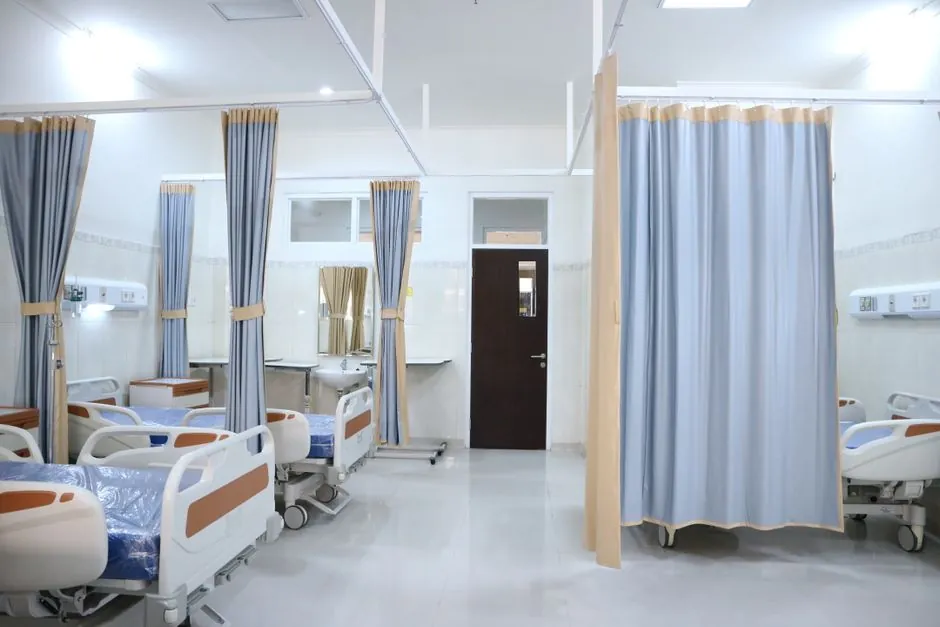
For hospital corridors, patient rooms, and sanitation zones, SPC flooring earns its place through a rigid limestone-PVC core (typically 4–8 mm total thickness) topped with a UV-cured wear layer of 0.3–0.7 mm, paired with an attached acoustic underlayment for impact-noise reduction [S1][S3].
Selection for a healthcare build is not a single decision but a stack: core density, wear layer thickness, slip rating, disinfectant compatibility, and acoustic performance must each be qualified against the room's use class. The guidance below distills what the published healthcare-flooring sources actually say, separated from generic SPC marketing claims [S2][S3].
What SPC Flooring Is and Why It Fits Hospital Spec
SPC is a rigid-core luxury vinyl tile made from a limestone (calcium carbonate) and PVC stabilizer composite, bonded to a vinyl print layer, a transparent wear layer, and usually an attached foam or IXPE underlayment; this layered build gives it dimensional stability, 100% waterproof behaviour, and resistance to rolling loads from hospital beds and wheelchairs [S2][S3].
Healthcare-specific sources call out three engineering properties that drive hospital fit: a non-porous surface that tolerates repeated disinfectant cleaning, a rigid core that resists indentation under static medical equipment, and acoustic damping from the underlayment that lowers impact noise in patient corridors [S1][S3]. The same composition also gives SPC a low thermal expansion coefficient compared to standard LVT, which matters over large ward footprints and under floor-to-floor temperature swings [S7].
Selection Criteria: Core, Wear Layer, Slip, Acoustic, Hygiene
Healthcare specifiers consistently prioritize five parameters, and published guidance maps cleanly to each: core thickness, wear layer thickness, slip resistance, acoustic underlayment, and cleanability under hospital-grade disinfectants [S1][S2][S3].
For core thickness, 4–6 mm SPC is the common hospital spec for patient rooms and offices, while 6–8 mm heavy-duty SPC is recommended for corridors, imaging suites, and any area with rolling bed or trolley traffic [S1][S3]. Wear layer selection is the second hard gate: a 0.3 mm (12 mil) layer is the minimum for light-traffic clinical offices, 0.5 mm (20 mil) is the typical commercial-hospital spec, and 0.7 mm (28 mil) is used in operating-room-adjacent corridors and emergency departments where trolley and gurney abrasion is constant [S2][S3]. The third decision is slip resistance, typically specified at R10 or higher on the DIN 51130 ramp-test scale, or a coefficient of friction consistent with local healthcare codes [S1]. The fourth criterion is the acoustic underlayment: attached IXPE or EVA foam in the 1–2 mm range is the typical hospital corridor target, with the goal of reducing impact noise transmission in patient recovery areas [S3][S4]. The fifth, and most operationally important, is disinfectant compatibility: the wear layer and print film must survive repeated exposure to quaternary ammonium, hydrogen peroxide, and sodium hypochlorite solutions without yellowing, delaminating, or losing surface gloss [S1][S3].
Comparison: SPC vs LVT vs Rubber vs Epoxy vs Sheet Vinyl in Hospitals
Against the four other common hospital flooring systems, SPC's position is highly use-case-dependent; no single product wins every room type [S2][S3].
On rolling-load performance, heavy-duty SPC (6–8 mm core) and rubber sheet flooring both handle hospital-bed casters well, while standard LVT and epoxy show indentation under sustained static loads and are more sensitive to substrate movement [S2][S3]. On acoustic performance, SPC with an attached underlayment falls between rubber (best in class, often 15–20 dB impact reduction) and ceramic tile (worst, hard and reflective), and is markedly better than bare epoxy or polished concrete [S3][S4]. On hygiene and cleanability, all four non-porous options (SPC, rubber sheet, homogeneous vinyl sheet, and epoxy with a polyurethane topcoat) are acceptable, but SPC's seam structure (click-lock or tight butt joints) is the weak point; for sterile-core zones such as operating theaters and compounding pharmacies, heat-welded homogeneous vinyl sheet remains the dominant spec [S2][S3][S6]. On lifecycle cost, SPC typically installs faster than rubber or epoxy, with click-lock systems reducing ward downtime, but published wear-layer and indentation data suggest a 15–20 year service life in hospital corridors rather than the 25–30 year life of poured epoxy [S2][S3].
Where SPC Flooring Is the Right Spec in Hospitals
Patient rooms, general wards, nurse stations, outpatient clinics, and non-sterile corridors are the strongest fits; the published case studies cite a German pediatric-hospital renovation where SPC was selected over epoxy and linoleum for these zones specifically because of rolling-load support, slip resistance with a UV wear layer, and cleanability under intensive sanitization [S2].
Reception areas, administrative offices, hospital cafeterias, and bank-or-retail-adjacent hospital wings also map cleanly to heavy-duty SPC, where the combination of 100% waterproof construction, acoustic underlayment, and design flexibility (wood-grain, stone, and abstract prints) is commercially preferred [S3]. For adjacent selection logic on temperature-sensitive spaces, see the field analysis of SPC flooring in cold storage rooms and the contamination-control discussion of SPC in cleanroom environments; the same core-wear-underlayment trade-off applies, with the limits shifting by room class.
Where SPC Flooring Should Not Be Specified in Hospitals

Operating theaters, interventional radiology, compounding pharmacies, and any ISO Class 5–7 cleanroom-adjacent zone are not appropriate for click-lock SPC; the seam geometry cannot be heat-welded to the same integrity as homogeneous vinyl sheet, and bioburden control fails the spec for sterile compounding under USP and equivalent rules [S3][S6].
MRI scan rooms, rooms with high-static-load equipment such as linear accelerator bunkers, and any area with point-load medical imaging tables should also default to thicker rubber sheet, poured resin systems, or specialized conductive/ESD flooring rather than SPC [S2]. Cold-storage or sub-zero temperature zones inside hospitals (pharmaceutical freezers, -80 °C biobank halls) sit outside SPC's published operating envelope; SPC's limestone-PVC core can become brittle at sustained sub-zero exposure, and the click-lock joint is vulnerable to thermal cycling [S3].
Standards, Sourcing, and What to Verify Before Purchase
For healthcare projects, the non-negotiable verification points are: a published slip-resistance rating (R10/R11/R12 on DIN 51130, or the local healthcare code equivalent), a documented wear-layer thickness in mil or mm, a fire-classification certificate (typically Bfl-s1 under EN 13501-1 for European hospital builds), a phthalate-free or ortho-phthalate-free formulation declaration, and a VOC emission certificate such as FloorScore, Indoor Air Comfort Gold, or AgBB/EMICODE EC1+ [S1][S2][S3].
For a deeper grounding in the layered construction that drives most of these ratings, the SPC flooring reference page walks through core density, wear-layer chemistry, and underlayment options, while the broader industrial flooring selection guide covers the resin, rubber, and cementitious systems SPC is typically compared against in hospital build-outs. On the supplier side, require lot-traceable certificates of analysis, a documented indentation rating (typically ≤ 0.1 mm at 750 N for commercial-grade SPC), and a confirmed residual-indentation test method (EN 433 or ASTM F1914); without these, a hospital tender cannot compare quotes on a like-for-like basis [S3][S5].
The next decision node after SPC selection is the wall-floor transition: hospitals almost always pair SPC with a heat-welded vinyl coved skirting in wet zones, and a separate transition strip at the door to any operating theater or imaging suite.
Spec-level background on the components involved: pressure transmitter.