
Specifying SPC (Stone Plastic Composite) flooring inside a working freezer room is a common procurement error: SPC click planks are engineered around a rigid CaCO3/PVC core that performs best at 15-30°C and is not rated for sustained sub-zero service [S7].
For cold storage warehouses operating at -20°F (-29°C) or below, the working floor choices remain polyurethane (PU) concrete and epoxy systems, supported by insulated slab construction and engineered mezzanine decks [S1][S2][S6]. SPC still has roles, just not as the freezer-room wearing surface.
SPC's Real Operating Window
Manufacturer guidance is explicit: SPC stock stored in very hot or very cold warehouses can suffer permanent damage to its physical characteristics, with the rigid core becoming brittle and the click joints prone to micro-fracture on cold-soak storage [S7]. SPC click-lock planks carry a typical surface temperature window of roughly 15-32°C, well above the -20°F (-29°C) baseline cited for cold storage service [S1][S7]. For a deeper look at how SPC compares to other rigid vinyl constructions in the broader SPC flooring category, the expansion/contraction behaviour, locking geometry, and wear-layer build-up of these products determine whether they survive any temperature swing at all. The same caution applies when comparing SPC to the wider industrial flooring family, where cold-rated chemistries (PU cement, resinous toppings) sit several performance tiers above commodity rigid LVT in low-temperature service.
What Cold Storage Floors Actually Need
Cold storage floors must survive five concurrent loads, and the failure mode of each is well documented: extreme temperature resistance at -20°F or lower, thermal shock resistance across defrost and hot-wash cycles, heavy dynamic load-bearing from forklifts and pallet jacks, moisture and chemical resistance, and compliance with hygiene and safety standards including non-porous, slip-resistant surfaces [S1]. Polyurethane concrete is repeatedly named the leading system because its coefficient of expansion tracks the concrete substrate, reducing cracking under thermal cycling, and because it tolerates the chemical and cleaning regime common in food and pharma cold rooms [S1][S2]. Urethane cement specifically is rated for a -40°F to 250°F operating range and is described as the standard flooring for cold storage and freezer warehouses for that reason [S6].
Epoxy remains a common alternative where temperature is stable, offering high resistance to oils, acids, and cleaning chemicals, custom colours for safety zoning, and a lower installed cost than PU, though with reduced thermal-shock tolerance and higher long-term maintenance [S1][S5]. The structural ground floor slab itself is described by global industrial flooring producer Twintec as "quite literally the support on which the entire cold storage operation rests," with extruded polystyrene (XPS) insulation beneath the slab forming part of the cold-rated floor assembly [S2].
Side-by-Side: SPC vs PU Cement vs Epoxy vs Mezzanine Panels
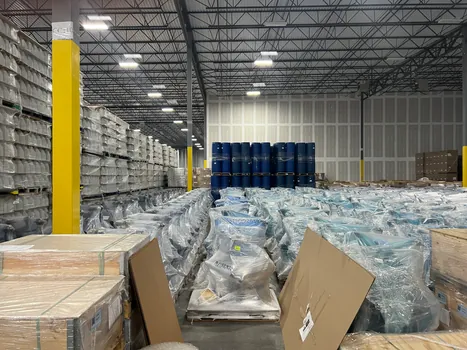
The four main floor types a cold-storage specifier will encounter score very differently against the criteria that actually matter in a freezer room, and the table below lines them up so the trade-off is visible at a glance: [S1]
Criterion 1, sustained low-temperature rating: PU cement holds -40°F to 250°F [S6], epoxy performs in stable cold but is weaker under thermal shock [S1], ResinDek mezzanine panels are rated to -20°F [S3], SPC click planks are not rated for sustained sub-zero service [S7]. Criterion 2, thermal shock tolerance: PU cement is the strongest because its expansion matches concrete [S1], epoxy is moderate, mezzanine panels depend on the steel/aluminium substrate [S8], SPC is poor because the rigid core is dimensionally sensitive. Criterion 3, forklift/pallet-jack traffic: PU cement and epoxy are both designed for heavy dynamic loads [S1][S2], ResinDek is engineered for mezzanine pallet traffic, and SPC will dent and joint-fail under point loads from powered trucks. Criterion 4, hygiene and cleanability: PU cement and epoxy are seamless and non-porous and meet food/pharma cleanability norms [S1][S2], mezzanine bar grating and ResinDek are open or semi-open, and SPC joints can trap moisture if the click is micro-cracked.
Where SPC Still Earns Its Place in a Cold Storage Project
Even when SPC is the wrong choice for a freezer room, it has legitimate roles in the wider cold-chain facility, and three use cases recur in practice. First, dry ambient zones: ante-rooms, dispatch lobbies, dock offices, battery-charging rooms, and packing areas typically sit between 10°C and 25°C, which is well inside SPC's comfort range and is where its click speed, water resistance, and cleanable wear layer are real advantages. Second, mezzanine office build-outs and partition-room floors on the warm side of the insulated envelope, where SPC can be floated over a continuous storage rack line-out platform or over a raised storage handling subfloor without any cold-soak exposure. Third, substrate protection during construction: SPC panels are occasionally specified as a temporary surface shield over cured PU cement while racking and refrigeration commissioning are completed, because the click system can be lifted later without damaging the resinous topping underneath. [S1]
ResinDek panels occupy a different but related niche for elevated work platforms: they are engineered for temperatures as low as -20°F and are positioned as a proven choice for refrigerated and freezer mezzanine decks, distinct from the slab floor system below [S3]. Where the mezzanine itself is in aluminium or steel bar grating, the slip resistance and low maintenance are repeatedly cited as the safety rationale in cold environments [S8]. For the storage enclosure that surrounds all of this, insulated metal panel systems, including FOAMULAR XPS underneath the slab, are part of the same cold-rated building envelope that the floor assembly is designed to support [S2].
Procurement Rules That Prevent the SPC-in-Freezer Mistake
Three rules keep a spec from drifting into the wrong product. Rule one, match product to zone: confirm the floor's rated operating temperature against the room's design setpoint, not the building average, and refuse any SPC quote that does not list a minimum surface-temperature value with a test method. Rule two, isolate SPC from thermal cycling: if SPC is used in a transitional area, specify expansion gaps at the documented rate for the product and keep the planks out of door-curtain airstreams that swing from -20°F to ambient. Rule three, demand system-level data, not just product data: ask the resinous-flooring supplier for the PU cement's published temperature range, slip-rating, and chemical-resistance certificate, and ask the cold-room builder for the slab insulation value, vapour barrier detail, and joint layout [S2][S4][S6]. For further reading on adjacent material decisions in industrial builds, the DEA Storage Cage Specs for Pharmaceutical Distribution: 2026 Selection Map covers cold-chain pharmaceutical storage hardware, and the Pneumatic Nail Gun Care for HVAC Installers piece walks through the cold-weather tooling side of the same envelope-construction work.
Track two signals over the next quarter: any SPC manufacturer datasheet revision that publishes a sustained sub-zero rating with a third-party test report, and any PU-cement supplier update that pushes the upper thermal-shock limit beyond the current -40°F to 250°F band [S6][S7]. Either of those would shift the procurement map.