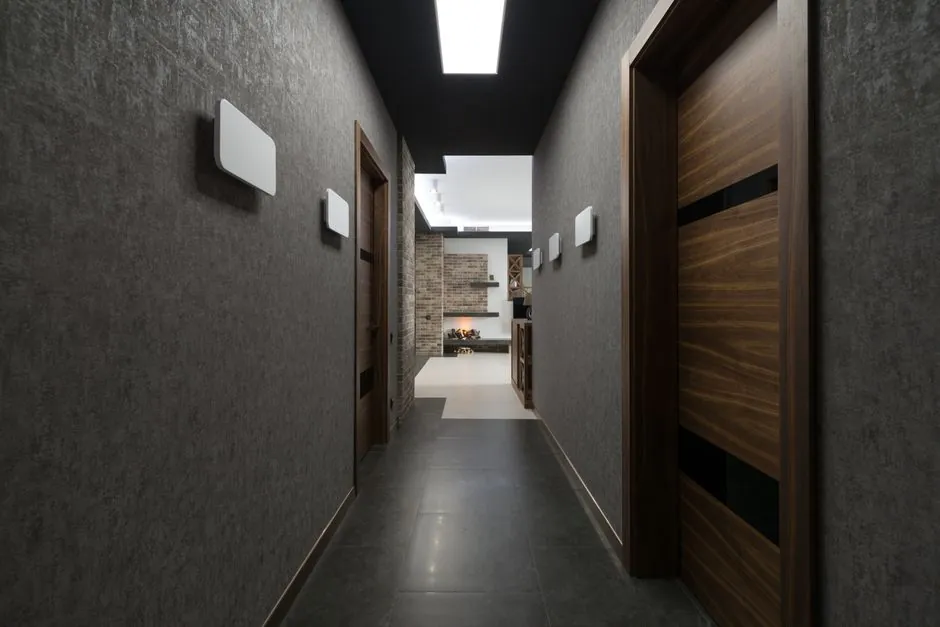
Certified acoustic fire-door assemblies combine sound control with fire resistance, with documented Ceco configurations reaching STC ratings up to 66 [S4].
Available construction includes wood and steel leaves, compression or adhesive seals, glazed openings, and tested complete assemblies for commercial, institutional, and industrial use [S1][S3][S5].
Separate STC Performance from Fire Resistance
STC and fire ratings describe two different performance requirements: STC measures airborne sound transmission, while a fire rating addresses resistance under fire exposure. A door can carry one rating without the other, so both claims must be verified for the specified assembly. [S4]
Ceco’s pre-configured acoustic door models offer varying levels of sound control up to STC 66, with adhesive-seal and compression-seal configurations [S4].
Buyers should not infer an STC rating from a fire label or treat a laboratory door as a complete acoustic opening.
Select the STC Target for the Space
A selected assembly must be tested in the configuration intended for installation.
Published product data ranges from STC 26 to STC 70 across specialty acoustic doors [S8]. VT offers sound-resistant STC doors for applications including airports, healthcare, hospitality, government, and municipal buildings [S3].
The numeric STC rating is most useful when tied to a defined use. A privacy door separating corridors may not justify the same acoustic construction as a patient room, studio entrance, classified facility, or critical operating space. The project drawing should identify the minimum STC value, permitted glazing, door size, hardware, frame, and seals rather than relying on the product family name alone.
For a broader technical reference, the fire door page provides the base assembly context, while the project specification should add the required STC performance and listing details.
Compare Wood and Steel Acoustic Fire Doors
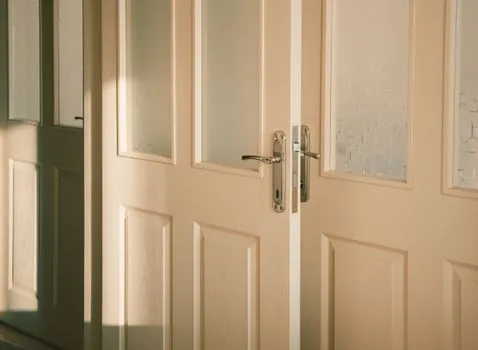
Krieger offers custom-manufactured acoustical doors using cold-rolled steel sheet and tested under standards including ASTM E90, ASTM E336, ASTM E1408, and ASTM E413 [S5]. Their acoustical performance must still be checked against the selected leaf, lite, frame, and seal configuration.
Ceco’s acoustical-opening systems provide Sound Transmission Class ratings up to 66 [S4].
Steel is not automatically the better acoustic choice, and wood is not automatically limited to low STC values. The decisive evidence is the tested or certified assembly for the selected size and configuration.
Control Installation Leaks and Glazing Weaknesses
An STC door rating applies to a defined assembly, not to a loose slab installed in an opening. Acoustic performance depends on perimeter seals, the threshold, hinges, locks, and the continuity between the frame and adjacent construction. [S5]
Ceco identifies three relevant seal strategies: adhesive-seal models simplify installation but have limited field adjustability, while compression-seal models require greater installation knowledge but allow adjustment for field conditions [S4]. Complete assemblies can include the door panel, frame, hinges, seal, and threshold, which reduces the risk that procurement will omit a performance-critical component [S5].
Glazing is a frequent weak point. Forte Openings states that some doors are STC construction only and are not evaluated for STC performance when a lite opening is installed [S6]. Krieger’s acoustical door assemblies may be configured with or without vision lites, side lites, and transoms [S5].
One available acoustic door configuration permits visible glass up to 24 by 52 inches with Firelite NT 5/16-inch glass, but the applicable rating depends on the exact door construction and test conditions [S6]. Glazed openings, perimeter seals, and any installed hardware should therefore be treated as configuration-specific components.
Match the Assembly to the Building Requirement

Acoustic fire doors fit corridors, patient rooms, classrooms, offices, conference rooms, laboratories, hospitality spaces, government facilities, SCIF rooms, and performance or industrial areas where both sound control and fire resistance are required [S3][S4][S5].
They are not the correct default for every opening. A low-STC standard steel door may be adequate where the acoustic requirement is modest and no certified acoustic assembly is needed [S2]. Conversely, high-STC products may be unnecessary where privacy is limited, while remaining insufficient where security, classified information, or critical process noise requires a more specialized opening.
High-acoustic systems may also need a different hinge specification. Krieger’s acoustical door assemblies can be configured with manual or power-operated controls [S5]. Ceco’s pre-configured models include adhesive-seal models using a standard door frame and compression-seal models using an adjustable seal design [S4]. A complete specification must therefore coordinate the leaf with the frame, hardware, seals, threshold, and glazed components.
Verify Listings, Tests, and Project Conditions
Acoustic door claims should be supported by the appropriate test method, assembly listing, and manufacturer documentation. Republic identifies ASTM E90 and ASTM E413 for its STC door assemblies [S10]. Ceco lists independent testing to ASTM E90, E1332, E2235, E413, SDI 128, and HMMA865 criteria [S4].
Fire evidence is a separate document set. Krieger lists metal acoustical doors up to 3 hours as certified to UL 10C, UBC 7-2, and UBC 7-4, with 250°F, 450°F, and 650°F temperature-rise options. Its wood-veneer doors carry smoke, 20-, 45-, and 60-minute UL labels [S5].
Size and glazing limits must be checked before ordering. The cited Ceco configuration allows a maximum single opening of 4 by 8 feet and a maximum paired opening of 8 by 8 feet [S4]. A nominal field check can compare the complete wall opening with those limits, then confirm the exact leaf, frame, lite, seal, and hardware combination in the manufacturer’s cut sheet or test report.
For project teams comparing core options, Mineral Composite vs Solid Wood Fire Door Cores provides a separate comparison. Acoustic selection still requires the certified configuration because core choice alone does not establish the assembly’s STC or fire performance.
Document the Performance Order
The most defensible specification requires both an STC value and a fire rating, then identifies the tested assembly that delivers them. For example, a project can require STC 52 at 20 minutes with a 1-3/4-inch unlatched wood leaf [S3], or STC 66 at 3 hours with a specified steel construction and compression seals [S4].
Trackable procurement signals are the approved test report and the manufacturer cut sheet. Confirm the door width and height, glazing dimensions and glass type, seal method, hinge model, frame gauge, hardware schedule, fire label, and closing mechanism against those documents before release.