
For a commercial envelope in 2026, fired clay brick is specified on four verifiable inputs: a minimum compressive strength, a documented water-absorption limit, a fire-rating test report, and a density/porosity balance that matches the climate and load path.
Selection starts with the fired brick reference page to anchor the terminology (solid, hollow, perforated, facing, engineering), then layers the code, climate, and lifecycle criteria the project actually enforces.
Pick the strength class first, not the colour
Under IS 1077:1992, burnt clay bricks are split into four compressive-strength classes: Class AA above 35 N/mm², Class A above 20 N/mm², Class B above 10 N/mm², and Class C above 7.5 N/mm² [S3]. A multi-storey commercial frame with masonry infill typically lands on Class A or AA; low-rise boundary walls can be specified to Class B. The same code caps water absorption at under 20% across AA, A, B, and C, and limits dimensional tolerance to ±3% on length, width, and height [S3]. Warpage is measured per IS 3495 Part 4, and efflorescence is rated Nil / Slight / Moderate / Heavy / Serious, with anything beyond Slight a reject on most commercial façades [S3].
Specifying by appearance alone is how projects end up with a façade that spalls in three winters. Burnt clay brick is porous; water absorbed during wet weather and frozen in cold spells drives spalling and joint decay, which is the dominant failure mode on commercial envelopes in freeze-thaw climates [S2]. The first spec line should therefore be the IS (or EN/ASTM equivalent) class plus the local-weather justification, with colour specified as a separate, non-structural line item.
Fire rating: match the test standard to the jurisdiction
Fire ratings for clay brick walls are expressed in minutes or hours and must be tied to a named test method, otherwise the building official will reject the submittal. ASTM E119 covers US wall, floor, and structural-element exposure, EN 13501-2 covers European fire classification including resistance duration, and ISO 834 sets the international time-temperature curve used as the underlying fire-exposure profile in many regional methods [S1]. The rating itself depends on composition, density, and manufacturing route: bricks with higher alumina (Al₂O₃) content reach refractoriness up to 1450°C, while additives like grog, chamotte, or mineral fillers are used to stabilise the body and cut shrinkage under fire [S1].
Density and porosity trade against each other on purpose. Dense clay brick carries higher mechanical strength but conducts heat faster; moderately porous brick insulates better and slows heat penetration, lengthening the time the wall holds the fire back [S1]. For most commercial fire walls and party walls, the spec is therefore a minimum density band (kg/m³) plus a minimum rating (hours) plus a fixed brick-and-mortar assembly, because the rating is on the wall system, not the brick unit on its own. Specifiers should request the assembly test report, not just the brick datasheet.
Solid, hollow, or perforated: geometry decides the load path
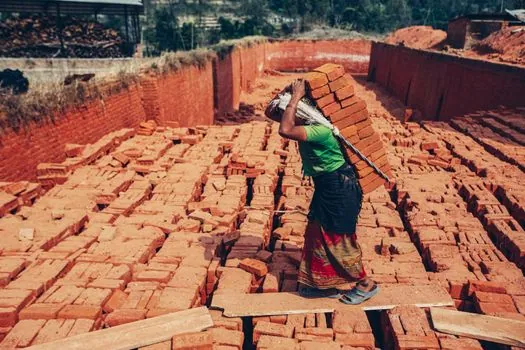
Geometry controls weight, grout consumption, and thermal performance. Solid units carry the highest compressive load per running metre and are the default for Class AA structural applications. Hollow and perforated units cut wall weight, reduce material cost, and improve thermal resistance, but their net compressive area is lower, so the same strength class delivers a lower wall capacity. For tall commercial frames with masonry infill, the project engineer will typically call a specific unit geometry alongside the IS class to keep the wall capacity calculation auditable. [S1]
Where the wall doubles as a service shaft or plant-room enclosure, a denser block brick geometry often replaces the standard facing brick to hit impact and acoustic targets without changing the fire class. This is a common workaround on mixed-use commercial builds where the same elevation needs to carry different functions storey by storey.
Terracotta cladding vs brick slips: same material, different firing
Clay-based façade cladding splits into two production routes that are easy to confuse at the spec stage. Terracotta is sinter-fired at temperatures typically above 1,200°C, producing a denser, less porous, and more colour-consistent unit, while brick slips are cut from conventional bricks fired at lower temperatures, retaining the higher porosity and natural colour variation of traditional masonry [S4]. The performance difference is real: terracotta's dense sinter-fired surface resists moisture penetration, freeze-thaw cycling, and chemical weathering better than brick slips, and modern systems often ship with integrated graffiti protection and permanent UV-stable colour [S4].
Brick slips still earn their slot where the design intent is a traditional masonry look, provided the project accepts the higher porosity and the periodic sealing/maintenance budget that comes with it [S4]. For healthcare and high-traffic commercial builds, the ter
racotta route dominates because the lower maintenance and the more predictable installation schedule outweigh the higher material cost over the building life [S4]. When specifying either, ask for the firing-temperature range and the water-absorption value, since those two numbers separate a high-performance ceramic façade tile from a dressed-up conventional brick.
Climate, mortar, and the maintenance trap
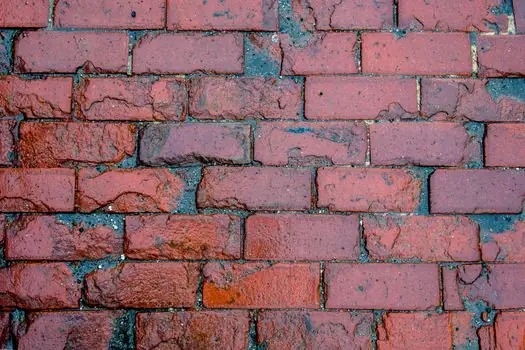
Climate sets the binding constraint. In freeze-thaw exposed façades, burnt clay brick's primary vulnerability is moisture absorbed into the face, which then expands on freezing and drives spalling and cracking; the same mechanism attacks the mortar joints, and once joints fail the moisture infiltration accelerates the brick-level damage [S2]. The spec response is a breathable penetrating sealant at the face and a planned repointing cycle, while explicitly avoiding film-forming sealants that block vapour escape and worsen internal freeze-thaw damage [S2].
Mortar specification should not be left to the bricklayer's discretion. A weaker mortar than the brick unit is deliberate, so the joint sacrificial fails before the brick face does; a stronger mortar leads to brick-face spalling and a wall that is harder to repair cleanly. Sand-lime (calcium silicate) brick is a different product with different failure modes (efflorescence rather than freeze-thaw spalling) and is sensitive to acid cleaners, so it is not a substitute for fired clay on a commercial envelope [S2]. For interior partitions where fired brick is used as a finish rather than a weather shield, a lighter specification is acceptable, and a pre-finished lightweight partition panel will often be the lower-cost alternative on non-load-bearing demising walls.
Cost, lead time, and market signal
Specifying brick is a procurement problem as much as a materials problem. The global clay brick market was valued at USD 22.37 Billion in 2025 and is forecast to reach USD 29.32 Billion by 2031 at a 4.61% CAGR, driven by construction-materials demand across infrastructure and real-estate segments [S5]. That growth tracks with extended lead times on Class AA units in tight regional markets, so commercial projects in 2026 should lock the brick class and the kiln source at the design stage rather than at the procurement stage.
Total cost of ownership shifts the answer between terracotta and brick slips: terracotta's higher material cost is partially offset by lower substructure requirements, simpler mechanical-fix installation, and reduced lifetime maintenance, while brick slips win on initial material cost and traditional aesthetic but carry the sealing and joint-maintenance budget over a 20-30 year service life [S4]. For most commercial envelopes, the breakeven is the project maintenance reserve, not the line-item cost on day one.
Selection criteria compared
On the four decision criteria that drive commercial façade specification, fired clay brick, terracotta cladding, and brick slips line up as follows. Compressive load: solid fired clay Class AA above 35 N/mm² is the strongest; terracotta is a cladding, not a structural unit; brick slips inherit the host brick's class but are typically non-load-bearing on a rainscreen. Water absorption of fired clay is governed by IS 1077 with testing per IS 3495 Part 2, terracotta is very low due to its sinter-firing process, and brick slips are higher because of parent-brick porosity [S3][S4]. Fire rating: all three are non-combustible clay ceramics, but the documented rating comes from the wall assembly test under ASTM E119, EN 13501-2, or ISO 834, not from the brick unit alone [S1]. Maintenance burden: fired clay is moderate (repointing, breathable sealants), terracotta is low (graffiti protection, UV-stable), brick slips are highest (sealing cycles, freeze-thaw monitoring) [S2][S4].
Failure modes and rejection thresholds
Three failure modes dominate commercial fired-clay-brick envelopes. Second, mortar-joint decay, which leads to wall-level moisture infiltration and is the precursor to brick-level spalling; the response is breathable sealants and a documented repointing cycle, not stronger mortar [S2]. Third, efflorescence, rated on the Nil-to-Serious scale, with anything beyond Slight flagged for rejection on most commercial façades because salt deposits hold moisture against the face and stain adjacent finishes [S3].
On the fire side, the most common specification error is to treat the brick datasheet's refractory temperature (up to 1450°C for high-alumina bodies) as a substitute for an assembly fire rating. Refractoriness is a material property; the wall fire rating is a system property tested under ASTM E119, EN 13501-2, or ISO 834, and the two are not interchangeable [S1]. Submittals that do not include the assembly test report should be returned.
Track two signals over the next procurement cycle: (1) the IS 1077:1992 class and IS 3495 test certificates on every incoming lot, and (2) the EN 13501-2 or ASTM E119 assembly report matching the wall build-up actually drawn on the project. If either is missing, the brick has not been specified; it has only been quoted.
Spec-level background on the components involved: pressure transmitter.