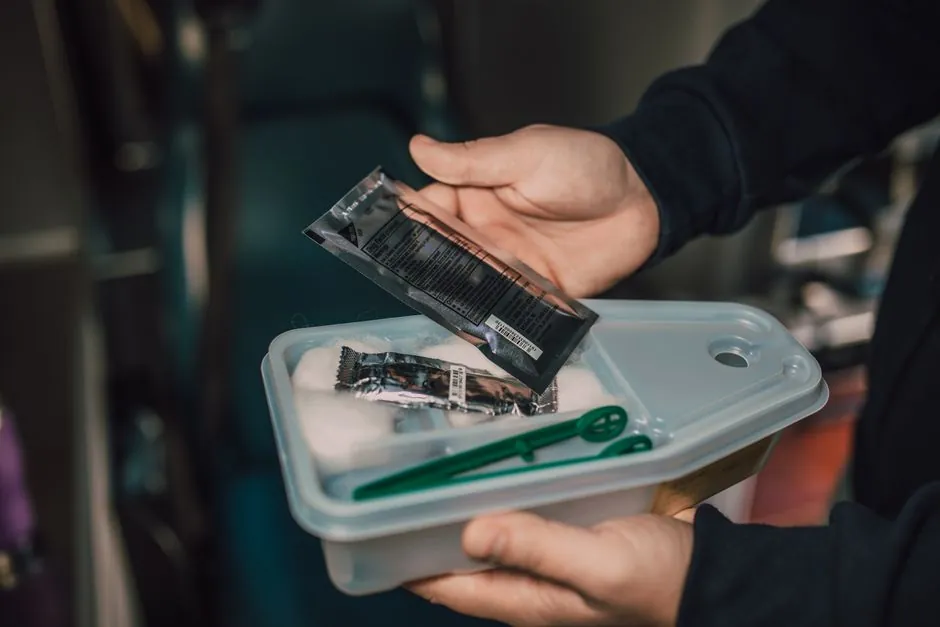
A worker suspended in a harness cannot wait for a ground-based medic, so the kit on their chest has to be small, harness-attachable, and stocked for severe bleeding, suspension trauma and burns rather than for paper-cut office incidents [S3][S4].
Three published standards govern the contents in 2026: BS8599-1:2019 (UK small workplace kit, 2.47 kg Cordura rucksack format at 34 x 27 x 20 cm) [S3], ANSI/ISEA Z308.1-2021 (US Class A / Class B split, with Class B adding a splint and tourniquet) [S5][S9], and CSA Z1220-17 (Canadian construction site kits) [S8]. Picking among them is a jurisdiction question first, a hazard-class question second.
Standards stack: which document governs your kit
BS8599-1:2019 defines three kit sizes (small, medium, large) keyed to headcount and hazard tier, with "small" being the baseline a single at-height operative carries, and a "high hazard" environment pulling in larger dressings and burns cover than a low-hazard office kit [S2][S3]. The heightec UMA1 pack is explicitly declared "fully compliant with BS8599-1:2019 small workplace first aid kit requirements" while adding items not normally found in that baseline, such as a CAT-style tourniquet, hydrogel burns dressings, cling film, and a foil blanket [S3][S4].
ANSI/ISEA Z308.1-2021 is the US consensus standard, and it does not mention height directly, but it splits kits into Class A (low-to-moderate hazard, e.g. offices, retail) and Class B (higher hazard, e.g. construction, manufacturing, warehousing), with Class B including everything in Class A plus larger quantities and two extra items: a splint and a tourniquet [S5][S9]. For tower climbers, steel erectors and rope-access technicians, Class B is the realistic floor.
Canada routes through CSA Z1220-17, which is the national standard construction sites are expected to meet to satisfy provincial occupational health and safety rules [S8]. OSHA's own rule, 29 CFR 1910.151(b), only requires "adequate first aid supplies shall be readily available", so the actual contents list is taken from the Z308.1 family rather than from OSHA itself [S5]. For broader first aid kit guidance, the three standards converge on the same minimum consumables, but diverge sharply on container type and supplemental items.
Decision criteria: hazard, container, harness-attachment, blood-loss
Four criteria separate a compliant kit from a kit that fails an actual fall-arrest rescue. First, hazard classification: low-hazard offices follow BS8599-1 small or ANSI Class A, while construction, tower work, wind energy and oil & gas follow BS8599-1 large, ANSI Class B, or CSA Z1220-17 [S2][S5][S8][S9]. Second, container type: ANSI defines four (Type I through Type IV), from wall-mounted indoor boxes to portable, waterproof, mobile-use cases, and the wrong container ruins sterile contents long before expiry [S5].
Third, harness-portability: a ground-based kit is useless to a suspended casualty. The heightec UMA1 specifies a "cordura nylon rucksack style case, with prominent reflective markings, zip around opening and robust carry handle / loop for harness attachment" at 34 x 27 x 20 cm and 2.47 kg test mass [S3]. The matching heightec UMA2 Critical Injury Pack follows the same harness-clip form factor and is built to the Mast & Tower Safety Group (MATS) First Aid For Working At Height Guidance GN-009 [S7].
Fourth, severe-bleed and burns capability. ANSI Class B requires a tourniquet and a splint; UMA1 adds a CAT-style tourniquet, a "pressure / battlefield dressing" for significant bleeds, hydrogel fluid and hydrogel burns dressings, and a foil blanket for temperature control [S3][S4][S5]. These are the same items a tower crew would otherwise have to bolt onto a generic BS8599-1 small pack, and skipping them is the most common audit finding on at-height sites.
Rescue kit pairing: rope, descent device, edge protection
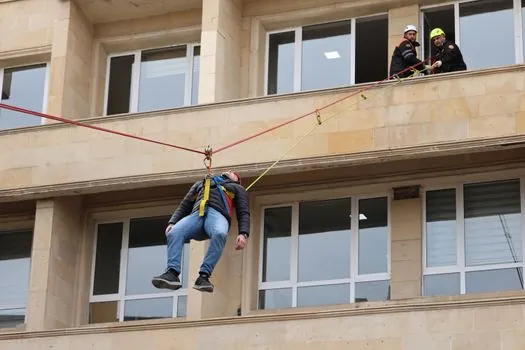
First aid is only half the problem, because a suspended worker who is bleeding but cannot be lowered is still going to die. The SafetyOne Basic Rescue Kit pairs 7/16" (11 mm) rope in 150, 250 or 350 ft lengths with a sewn eye and metal thimble on the anchor side, a dedicated anchor sling with built-in edge protection, a twist-lock steel carabiner, a controlled descent device, a pick-off sling and all the connectors needed to reach a second person [S1]. Kit weights are 21, 24 and 28 lb for the three lengths, and the packed size is 12" x 12" x 24", with all connections rated for a two-person rescue load [S1].
Two operational points matter. The SafetyOne kit ships "pre-rigged and ready for rescue" rather than as a bag of parts, and the rescue tool is sized for one rescuer plus one patient (two-person load) [S1]. The optional 4:1 pick-off / haul tool is recommended for mechanical advantage, sold separately [S1]. For a fuller discussion of aerial work platform rescue planning, the rope length choice is driven by structure height, not by headcount: 150 ft covers most commercial roof and signage work, 250 ft covers telecoms and small turbines, and 350 ft is the floor for lattice mast and wind-tower descents.
Comparison: BS8599-1 small vs ANSI Class B vs CSA Z1220-17 vs the MATS-aligned Critical Injury Pack
On four decision criteria, the published options line up as follows. For typical contents, BS8599-1:2019 small gives a baseline consumable list (dressings, plasters, gloves, foil blanket) [S2][S3], ANSI Z308.1-2021 Class B adds a splint and a tourniquet on top of the Class A list [S5][S9], CSA Z1220-17 is the construction-site compliance baseline in Canada [S8], and the heightec UMA1 / UMA2 packs sit on top of BS8599-1 with the MATS GN-009 extras (tourniquet, pressure dressing, hydrogel, foil blanket) [S3][S7].
For container and mounting, BS8599-1 leaves container choice open [S2], ANSI Z308.1-2021 specifies four container types (Type I-IV) by environment [S5], CSA Z1220-17 is implementation-flexible [S8], and UMA1/UMA2 are fixed to a 34 x 27 x 20 cm Cordura rucksack with harness clip [S3][S7]. For jurisdiction: BS8599-1 covers the UK, ANSI Z308.1 covers the US, CSA Z1220 covers Canada, and MATS GN-009 covers UK telecoms / mast & tower [S3][S5][S7][S8]. For severe-bleed capability, BS8599-1 small does not mandate a tourniquet, ANSI Class B mandates one, CSA Z1220-17 is hazard-driven, and UMA1 includes a CAT-style tourniquet plus a pressure / battlefield dressing [S3][S5][S8].
OSHA 1926.50 and the consumable checklist that is not optional
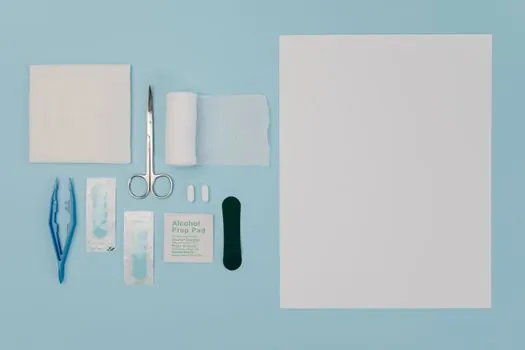
OSHA Appendix A to 29 CFR 1926.50 and ANSI/ISEA Z308.1 together define the consumable floor for US construction sites, and a compliant kit is expected to carry adhesive bandages in multiple sizes, 4" x 4" and 8" x 10" gauze pads, 2 in roller bandages, triangular bandages for slings, sterile wound-cleaning towelettes or antiseptic wipes, scissors and tweezers, and adhesive tape [S6]. The UMA1 contents list mirrors this set and extends it with items that an at-height scenario actually needs: trauma shears for clothing access, disposable tweezers, alcohol-free wipes, saline pods, a clinical waste bag, a casualty prompt card, a pocket resus mask, a resus face shield, low-adherent dressings, finger / small / medium / large dressings, a foam splint for fractures, and conforming bandages [S3][S4].
For US at-height projects, pairing the consumable floor with ANSI Class B is the cleanest audit trail, because the Class B tourniquet and splint items overlap directly with MATS GN-009 expectations and with the heightec UMA1 contents, which keeps a multinational crew within one mental model of the kit [S3][S5][S7].
Limitations and failure modes
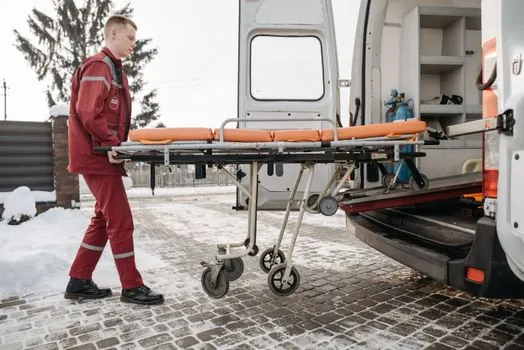
Three failure modes recur in incident reports and they are all design choices, not operator error. First, a non-portable container: a wall-mounted Type I or II box is fine for a fixed site but useless to a worker on a lattice tower, and the wrong container is the most common reason a "compliant" kit fails at the moment of need [S5]. Second, no rescue rope: a first aid kit without a paired descent system only stabilises a casualty who is already on the ground, so any at-height specification should treat the first aid pack and the rescue kit as one procurement line, not two [S1][S7].
Third, training mismatch: the UMA1 is declared "compatible with the training requirements of the GWO BST standard first aid courses", so a kit whose contents assume GWO-trained responders will underperform in the hands of a crew trained only to generic BS8599-1 small-kit level [S3][S4]. Buyer-side, that means the kit specification, the training standard, and the rescue plan should be written by the same person, and changes to one should force a review of the other two. For related aerial work truck and height gauge selection, the same procurement logic applies: pick the standard, then the container, then the consumables, in that order.
Sourcing, training alignment and next signals
The clearest 2026 sourcing pattern in the data is convergence on a small set of named compliance documents: BS8599-1:2019, ANSI/ISEA Z308.1-2021, CSA Z1220-17, OSHA 29 CFR 1910.151(b) with Appendix A to 1926.50, and the Mast & Tower Safety Group GN-009 guidance [S3][S4][S5][S6][S7][S8]. Kit builders are responding with two-tier catalogues, the first tier being a general-purpose BS8599-1 small or ANSI Class B pack, and the second tier being a height-specific pack that bolts on the tourniquet, pressure dressing, hydrogel and foil blanket [S3][S4][S7]. The pricing reference points in the source data are £146.48 + VAT for the UMA1 and £122.85 + VAT for the UMA2 from heightec, and $802.99 excl. tax for the SafetyOne 7/16" rescue kit at the 150-350 ft lengths [S1][S4][S7].
Two trackable signals to watch over the rest of 2026 are a revision activity around ANSI/ISEA Z308.1 (the 2021 edition is the current reference and any 2026 update will shift the Class A / Class B contents list) and any tightening of MATS GN-009 wording around haemostatic agents, which are increasingly common in tower kits but not yet mandated in the published standard snapshot [S5][S7]. Procurement teams writing an at-height first aid specification in September 2026 should anchor on BS8599-1:2019 or ANSI/ISEA Z308.1-2021 Class B as the floor, add the MATS GN-009 extras, and pair the consumable pack with a pre-rigged 11 mm rope rescue kit matched to structure height.
Related analysis: Mold and Die Lubricant Selection: Spec Map for HPDC, Stamping, and Injection Tooling.