A correct belt tensioner line item on a retrofit RFQ carries six mandatory fields: shaft diameter, belt cross-section and width, target tension force in newtons, tensioner type (fixed, spring-automatic, or hydraulic), pulley material, and minimum IP rating, with the values locked to the drive data rather than left to vendor assumption [S2][S9].
Packaging lines, including form-fill-seal, cartoning, and vacuum packaging machine setups, commonly run 8–25 mm wide flat or V-belts at line speeds of 0.5–3.0 m/s, where a mis-specified tensioner is the first failure mode in drive retrofit audits and a leading cause of unplanned stoppages [S9].
RFQ Line Item: Mandatory Parameters and Why Each One Matters
A tensioner specified only by "suit for drive" will be returned as a generic part number, forcing a 2- to 4-week requote cycle; the line must instead carry shaft diameter (e.g. 8, 10, 12, 15, 17, 20 mm), belt width (mm), belt type (flat, V, ribbed/Poly-V, timing), maximum linear belt speed (m/s), and the calculated static tension force in newtons [S2][S9].
Spring-automatic tensioners from the same Taiwan-based product line (TF01001, TF02001, TF04001) are cross-referenced to multiple automotive OEM part numbers (e.g. 13505-62030, 13070-BN700, 14510-PTO-003), demonstrating that the industry standardizes tensioner SKUs against OE cross-reference lists rather than against dimensional drawings, which is why RFQ text must include the current OE or house part number when replacing an existing unit [S1][S3][S5].
The tensioner type field is the single most common spec error: a fixed (dead-weight) tensioner cannot be substituted for a spring-automatic unit, because a fixed unit only sets a one-time length compensation while a spring unit absorbs the dynamic run-in stretch of a polyurethane timing belt and the thermal expansion of a long belt conveyor on a packaging line [S2][S9].
Tensioner Type Comparison: Fixed, Spring-Automatic, Hydraulic
Three tensioner classes dominate retrofit quotes for packaging drives, and they differ along four criteria that an RFQ must force the vendor to declare: tension holding force (N), damping behaviour, maintenance interval, and cost premium over a fixed unit [S2].
Fixed (dead-weight or screw-adjusted) tensioners are the lowest cost, hold a constant deflection, and are acceptable only on short, low-speed, non-critical drives such as an idler on a small cartoning machine where the belt is rarely replaced [S9].
Spring-automatic tensioners (the class behind the TF-series parts) are the workhorse for packaging retrofits, providing constant force over a defined deflection stroke, compensating for belt wear and thermal elongation, and fitting the typical 0.5–3.0 m/s packaging-line speed range without inducing belt resonance [S1][S2][S3].
Hydraulic (oil-damped) tensioners add controlled damping and are specified where the drive is exposed to high cyclic load or large inertia, for example the main drive of a high-output packaging machine running 24/7; the cost premium is typically several times a spring unit, so leaving "tensioner type" blank on an RFQ almost always returns a spring unit, which is then rejected on noise or wear grounds during commissioning [S2].
Mechanical Interface and Pulley Material Gates
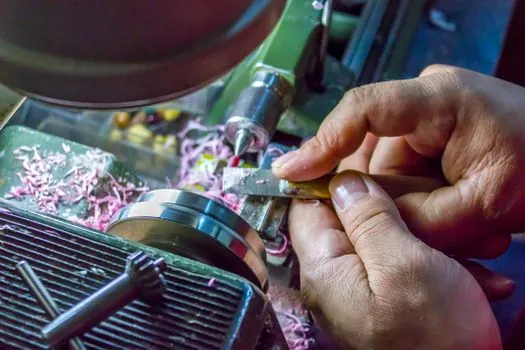
The mechanical interface must be specified by shaft diameter, keyway or set-screw style, overall arm length (mm), and pulley pitch diameter (mm), because a tensioner arm that is 10 mm too short for the available mounting space is the second most common retrofit failure on a form-fill-seal rebuild [S2][S9].
Pulley material should be declared as steel (for timing belts and high-load drives), aluminium (for weight-sensitive or low-inertia drives), or polymer/PA66 (for noise-sensitive applications such as food packaging material handling), and the surface finish (smooth, knurled, or toothed) must match the belt profile to avoid micro-slip [S1][S3].
For a Poly-V or ribbed belt on a multi-rib drive, the number of ribs (e.g. PJ 6, PK 8) must be called out, because an automotive-style smooth idler pulley (90 mm O.D. as listed in one cooling-system aftermarket part) is mechanically wrong for a ribbed-belt conveyor drive and will wear the ribs in under one shift [S7].
Environmental, Hygiene, and Standards Gates
For any packaging line that runs washdown or food-contact zones, the RFQ must call out a minimum IP rating (IP54 is the practical floor for dry packaging halls, IP65 for washdown zones, IP67 for direct-spray cleaning) and a housing material (zinc-plated steel, stainless 304, or stainless 316) [S2][S9].
Stainless 316L is the conservative default for direct food-contact zones on a vacuum packaging machine, while zinc-plated steel is acceptable for the dry, non-contact side of the same line, and quoting both zones on one line item without the split is a common cause of over-spec on the dry side and under-spec on the wet side [S2].
Operating temperature range must be declared (typical packaging hall is 5–40 °C; a heat-seal station can radiate 60 °C locally at the bearing seat) and the spring material grade noted, because standard spring steel loses tension force above roughly 120 °C, which is rarely an issue on packaging but becomes one when the tensioner is mounted near a continuous-motion sealer [S2][S9].
Acceptance Criteria and Failure-Mode List for the RFQ
Acceptance criteria should be numeric and testable: tension force held at mid-stroke within ±10 % of the RFQ value, arm deflection stroke of at least 8–15 mm to absorb belt elongation, a minimum bearing L10 life of 20,000 hours at the declared rpm, and a maximum noise level of around 60 dB(A) at 1 m for a spring unit on a packaging line [S2][S9].
Common failure modes the RFQ should pre-empt: spring fatigue (force drops below the lower tolerance within 12 months), bearing seizure under washdown (skip the IP rating, and you will get a standard sealed unit that fails in 6 months), pulley wear (steel on polyurethane timing belt, not aluminium, which wears fast and contaminates the drive), and corrosion (zinc-plated steel in a damp packaging hall will rust within one shift of a cold-room door opening) [S1][S3][S7].
Reference standards to cite on the RFQ line (without inventing a clause number): ISO 4183 for belt drives, ISO 5293 for synchronous belt drives, and ISO 10823 for tensioner selection guidance; the RFQ should require the vendor to state which of these their declared force value is based on, because a "rated force" with no basis is the single most requoted number in a tensioner line [S2].
Cross-Reference and Lead-Time Notes for the Retrofitting Buyer
Aftermarket tensioner cross-references are dense, with the same TF-series part covering 6–8 OE numbers (for example, TF01001 covers 13505-20010, 13505-20020, 13505-62030, 13505-62031, 13505-62050, 13505-62060, JBT268B, T41075, VKM71004 for Toyota/Lexus 94–04 V6 applications), so passing the existing OE number alongside the dimensional data gives the vendor a second validation path and typically shortens lead time by 1–2 weeks [S3].
For a retrofit, the buyer should also list the existing belt tensioner SKU, the belt manufacturer and profile (e.g. Gates Poly-V PJ1210, ContiTech timing belt HTD 8M), the drive motor power in kW, and the daily run hours, because these four numbers let the vendor pick the correct bearing series and spring stiffness without a clarification round [S1][S2][S3][S5].
Two trackable signals to monitor after the RFQ is issued: vendor response time on a fully-dimensioned line versus a "suit for drive" line (a well-specified line should return a firm quote within 5 working days, versus 2–3 weeks for a clarification loop), and the number of substitute SKUs offered (more than 3 substitutes on a single line usually means the original spec was ambiguous) [S2][S3]. For adjacent retrofit context, the same OE-first specification discipline covered here for tensioners also governs chain-belt selection on the same packaging line, where cross-reference plus pitch and width follows the same logic.
Background reading: AMR selection for chemical shipping: classified-area spec map.