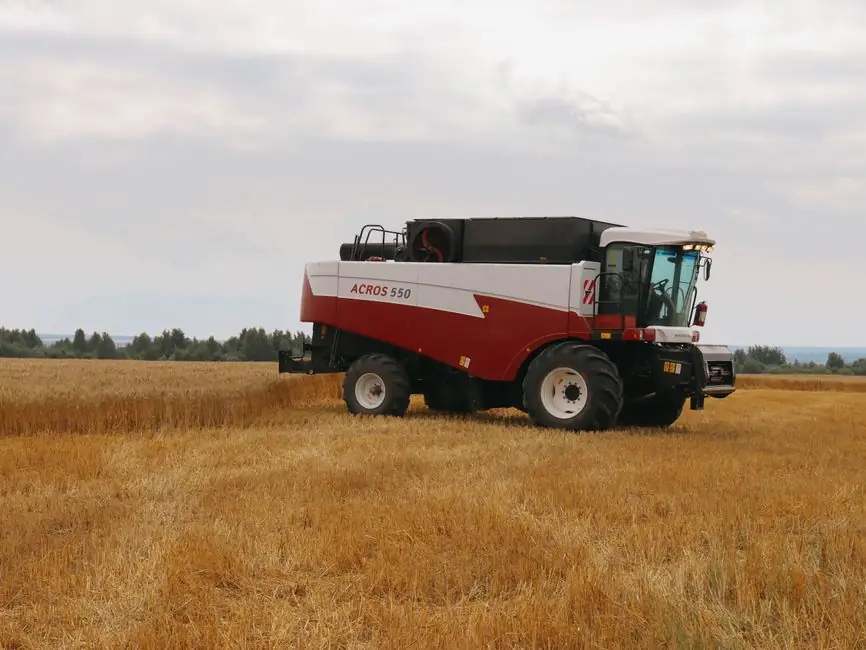
Agricultural machinery operates under dust, mud, shock loading, and misalignment, conditions that drive spherical plain bearing selection toward heavy-duty radial or angular-contact steel/steel types with effective seals, while maintenance-free PTFE-lined variants are reserved for grease-inaccessible pivots [S2][S6].
Spherical plain bearings carry load through sliding contact between a convex inner ring and a matching concave outer ring, accommodating misalignment and oscillation where rolling bearings would fail prematurely; in farm equipment, this geometry is used at implement lift links, three-point hitch pivots, steering cylinders, and trailed-machine articulation joints [S1][S2].
Where Spherical Plain Bearings Sit in Agricultural Machinery
Spherical plain bearings are specified at articulating joints on agricultural linkages, hydraulic cylinder eyes, and material-handling points where oscillating or tilting movement dominates, rather than at high-speed rotating shafts where spherical roller bearings or ball bearings are the correct choice [S1][S2].
Typical agricultural positions include three-point hitch lift arms, drawbar pivots, trailed implement steering rams, loader boom pins, and PTO support frames, all of which combine slow oscillation, heavy static load, and exposure to slurry, crop residue, and field dust [S1][S6]. For broader driveline and rotating-shaft positions (gearboxes, harvester threshing drums, auger drives), spherical roller bearings sized per DIN 635-2 with sealed or shielded variants are usually selected instead, since those positions see continuous rotation and combined radial/axial load [S3][S5].
Radial, Angular-Contact, and Thrust Types: Pick by Load Direction First
Radial spherical plain bearings carry primarily radial load with a limited axial component, angular-contact types carry combined loads with a defined axial direction and are often mounted in pairs, and thrust types carry mainly axial load with only a small radial share, so the first selection step is matching the basic type to the actual load vector on the pin [S2].
A buyer should not assume that equal bore diameter across families implies equal capacity, because ring widths, contact geometry, and permissible loads differ between the GE radial, angular-contact, and thrust series for the same bore [S2]. Extended-inner-ring radial versions add spacing for adjacent components such as seal carriers or mount brackets on implement linkages, while rod-end variants integrate a threaded shank for hydraulic-cylinder eyes and steering arms [S1][S2]. Misalignment allowance is set by the model’s stated limit, and surrounding hardware must not clamp the bearing past that limit, otherwise the sliding surface is braked and wear accelerates [S1][S2].
Steel/Steel, PTFE-Lined, and Sealed: How Sliding Surface Changes Maintenance
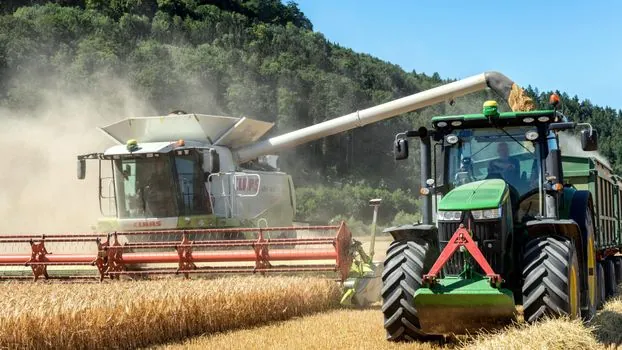
Steel/steel spherical plain bearings require regular greasing, with the grease film separating the sliding surfaces, reducing wear, and helping to block corrosion, so lubrication holes and grooves must be aligned with the supply path on the machine [S2].
Maintenance-free designs use PTFE-based fabric, composite, or fibre-reinforced polymer sliding layers, and they are specified where relubrication is impractical, such as sealed loader-pivot pins or linkage joints buried inside the machine frame; however, load, temperature, moisture, edge stress, and oscillation angle still govern their service life and the published limits must be respected [S2]. Sealed variants retain lubricant and exclude contaminants, but the seal elastomer and lip geometry must suit the movement and temperature, typically -30°C to +120°C for standard nitrile seals on agricultural units such as the Schaeffler 230..-E1-K series, whose operating envelope is published at T_min -30°C / T_max 200°C for the bearing itself with grease constraints governing the seal choice [S5].
Spec Comparison: Which Option Matches Which Agricultural Position
For agricultural buyers, the practical decision is between three families, and the choice is driven by four criteria: load direction, relubrication access, contamination level, and movement type (oscillation vs. continuous rotation) [S1][S2][S6].
The comparison below lines the families against those criteria, so the right type can be picked before the model code is decoded. Steel/steel radial spherical plain bearings (e.g. GE series) carry high static and alternating radial load, accept relubrication, tolerate mud and dust when sealed, and suit oscillating implement pivots [S2]. Steel/steel angular-contact spherical plain bearings carry combined radial+axial load with a defined direction, are greased, need paired mounting where force reverses, and suit hydraulic cylinder eyes and steering linkages [S2]. PTFE-lined maintenance-free radial spherical plain bearings carry moderate radial load, run without grease, suit inaccessible pivots, and tolerate oscillation within the manufacturer’s published angle and load limits [S1][S2]. Sealed heavy-duty spherical roller bearings, dimensioned to DIN 635-2 like the 23032-E1-XL-K-TVPB (160 mm bore, 240 mm OD, 720 kN dynamic / 1,010 kN static radial, 3,050 rpm limiting speed), carry the highest combined radial+axial load, run continuously, tolerate ±1.5° to ±2.5° misalignment depending on series, and suit harvester drivelines, gearbox countershafts, and large auger drives where rotation is continuous rather than oscillating [S3][S4][S5]. The first three are true plain bearings; the fourth is a rolling bearing and only substitutes for a spherical plain bearing if the application has become a continuous-rotation position with combined load [S3][S4].
Agricultural Selection Criteria: Mud, Shock, Misalignment, and Slow Oscillation
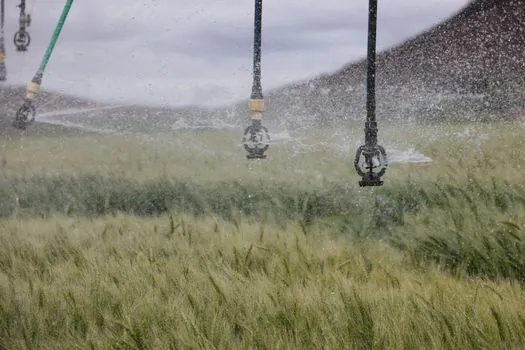
For farm conditions, bearings must be specified for mud, dust, heavy shock loads, and frequent misalignment rather than for high speed or precision, and the published limits for the chosen bearing must be confirmed against the worst-case field load rather than the average duty cycle [S6].
Five spec checks follow from that brief. First, match the basic type to load direction: radial for hitch and drawbar pins, angular-contact for cylinder eyes and steering, thrust for vertical-load pivots [S2]. Second, decide on lubrication strategy: steel/steel with a greasing path where the pin is reachable every service interval, PTFE-lined where the joint is sealed for life [S1][S2]. Third, verify the seal: a suffix such as -2RS or equivalent must be on the purchase order, and the elastomer must suit any chemical or fertiliser exposure [S2]. Fourth, confirm the operating temperature range, normally -30°C to +120°C for standard NBR seals on agricultural units, with high-temperature grease or fluoroelastomer seals required for oven-dryer, combine-harvester engine-bay, or biogas-adjacent positions [S5]. Fifth, verify the full model code, because bore and OD alone do not describe the bearing, and a buyer who omits the suffix risks receiving an unsealed or wrong-liner variant [S2]. For a related application on packaging lines, the same code-discipline logic applies and is examined in Spherical Plain Bearing Selection for Packaging Lines.
Misalignment, Speed, and Where Spherical Plain Bearings Are the Wrong Choice
Spherical plain bearings typically accommodate oscillation rather than continuous high-speed rotation, and the permissible speed is lower than a same-size rolling bearing, so a buyer who specifies a spherical plain bearing on a continuously rotating shaft invites premature wear and grease failure [S1][S2].
Self-aligning ball bearings tolerate up to ±3° misalignment and run at higher speed, but they have only point contact and so carry roughly one-quarter to one-fifth of the radial load of a same-bore spherical roller bearing (a 1212 SABB at 60 mm bore rates about 25.5 kN dynamic, against 120 kN for a 22212E SRB), which makes them unsuitable for heavy shock-loaded agricultural positions even though their misalignment window is wider [S4]. Linear bearings are not a substitute here because the motion is angular oscillation, not linear travel. Spherical plain bearings are also the wrong choice where the application demands very high speed, where continuous rotation rather than oscillation is present, or where the joint is so heavily contaminated that even a sealed unit cannot survive, in which case an enclosed agricultural-greaseable joint with an external boot should be considered instead [S1][S2][S4][S6].
Installation, Removal, and Sourcing Checks for Farm-Fleet Buyers

Spherical plain bearings are often mounted on adapter or withdrawal sleeves (for example H3032 / AH3032 for the 23032 size), so the shaft and housing must be machined to the published shoulder and chamfer dimensions, and a hydraulic or mechanical mounting method should be used to avoid brinelling the raceway during press-on [S5].
Buyers should confirm the published load ratings, the permissible oscillation angle, the temperature envelope, the seal suffix, and the lubrication schedule before release of the purchase order, since the same bore can exist in radial, angular-contact, thrust, and rod-end families with different load and width envelopes [S2][S5]. Stocks should also verify that the manufacturer’s agricultural-machinery guidance is referenced rather than general industrial data, because agricultural ratings already assume shock, dust, and misalignment loading [S6]. A practical next step for a farm-equipment OEM is to pull the bore-specific data sheet (C_r, C_0r, n_G, n_ϑr, permissible misalignment) for the radial spherical plain bearing on each implement-lift and steering pin, then cross-check that the field shock load stays below 1.5× the basic dynamic load rating, which is a common screening band for shock-loaded farm joints.