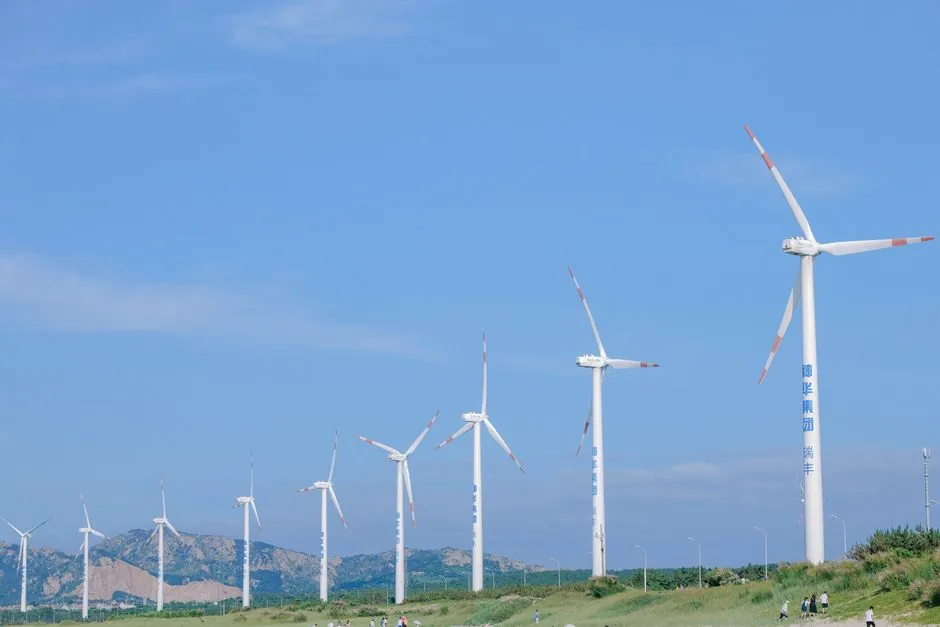
Spherical plain bearings are sliding-contact bearings specified for the oscillating joints of a wind turbine: blade pitch hinges, yaw drives, and nacelle alignment linkages, where motion is slow, angular travel is large, and misalignment is structural [S1].
Wind turbine drivetrains combine five distinct bearing families, spherical roller, cylindrical roller, tapered roller, slewing, and electrically insulated, and the plain spherical type only fits where oscillation, shock, and misalignment dominate over continuous rotation [S3][S4]. Pitch and yaw systems operate under heavy combined loads and slow oscillating motion, and they are the documented use case for self-aligning plain bearings rather than rolling-element types [S2].
Why Spherical Plain, Not Spherical Roller, in Pitch and Yaw Joints
Spherical plain bearings accommodate angular motion through a spherically convex inner ring sliding against a concave outer ring, with no rolling elements, which makes them tolerant of shock load and large misalignment that would brinell a roller raceway [S1]. Spherical roller bearings, by contrast, use two rows of barrel rollers on a common sphered raceway and are sized for continuous high radial load at moderate speed, not for the slow ±90° oscillation of a pitch bearing [S1][S3]. In a 3–5 MW onshore turbine, the pitch system typically oscillates each blade through a limited arc per wind-speed change, and the load path is dominated by combined axial thrust (from aerodynamic lift) and radial reaction (from blade weight), exactly the load mix where a sliding spherical plain bearing with a PTFE or metal-polymer liner is specified [S2][S4]. Spherical roller bearings remain the workhorse of the main shaft and gearbox high-speed stages, where their load ratings per ISO 15 dimensional series are unmatched for a 100–200 mm bore [S3].
Selection Criteria: Load, Motion, Environment, Lubrication
Four criteria drive spherical plain bearing selection for wind power, and each maps to a verifiable parameter rather than a generic checklist: dynamic load rating C_d, angular oscillation range, environmental exposure class, and lubrication regime [S1][S4]. The dynamic load rating sets the maximum permitted radial load for a given oscillation cycle count, and for a typical pitch bearing on a 3 MW class turbine, ratings in the 500–1,500 kN range are common; oversizing brings stiffness penalties that overload the blade bolt circle [S4]. Angular oscillation range governs the inner-ring geometry: a GE-style radial spherical plain bearing typically allows ±10°–±18° of misalignment, while angular-contact variants designed for hinge applications allow ±30° or more to absorb blade deflection [S1]. Environmental exposure drives the corrosion call: offshore turbines face salt spray and humidity cycling, which mandates stainless steel races, PTFE fabric liners, or zinc-flake coated housings; onshore units in C3/C4 ISO 12944 corrosivity can run standard 42CrMo4 rings with lithium grease [S4]. Lubrication regime is the single largest service-life lever: metal-on-metal plain bearings require re-lubrication intervals tied to grease channel geometry, while composite PTFE-lined units are specified as maintenance-free for the turbine's 20-year design life but carry a lower PV (pressure-velocity) limit [S1].
Material and Liner Comparison for Wind Service

Three material systems compete in wind-power spherical plain bearings, and the choice is set by load, oscillation frequency, and corrosion exposure rather than by habit: metal-on-metal (hardened steel on steel, with bronze or copper-alloy overlay), metal-polymer (steel race with PTFE or PTFE-fabric liner), and self-lubricating fiber-composite (woven fabric on a fiberglass or carbon back) [S1]. Metal-on-metal handles the highest specific load, typically 100–300 MPa allowable contact stress, and survives shock and edge loading, which is why it is preferred for yaw bearing inner-race pivots on multi-MW turbines; it requires grease and a relube schedule [S1]. Metal-polymer with PTFE fabric drops allowable contact stress to roughly 50–100 MPa but eliminates relube and runs clean, which is why OEMs favor it for blade pitch bearings where grease contamination of the blade root is a documented risk [S1][S4]. A comparison across four decision criteria lines up the three options directly: on load capacity, metal-on-metal is highest; on maintenance burden, PTFE-lined is lowest; on corrosion resistance, PTFE-lined stainless variants are highest; on cost per kN of rating, metal-on-metal is lowest. The trade-off is not subtle: a maintenance-free PTFE bearing typically costs 2–4× a comparably rated greased metal-on-metal unit, but it removes the need for a central grease distribution system on the hub, which has its own installed cost and failure modes [S1][S2].
Installation, Misalignment, and Sealing
Self-alignment is the defining mechanical property of a spherical plain bearing, but it does not excuse poor installation: misalignment beyond the catalog limit produces edge loading on the spherical raceway, raises contact stress, and cuts fatigue life exponentially rather than linearly [S1]. For wind service, where tower shadow and wind gusts impose cyclic side loads on the hub, the practical alignment budget is usually held within ±0.5° of bearing centerline during hub assembly, verified with a dial indicator across the journal before final bolt torque [S4]. Sealing is the second installation decision: a 2RS or 2CS seal on each face keeps salt, dust, and water out of the sliding interface, and for offshore turbines a triple-lip seal with stainless spring is the common upgrade over the onshore double-lip nitrile unit [S1][S4]. A directly related engineering decision sits upstream: the selection of a spherical plain bearing for the pitch hinge must be made in the same review as the power supply sizing for the pitch motor, because the motor's stall torque defines the maximum bearing moment load during a feather-event brake test.
Where Spherical Plain Bearings Are NOT the Right Choice

Spherical plain bearings are the wrong type for the main shaft, the gearbox high-speed stage, and the generator, and a common procurement error is to substitute them where a spherical roller bearing is required [S3]. The main shaft runs at 10–20 rpm continuous with very high radial load, which demands the rolling-element geometry of a spherical roller bearing on an ISO 15 dimension series; substituting a plain bearing here fails by overheating within hours, not months [S3][S4]. Similarly, the gearbox intermediate and high-speed shafts (1,500–1,800 rpm) require cylindrical or tapered roller bearings for combined load and speed; plain bearings at those speeds destroy themselves through frictional heat even with forced oil flow [S3]. For yaw and pitch systems specifically, a slewing bearing (a large-diameter four-point contact or crossed-roller type) is sometimes the correct alternative to a spherical plain bearing when the loads are purely radial and the oscillation is small, but it loses to a plain bearing as soon as large angular misalignment or shock loading enters the duty cycle [S2][S3]. The cross-industry view matters here: the same part used in a quarry haul truck or a cement kiln has to survive contamination and water, while a wind pitch bearing sees a cleaner but more corrosive and more cyclic environment.
Standards, Sourcing, and Verification
Wind-power spherical plain bearings are typically specified against ISO 12240-1 (radial spherical plain bearings, dimensions) for series geometry and against OEM-specific fatigue test protocols derived from IEC 61400-1 design load cases, though the bearing standard itself is generic across industries [S1]. A typical procurement data sheet should carry: bore and width to ISO 12240-1 series, dynamic load rating C_d in kN, angular misalignment limit in degrees, liner material, seal type, surface treatment (Zn-flake, stainless, or phosphate), and grease specification if relube is required [S1][S4]. Verification on receipt includes dimensional inspection against the ISO 12240-1 tolerances, a hardness check on the raceway (typically 58–62 HRC for through-hardened 100Cr6 or 42CrMo4 case-hardened to 60 HRC minimum), and a run-fit check of the spherical clearance against the catalog value [S1]. For related decisions in the same turbine, Pillow block bearing selection for automotive production lines covers housed-unit choices for non-rotating pivots, while PEEK selection for energy equipment covers the polymer-liner material that increasingly replaces PTFE in high-temperature pitch-bearing variants.
Trackable signals for the next 6–12 months: ISO 12240-1 fatigue-life updates for oscillating service factors, OEM disclosures of PTFE-free liner systems (PEEK and PI-based) qualifying for 20-year pitch-bearing service, and reported field data on offshore 15 MW class turbine pitch-bearing relube interval extension. A close related read is Spherical Plain Bearing Selection for Food Processing Lines, which covers the same bearing family under washdown rather than salt-spray conditions, and is useful for separating the corrosion call from the hygiene call in a similar spec sheet.
Spec-level background on the components involved: power cable.