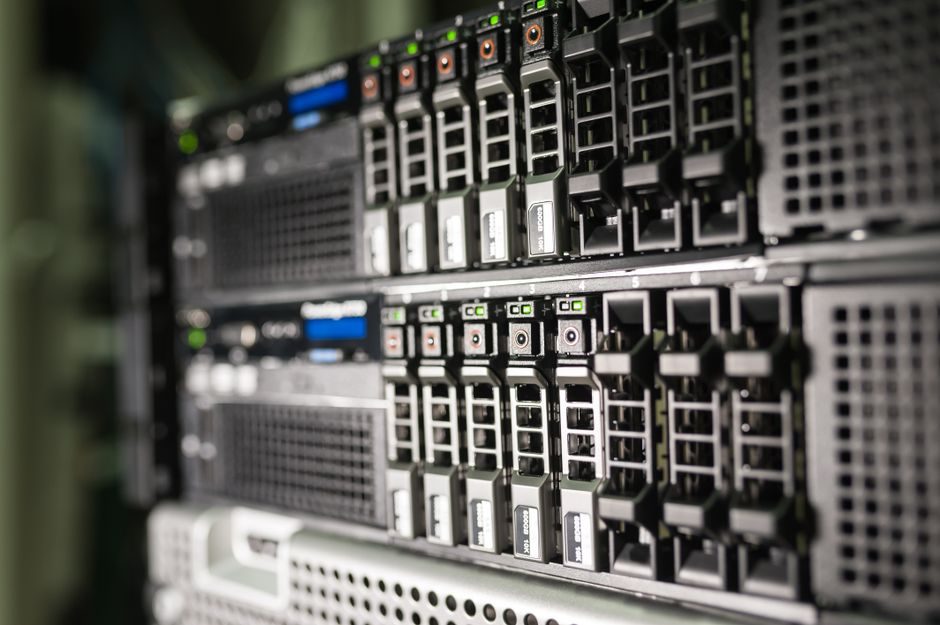
Self-lubricating radial spherical plain bearings in the GE..FW-2RS style — 100Cr6 bearing steel race with a PTFE liner bonded to the inner ring and a hard-chrome-plated 100Cr6 ball — are the default pick for data center swinging panels, tilting server-rack frames, CRAC-unit louver pivots and overhead cable-tray articulation points, where the bearing must run dry for 5-10 years without grease [S1].
For data center ambient of 20-30°C with controlled humidity, PTFE-lined steel/steel pairs are typically rated for continuous operation up to roughly 200°C short-term, with the PTFE liner capping the practical ceiling well below the steel's own thermal limit [S1][S2]. Where pivots sit directly in hot aisles above 80°C, designers usually step up to metal-on-metal (steel/bronze or steel/steel with MoS₂) or to filament-wound composite races.
Bearing Architecture and Tribological Pairings for Server-Hall Duty
A radial spherical plain bearing is a two-piece pivot: an outer race with a concave spherical socket, an inner race with a matching convex ball, and a sliding contact arc that accepts combined radial load and angular misalignment [S1]. In the FLURO GE..FW family the inner ring carries a PTFE fabric liner bonded to the bore, the ball is 100Cr6 hardened, ground, polished and hard-chrome plated, and from size 20 upward the bearing is delivered only as a sealed -2RS (two-side contact seal) execution to keep dust out of the sliding interface [S1].
For data center applications the practical tribology menu narrows to three pairings: (1) steel/PTFE for dry, low-friction, maintenance-free pivots under moderate radial load; (2) steel/bronze or steel/steel for higher radial capacity and shock load where a re-lube interval is acceptable; (3) polymer or filament-wound composite (often a glass-fibre-reinforced fabric liner) for electrical-insulation-sensitive or corrosive-edge environments [S2]. Maintenance-free PTFE-lined units eliminate grease migration onto white-room and adjacent IT flooring, which is why facility engineers standardise on them for overhead and rack-mounted pivots [S1].
Load Capacity, Pivot Angle and Size Mapping
Static load capacity for a PTFE-lined spherical plain bearing is governed by the projected bearing area and the PTFE liner's allowable contact pressure, typically 40-60 MPa for short-term static loading at 23°C, dropping for sustained dynamic service; CSB's plastic plain-bearing catalogue (CSB-EPB finder V2.1) publishes the per-design max static load, max dynamic load and long-term temperature ceiling for each part number, which is the cleanest way to confirm a candidate [S2]. GE..FW size 15 is the smallest with an optional seal; size 20 and above are sealed-only on both sides, so any data center spec drawing that calls out "sealed" is implicitly pointing at the size-20+ catalogue range [S1].
Pivot angle is the second hard constraint: the FLURO G-series, with its wider ball geometry, delivers a higher pivoting angle than legacy narrow-ball radial designs, which matters for tilting CRAC louver frames and swing-out rack panels that routinely ask for 15-30° of angular travel [S1]. A 100Cr6 race on a PTFE liner is not a high-radial-capacity design compared with a roller bearing of the same envelope — for any shaft-driven, rotating-radial load (fans, blowers, generator rotors) a cylindrical or tapered roller bearing is the correct architecture, not a spherical plain bearing; the spherical plain bearing belongs only on oscillating or slow-pivoting joints [S1].
Why a Spherical Plain Bearing Fits Data Center Pivots (and What It Cannot Do)
Data center mechanical hardware is dominated by slow, intermittent, high-misalignment pivots: rack-mount swing arms, bayed-row blanking-panel hinges, CRAC-unit inlet louvres, overhead bus-duct support trunnions, and the yaw pivots on aisle-containment doors — all are applications where combined radial load plus 5-30° misalignment must be absorbed without scheduled lubrication, and a sealed PTFE-lined spherical plain bearing is purpose-built for exactly that load case [S1]. The hard-chrome-plated 100Cr6 ball gives corrosion resistance in the lightly humid data hall envelope, while the PTFE liner cuts breakaway torque to a fraction of a steel/steel pair and runs silent — both of which are auditable advantages on the operations side.
It is the wrong part for continuous high-speed rotation, for pure thrust loading (spec a thrust spherical plain bearing or an angular-contact ball bearing instead), and for any joint where radial load exceeds roughly 60 MPa projected on the PTFE liner at 23°C [S2].
Material and Liner Trade-offs Against Three Decision Criteria
The real spec decision in a data center is not "which brand" but "which tribological pair". On a steel/PTFE vs steel/bronze vs polymer-composite comparison, the axes that matter are maintenance interval, peak temperature, and corrosion/insulation behaviour. Steel/PTFE is the maintenance-free baseline, fits the 20-30°C data hall, but caps out at moderate radial pressure and cannot tolerate sustained temperatures in the PTFE degradation zone; steel/bronze takes higher radial load and higher temperature, but requires periodic grease and can weep lubricant onto adjacent hardware; polymer-composite (e.g. glass-fibre-reinforced fabric or filament-wound races) is electrically insulating, corrosion-proof and light, but has lower load capacity per unit envelope and is sensitive to UV unless jacketed. [S1]
For most data center pivot points — overhead, indoor, ambient-controlled — the steel/PTFE -2RS sealed execution wins on all three: zero maintenance, sufficient radial capacity for panel and louver duty, and clean operation. For plenums, generator-skid mounts and high-cycle swing arms, a steel/steel or steel/bronze re-lubricated design with a documented grease interval is the more honest choice. For edge-cabinet outdoor enclosures or coastal sites, a stainless-on-PTFE or filament-wound composite is the correct escalation, even at higher unit cost [S1][S2].
Sourcing Channels, Lead-Time Reality and What Buyers See in 2026

Supply is split between branded European engineering catalogues (FLURO-Gelenklager GmbH being the reference for the GE..FW / G-series pattern) and high-volume Chinese OEM/ODM capacity; Shandong Fuma Bearing (BLS), Unifit Industrial Supply and TF Bearing all publish spherical plain bearings as part of multi-line bearing catalogues, with monthly production in the 10⁶-piece band for the largest Chinese suppliers and direct RFQ pipelines on B2B platforms [S3][S4][S5]. The CSB-EPB finder V2.1 is the practical engineer-side tool for plastic-liner plain-bearing selection, with max static load at 23°C, max dynamic load at 23°C, and max long-term operating temperature as the three published axes per part number [S2].
For 2026 sourcing, expect branded European GE..FW-2RS sealed sizes (15, 20, 25, 30) to carry longer lead-times — typically 8-14 weeks for non-stock sizes — while Chinese-made equivalents on Alibaba-style RFQ platforms shorten that to 3-6 weeks for standard metric sizes, with negotiable MOQ and monthly production capacity in the 1,000,000-piece band [S3][S4][S5]. Industrial pump supply chain coverage in 2026 highlights that bearing sourcing follows the same OEM-tier logic as pumps: European engineering brands for spec-driven bids, Chinese OEM/ODM for volume and fast iteration. For adjacent pivot hardware, tapered roller bearing sizing is a useful cross-read on radial-load architecture even though tapered roller bearings are not the right pivot part.
Failure Modes and Verification Steps Before Sign-Off
For -2RS sealed executions, confirm both faces are sealed, since the FLURO G-series only guarantees a seal from size 20 upward; below that the spec must explicitly call for the -2RS option, or the bearing will run open and ingest hall dust [S1].
A further check is galvanic compatibility at the mounting interface: a 100Cr6 chrome-plated ball on a powder-coated steel bracket is benign; the same ball on an aluminium bracket in a humid aisle can pit. For any insulating requirement — overhead bus-duct trunnions, isolated grounding paths — step the liner from PTFE to a glass-fibre-reinforced fabric and re-verify load capacity, because composite liners carry less radial pressure per unit area at 23°C than virgin PTFE [S1][S2]. A linear-bearing-class catalogue is the right cross-reference for any adjacent rail slide; the linear bearing family handles translation, not pivots, and should not be substituted in error.
Standards, Documentation and Audit Trail

Spherical plain bearings are covered by ISO 12240-1 (radial spherical plain bearings, dimensions), with the sliding-contact pairings typically qualified per ASTM / OEM internal test rigs on wear rate, friction coefficient and PV limit; the PTFE-liner static load ceiling at 23°C is part of the published catalogue data, not a derived test value, so it is the cleanest entry in the spec sheet [S2]. For a data center spec, the audit trail should record: (1) catalogue reference and part number, (2) max static and dynamic load at 23°C, (3) long-term temperature ceiling, (4) seal execution (-2RS confirmation for size 20+), (5) ball material and liner material, and (6) the re-lube interval (or "maintenance-free" declaration) — those six lines are sufficient to verify the part for facility-engineering sign-off [S1][S2].