
Stainless-steel spring washers can support food-processing assemblies exposed to moisture, acids, vibration, and repeated cleaning, but the correct type must be matched to load, space, and cleanability requirements [S2][S4].
Food-processing equipment uses spring washers to maintain fastener preload in mixers, ovens, saws, grinders, conveyors, and other machinery exposed to vibration, thermal movement, and corrosive washdown conditions [S2][S5].
Spring Washer Function in Food Processing Equipment
A spring washer stores mechanical energy and applies a compensating force to a bolted joint, helping counter loosening caused by vibration, thermal expansion, and changing loads [S2][S4]. In bakery mixers, this function can keep structural fasteners from separating during high-speed operation; in meat-processing saws and grinders, it can help maintain the security of blade-related components [S2].
The function must be defined before the geometry is chosen. Spring washers can maintain preload, distribute load, take up stack gaps, or resist fastener back-off through friction and mechanical engagement [S4]. A food-equipment joint may need more than one function, for example, vibration damping plus gap compensation, so selecting a washer by shape alone is inadequate.
Spring washers are not a substitute for correctly sized structural bolts, a defined tightening procedure, or joint verification. Their force varies with washer size, shape, material, and hardness, and permanent deformation can occur if the operating load exceeds the washer’s yield limit [S3].
Material Selection for Washdown and Corrosive Service
Stainless steel is the normal material preference for food-processing spring washers because it combines corrosion resistance with durability in environments exposed to moisture, acids, and cleaning chemicals [S2]. Material selection still requires verification against the actual wash chemistry, because stainless steel grades differ in corrosion behavior, passivation state, spring performance, and temperature capability [S4].
Spring washers can be made from spring steel, stainless steel, beryllium copper, and bronze, with zinc-clear, zinc-yellow, black-oxide, cadmium-yellow, and nickel finishes among the options described by industrial suppliers [S3]. Carbon steel is economical and strong but normally needs a protective coating in corrosive service, while stainless grades such as 301, 302, and 17-7PH are identified for corrosion resistance and useful spring properties [S4].
For a food line, compare materials against four criteria: corrosion resistance in the actual cleaning regime, mechanical performance at the joint temperature, cleanability of the finished surface, and whether the alloy or coating can create a product-contact concern. The washer grade, heat treatment, surface finish, and documentation should be recorded separately, because selecting a stainless family name alone does not define the final component [S2][S4].
Belleville, Wave, and Split-Washer Comparison
Belleville washers, wave washers, and split lock washers differ more in force capacity, deflection behavior, and cleaning complexity than in basic fastener function. The comparison should begin with the required joint load and available axial space rather than the washer’s appearance [S3][S6].
Belleville or conical washers generate high load with small axial deflection, making them appropriate for high-load, space-constrained joints when the design remains below the allowable load and deflection limits [S3]. Wave washers provide lighter spring force, shock absorption, and varying load compensation; configurations are offered with 1, 2, 3, 4, 6, and 8 waves [S3][S4]. Split lock washers resist loosening mainly through friction and edge engagement, which makes them a general-purpose option for lighter vibration conditions [S4].
For washdown equipment, wave washers can create multiple valleys where residues may collect, while split washers introduce a split and raised ends that can complicate cleaning. Belleville washers are more open but still require attention to the cone, bearing contact area, and crevice around the fastener. Cleanability should therefore be included in the comparison alongside load, space, corrosion resistance, and installation control.
Load, Deflection, and Joint Design Inputs
Washer selection requires the required load, available space, expected deflection, and load-versus-deflection behavior, not merely a catalog spring rate. The choice of a particular spring washer depends on available space and the deflection and load characteristics required by the application [S6].
Spring washer forces can range from a few ounces for thin wave washers to thousands of pounds for conical or Belleville washers [S3]. A large Belleville washer may span several inches and carry tons of preload, while an M2 electronic washer may be only 2–3 mm across [S4]. Those ranges establish why material and type labels do not constitute a complete specification.
For food-processing machinery, the washer must remain elastic through the expected load cycle, and the joint should be checked for preload loss, fatigue, and permanent set [S3][S4]. Belleville washers can also be stacked in controlled configurations to increase load or alter the load-deflection characteristic, but stacking changes the system response and should be documented as an assembly [S5].
For a joint that combines spring retention with mechanical locking, the engineer should evaluate the fastener system rather than treating the two devices as interchangeable. The locking assembly can combine spring preload with a locking feature, while a separate lock nut may address thread rotation through a different mechanism.
Cleanability and Food-Contact Exposure
Complex washer shapes, fine-pitch features, and crevices can retain food particles and microorganisms, so cleanability is a functional selection criterion rather than a finishing detail [S2]. Spring washers in food-processing equipment should have open geometries that permit complete drainage and access during cleaning, with no unnecessary pockets around the cone, wave valleys, or split.
Material selection addresses corrosion resistance, but it does not replace hygienic design or validated cleaning. Stainless steel is described as corrosion-resistant and non-reactive with food, yet surface condition, fabrication residue, crevice geometry, and chemical-cleaner compatibility still require attention [S2]. The relevant acceptance criteria should include the product-contact zone, cleaning chemistry, exposure time, and inspection method.
Spring washers are better suited to selected external or non-product-contact fastening points than to locations where a shadowed crevice cannot be inspected. If a joint requires a locking function, a shaft collar or other retaining component may offer a more inspectable solution than a washer with a complex profile, depending on the shaft and fastening arrangement.
Installation and Failure Modes
Correct compression is required to develop the intended spring force, and improper installation can leave a fastener vulnerable to loosening even when the washer is suitable [S2]. Installation must follow the washer and fastener manufacturer’s instructions, including the intended orientation, seating condition, and any requirement for a hardened flat washer.
The principal failure modes are permanent set from overloading, fatigue from repeated loading beyond the design cycle, corrosion at contacting surfaces, loosening caused by inadequate preload, and hygiene defects caused by trapped residue [S2][S3][S4]. Another practical failure is mismatch between washer force and the joint’s clamping requirement, where excessive force can damage a cover, gasket, or housing while insufficient force fails to control movement.
For high-speed tightening, surface-phosphated spring washers are identified as an option to improve wear resistance [S8]. That treatment recommendation should not be transferred automatically to washdown service without checking the cleaning chemicals and corrosion requirements, because the surface finish forms part of the material-selection decision [S3].
Specification Checklist for Procurement
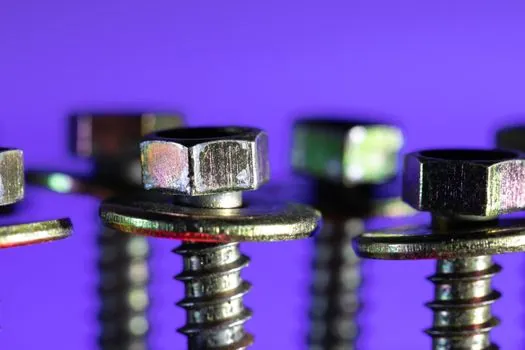
A complete food-processing spring-washer specification should identify the washer type, material grade, dimensions, load-deflection requirement, corrosion environment, temperature range, surface finish, cleanliness criteria, and governing joint drawing. It should also state whether the washer is suitable for direct food contact, indirect food contact, external service, or a non-product-contact structural joint. [S4]
At minimum, request dimensional and material certificates, define the required preload and permitted permanent set, and identify the manufacturer’s load-deflection data. If a split lock washer is used, specify the relevant internal or external diameter and material rather than accepting a generic “stainless spring washer” description. DIN 2093 and DIN 6796 are among the spring-washer product designations listed by industrial suppliers, but the governing requirement must be confirmed against the actual joint [S7].
For load-sensitive industrial joints, the spring washer should be treated as a calibrated mechanical element, and the fastener, washer stack, gasket, and housing should be evaluated together. Spring washer load-deflection curves provide a useful technical starting point for comparing linear and non-linear selection behavior.
A traceable specification, validated cleaning procedure, and joint preload calculation are the three controls to verify before releasing a food-processing assembly for production.