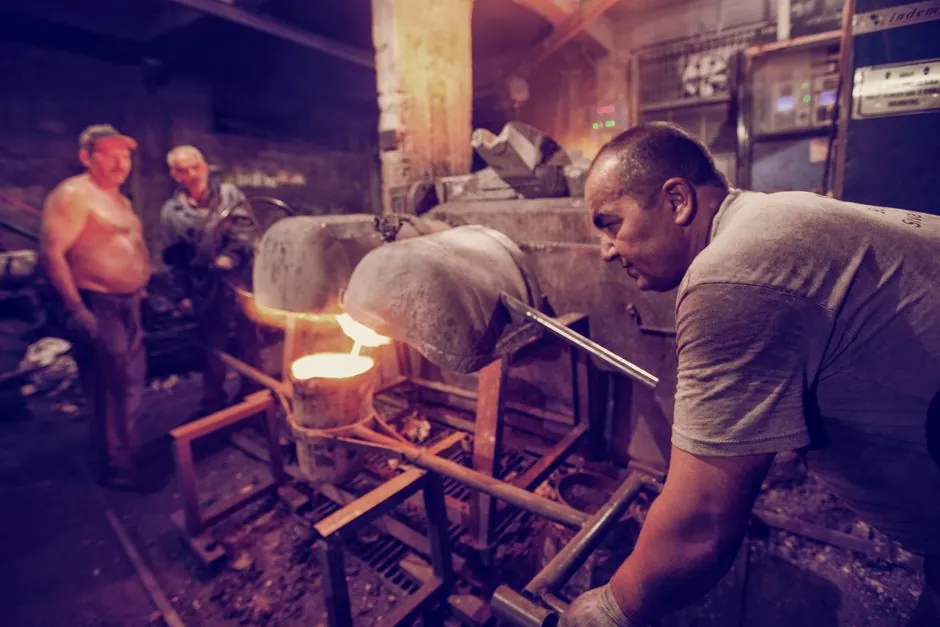
Buyers who plan to integrate a squeeze casting machine into a sand-casting inspection cell need to convert the press specification into RFQ language, not just hand the vendor a process name. Loukus Tech operates a vertical REL press at 1,500 ton clamp force and 1,200 ton injection/squeeze force, with a maximum part envelope of 3 ft x 3 ft (1,296 in² / 0.84 m²) and a 5 in (12.7 cm) wall thickness ceiling [S5]. That envelope is the realistic upper bound a buyer should benchmark when writing a line item, because it defines what the press can physically hold, fill, and pressurize.
Squeeze casting is a modified high-pressure die casting route where the injection pressure is high but shot speed is lowered to keep metal flow laminar, which is what makes it viable for safety-critical parts and for infiltrating ceramic preforms in metal matrix composite (MMC) work [S5]. When the upstream process is sand casting for prototype geometry and the downstream inspection regime is air-decay or mass-flow leak testing, the squeeze press is usually purchased as a dedicated high-integrity production cell, not as a sand-line auxiliary. That is the buying decision this RFQ targets.
Clamp force, injection force, and the intensification window
The first three numeric lines on any squeeze casting RFQ are clamp tonnage, injection tonnage, and peak intensification pressure, and they are the lines most often left blank in casual quotes. Loukus Tech's REL-built vertical machine delivers 1,500 ton clamp with 1,200 ton injection/squeeze force, which sets a 0.8 clamp-to-injection ratio that buyers can use as a sanity check against other quotes [S5]. Le Sueur's process notes that squeeze pin technology relies on very high local pressure being transmitted back into the semi-solid casting to displace material and close shrinkage porosity, so the press must hold intensification long enough for the squeeze dwell to complete without pressure decay [S4].
If the RFQ does not state intensification pressure in MPa, the vendor will assume the machine's default, and requote cycles start. Published squeeze casting process literature treats 50-150 MPa as the practical intensification window for aluminum and magnesium parts, with the higher end reserved for thin-wall or large-area MMCs [S1][S5]. A line that reads "intensification: 100 MPa minimum, hold time 5 s minimum, controlled ramp-down" gives the foundry a target they can price, and stops the back-and-forth where one shop quotes a 70 MPa press and another quotes a 130 MPa press for the "same" job.
Shot speed, fill mode, and turbulence control
The second cluster of RFQ parameters governs how the metal enters the die cavity, and it is the cluster that distinguishes squeeze casting from conventional cold-chamber die casting. The published description is explicit: "the casting pressure is high, yet the shot speed is considerably lower to minimize turbulent flow" [S5]. A buyer who writes "high-pressure die casting" on the RFQ without a shot-speed target will receive a turbulent-fill die cast quote, not a squeeze cast quote, and the porosity outcome on machined surfaces will be different.
For buyers moving from a sand mold prototype line to a squeeze casting production line, the practical shot-speed range to specify is roughly 0.1-0.5 m/s for aluminum and magnesium fills, with a slow-fill to fast-fill transition controlled by the position of the shot plunger rather than by a fixed time [S2]. The Case Metal Processing Lab has published experimental work on plunger speed, pressure, gating design, and casting quality for squeeze cast parts, which is the academic anchor for the shot-speed window [S2]. Buyers who omit this line typically pay for it later as surface-connected porosity that fails leak testing on the first articles.
Shot sleeve volume, billet size, and alloy envelope
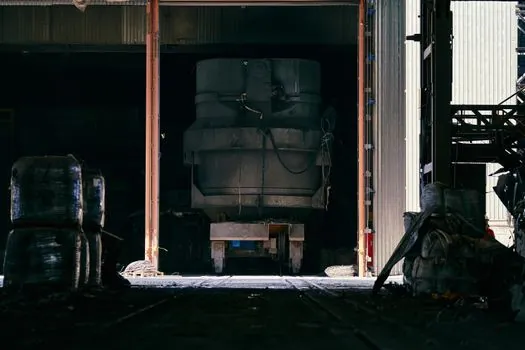
The third numeric cluster is shot sleeve diameter and stroke, because that defines the maximum pour weight per cycle and the alloy envelope the press can swallow. Horizontal cold-chamber squeeze presses commonly take 1,000-8,000 mm³ shot sleeves for aluminum; vertical presses built around larger envelopes such as the REL machine cited above push the upper end past 12,000 mm³ to feed the 0.84 m² projected area parts [S5]. A buyer who writes only "squeeze casting machine" without sleeve volume will receive quotes that are dimensionally incompatible with the part print.
Alloy envelope should be stated as a closed list: A356, A357, and A201 for aluminum; AZ91 and AM60 for magnesium; and any MMC system, such as Al/SiC or Al/Al₂O₃, that the buyer plans to run through the press for ceramic preform infiltration [S5]. Le Sueur's pressure-tight casting work uses Optical Emission Spectrometer (OES) verification on every heat before pour, which is the inspection-side evidence that alloy chemistry is controlled at the furnace, not at the press, and the RFQ should call that out so the squeeze machine vendor does not double-quote spectrographic instrumentation that the buyer already owns [S4].
Squeeze pin integration and porosity control
Squeeze pin technology is the leak-tightness lever that links the press specification to the downstream inspection regime, and it deserves its own RFQ line. Le Sueur describes the mechanism: as the die casting cools and the aluminum enters the semi-solid state, specially designed pins are deployed into the part under very high pressure, displacing material and increasing local mold cavity pressure to suppress shrinkage porosity in heavy or isolated mass regions [S4]. For pump, compressor, transmission, hydraulic, and pneumatic service, this is the difference between a casting that passes air-decay leak testing and one that does not.
The RFQ should specify the number of squeeze pins the press can actuate per cycle, the pin actuation pressure range, and the pin timing window in seconds from shot completion. If the press is not equipped with squeeze pins, the buyer is buying a high-pressure die cast cell, not a squeeze cast cell, and the inspection criteria downstream have to be relaxed to match [S4]. Buyers who skip this line typically discover the omission during first-article air-decay testing, which is the most expensive place to discover it.
Inspection interface, leak testing, and the casting-mold handoff

For sand casting inspection builds, the squeeze casting machine RFQ should be written so the press output is directly inspectable on the same cell. The relevant inspection modalities are Air Decay (Pressure Decay), Mass-flow, and Underwater Testing, plus digital radiography (DR), computed radiography (CR), and film radiography for internal defect review, and liquid penetrant inspection for surface crack detection [S4]. A press quote that does not interface with these inspection stations will force the buyer to add a separate leak-test cell later.
The handoff from a sand-cast prototype to a squeeze-cast production part should also be visible on the RFQ, because the geometry that was prototyped in a sand mold needs to be re-validated against the steel die before the squeeze press is locked into a takt. Magma simulation is the upstream tool that flags leak risk before tooling cuts, and the RFQ should ask the vendor whether they run Magma or equivalent fill-solidification simulation on every new tool, because foundries that skip simulation produce castings that fail leak testing at a higher rate [S4]. Buyers who anchor the squeeze casting RFQ to a casting mold RFQ line item avoid the geometry mismatch that drives requote cycles.
Comparison: squeeze casting vs sand casting vs die casting on RFQ decision criteria
On a head-to-head comparison for the four criteria that drive RFQ outcomes, squeeze casting sits between sand casting and die casting rather than at either extreme. Squeeze casting matches die casting on pressure-tightness and repeatable thin-wall detail, while matching sand casting on alloy flexibility (aluminum, magnesium, MMCs) and on the ability to handle heavy mass sections without isolated porosity [S1][S5][S7]. Sand casting wins on tooling cost and part size ceiling for very large castings, and die casting wins on cycle time and unit cost at high volume [S3].
Tooling cost is higher for squeeze casting than for sand casting because a steel die replaces the sand mold, but lower than for conventional die casting on safety-critical parts because the slower shot speed relaxes die fatigue [S7]. Tolerance target is finer than sand casting (typically 0.2-0.4 mm on critical features versus 0.5-1.0 mm for sand) and comparable to die casting on small-to-medium parts [S3]. For buyers running a sand blasting machine or sand mixer upstream for prototype work, the squeeze press is the production-line step, not a replacement for the sand cell, and the RFQ should be written with that division of scope clearly marked.
The squeeze casting process is sometimes called "the best of all worlds" when compared to high-pressure, low-pressure, and gravity (sand) casting, because it borrows the pressure intensification of die casting and the alloy flexibility of sand casting without inheriting the turbulence of conventional high-pressure fill [S7]. That positioning is the technical justification for the price premium the buyer will see in the quote, and it is the line the RFQ should make the vendor defend in writing.
Buyer profile: who squeeze casting on a sand-line RFQ is for, and who it is not for
This RFQ is for buyers who have already prototyped a pressure-tight aluminum or magnesium part in sand, validated the geometry, and now need a production cell that can hold the leak rate the sand prototype demonstrated. Typical end uses are pump housings, compressor bodies, transmission cases, hydraulic valve blocks, and pneumatic manifolds, where the casting must hold a specified internal pressure for a specified time [S4]. The buyer who benefits is one running annual volumes in the low thousands to tens of thousands, where tooling cost amortizes but unit cost still matters.
This RFQ is not for buyers prototyping a one-off geometry, not for buyers whose part print allows as-cast porosity on machined surfaces, and not for buyers running ferrous alloys, because commercial squeeze casting capacity in the cited public references is built around aluminum, magnesium, and MMCs [S5]. It is also not for buyers who need very large castings past the 0.84 m² envelope the cited vertical press can hold, because the next step up in squeeze press size is a custom build and the lead time moves from months to years [S5]. For those scopes, a sand casting line with a resin sand line for mold preparation is the right RFQ, not a squeeze casting machine.
Trackable signals for the next buying cycle: (a) vendor confirmation that intensification pressure and shot speed are written into the quote as numeric lines, not as process names, and (b) vendor confirmation that squeeze pin count and timing are quoted per the part print rather than as a press default. If both signals come back positive, the press specification is sound; if either comes back as a verbal "we will run it at our standard," the RFQ needs another revision before it goes to PO.