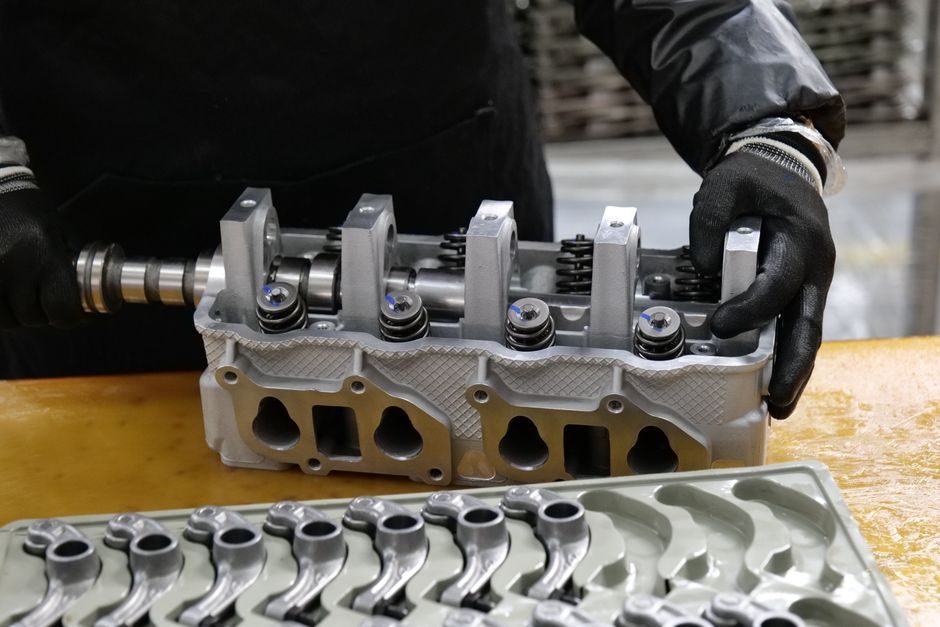
Squeeze casting holds molten aluminium under sustained direct compression through full solidification, which is the engineering reason automotive structural parts — steering knuckles, control arms, suspension links, pump housings and steering-column components — are specified on a squeeze casting machine rather than a conventional high pressure die casting machine [S2][S3].
For 2026 automotive programmes the practical envelope is aluminium alloys in the A356 / A357 / 6061 family for heat-treated structural parts and ADC12-class alloys for high-integrity non-ferrous conversions, with the process running in two flavours — direct (liquid-metal forging, metal poured into a lower die inside a hydraulic press) and indirect (a shot sleeve feeds the cavity under controlled velocity) [S2][S6].
Process Architecture: Direct vs Indirect Squeeze Casting
Direct squeeze casting, often termed liquid-metal forging, pours a measured charge into the lower die of a hydraulic press; the upper die closes and pressure is held throughout solidification, which is the configuration Contech's P2000 line uses for high-volume automotive structural components [S2].
Indirect squeeze casting routes melt through a shot sleeve into the cavity under controlled fill velocity, which minimises ingate turbulence and lets the press run more like a horizontal HPDC cell; the Horizontal Squeeze Casting (HSC) and Horizontal-Vertical Squeeze Casting (HVSC) variants documented in the academic literature use ADC12 aluminium with bottom-fill patterns to suppress gas porosity [S6].
Selection rule of thumb: direct squeeze casting wins on mechanical-property ceiling (it is the closest analogue to forging); indirect squeeze casting wins on cycle-time consistency and on integrating into a horizontal HPDC-style cell when the part geometry tolerates a runner system [S2][S6].
Clamping Tonnage, Pressure Envelope and Machine Sizing
Squeeze casting pressures in the literature run an order of magnitude above gravity die casting — typically 50–150 MPa applied through the punch and held to full solidification — which dictates that machine selection is driven by projected area × intensification pressure, not by shot weight alone [S3].
For automotive structural parts the working envelope in 2026 sourcing is roughly 200 t to 2000 t clamping force, with the small-tonnage end covering knuckles and control arms in the 1–3 kg finished-weight range and the upper end covering subframes, large suspension links and pump housings where projected area can exceed 600 cm² [S2][S3].
On a gravity die casting machine the same part would need much longer freeze times and would not reach T6-temperable density; on a conventional HPDC cell the same geometry would fill faster but would carry the gas porosity that disqualifies it from safety-critical service, which is the explicit trade-off Contech's paper documents against HPDC, GPM and LPDC baselines [S2].
Alloy and Temper Match: A356, 6061, ADC12

ADC12 (and the equivalent A383 family) shows up in HSC/HVSC studies aimed at high-integrity near-net-shape parts where the bottom-fill pattern and low ingate velocity suppress the gas porosity that normally disqualifies Al-Si-Cu die-casting alloys from structural duty [S6].
Magnesium squeeze casting is feasible on the same press architecture but is a different procurement question — covered separately on the magnesium die casting machine page — and is usually justified only where density below 1.8 g/cm³ is a programme-level target [S1][S3].
Comparison: Squeeze Casting vs HPDC vs LPDC vs Gravity
Process / criterion — Squeeze Casting (direct) — HPDC — LPDC — Gravity Permanent Mold: pressure during solidification: held 50–150 MPa through full solidification [S3]; drops after cavity fill; held at low MPa on melt surface; zero applied pressure. Porosity level: low, T6-temperable [S2]; gas porosity inherent; low; moderate. Best fit wall thickness: ~3–25 mm structural [S3][S4]; 1.5–4 mm thin-wall; 4–15 mm medium-wall; 4–20 mm medium-wall. Heat treatment: yes (T6) [S2]; not standard; limited; yes. Production volume band: medium-to-high batch [S3]; mass production; medium batch; low-to-medium batch. Typical automotive parts: knuckles, control arms, pump housings, steering columns [S1][S2]; engine blocks, oil pans, transmission housings; wheels, suspension arms; wheels, pistons, brake components.
This four-row matrix is the comparison a sourcing engineer should be able to draw on a whiteboard in 2026; if a part is thin-wall or true mass-production, an aluminum die casting machine still wins on cost-per-part [S2][S3].
Defects, Limits and When NOT to Specify Squeeze Casting
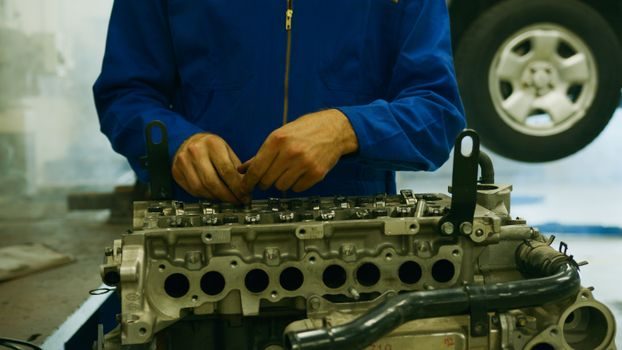
Squeeze casting is not a universal substitute: parts with wall sections below roughly 3 mm do not sustain the pressure field long enough to benefit, and the cycle time (medium batch band) makes it uneconomic against HPDC when annual volume crosses into true mass-production territory [S3].
Process optimisation studies on aluminium squeeze casting estimate that better process control can cut scrap by around 15% versus current practice, which is a useful negotiation number when a Tier-1 presses for tighter unit cost [S7].
Process-window sensitivity is real: melt temperature, die temperature, intensification pressure and dwell time all interact, and squeeze castings still fail on cold shuts, oxides and insufficient pressure-tightness when any one of those drifts — the vacuum die casting machine architecture is the alternative path when the defect driver is trapped gas rather than shrinkage [S1][S7].
Application Map: Which Automotive Parts Are Real
Documented high-volume automotive squeeze castings include steering knuckles, control arms, suspension links, pump housings, steering-column components, brake master cylinders and various powertrain parts, with pistons and wheels also cited across both academic and industry sources [S1][S2][S8].
The Contech P2000 case studies in particular call out steering knuckles and control arms as the safety-critical workhorses that drove the commercial case for direct squeeze casting replacing both steel forgings and ductile-iron castings on weight-driven programmes [S2].
Defence and adjacent sectors pull on the same press capacity — squeeze-cast iron mortar shells and aircraft structural elements are documented end uses — so Tier-1 foundries running squeeze casting machine cells should plan capacity against that cross-sector queue, not just the automotive forecast [S8].
Procurement and Spec Gates for 2026
A defensible 2026 RFQ should carry: process variant (direct vs indirect), alloy and temper (e.g. A356-T6), projected area and required clamping tonnage with a documented intensification pressure (typically 50–150 MPa), die temperature control window, T6 heat-treatment route, target mechanical properties (UTS, YS, elongation), porosity acceptance criterion (often radiographic or dye-penetrant), and cycle-time / annual-volume band [S2][S3].
For electronics-housing-adjacent work where the safety case is pressure tightness rather than fatigue, the spec gates line up more closely with a vacuum die casting machine build than with a structural squeeze casting cell — a different article, but worth flagging because procurement teams often conflate the two [S3].
Trackable 2026 signals to watch on the squeeze casting line: the spread of HVSC-style horizontal indirect cells into Asian Tier-1 supply, alloy development around heat-treatable Al-Si-Cu-Mg variants, and any OEM release that explicitly substitutes squeeze castings for forged steel knuckles on a high-volume SUV or light-truck platform [S2][S6].
Background reading: Carbon Steel for Aerospace: Grade Map, Spec Range, and Where It Still Fits.