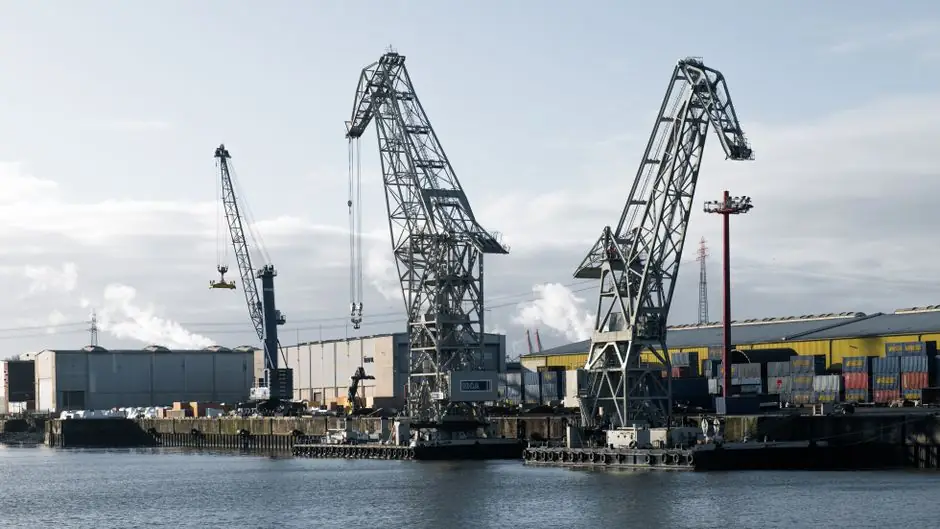
An automated stacker crane is a rail-guided handling machine that stores and retrieves unit loads inside a single dedicated aisle of a high-bay warehouse, combining horizontal travel, vertical lifting, and telescopic fork extension into one AS/RS work cycle [S1][S3].
Typical operating envelopes quoted by system builders are 30–50 m lift height, 1,500–5,000 kg payload, aisle widths of 1.5–1.9 m, and travel/lift speeds up to 6 m/s with accelerations of around 1 m/s², which together set the throughput boundary for any installation [S1][S4].
What a stacker crane actually does inside an AS/RS
A stacker crane is a computer-controlled crane on a floor rail and a top rail, with a mast carrying a lifting platform and a telescopic or shuttle fork that reaches into the rack to deposit or extract a pallet, container, or tote [S1][S3]. Mecalux describes the work envelope as three coordinated motions: longitudinal travel along the aisle, vertical travel up the mast, and transverse fork travel into the storage position, with the WMS/WCS selecting each storage location [S1].
The crane executes either a single command cycle (one put-away or one retrieval) or a dual/combined cycle, where the machine drops one load and picks another on the same trip, which is the standard throughput optimisation in pallet AS/RS design [S2][S3]. Modulblok notes that the defining architectural feature is direct random access: every storage location is individually addressable, unlike accumulation-based systems where the crane must dig through a lane [S3].
Stacking depth is the main configuration variable. Single-deep, double-deep, and multi-deep (paired with a Pallet Shuttle or pallet flow lanes) are the three commonly quoted options, with multi-deep trades selectivity for cube utilisation [S1][S2][S3].
When a stacker crane is the right answer
Stacker cranes earn their capital cost when the warehouse hits at least three of these conditions: rack height above ~10 m, sustained SKU turnover, tight floor footprint, and a need for high selectivity and traceability per pallet [S1][S3][S4].
Typical fit-for-purpose segments cited by vendors are FMCG and grocery distribution, beverage production, cold-chain and deep-freeze, pharmaceutical, automotive, metallurgy, and 3PL centralised hubs, with Körber specifically listing high-bay pallet, FMCG, beverage, cold-chain, inbound/outbound buffering, and 3PL as its six target use cases [S4]. Mecalux adds food, metallurgy, automotive, and pharmaceutical, and highlights cold stores down to -30°C as a stand-out application because human-operated forklifts lose productivity sharply in that range [S1][S2].
For brownfield sites, a trilateral stacker crane variant can be installed in place of existing trilateral turret trucks without changing the racking structure, which is the common retrofit path when an operator wants AS/RS-level traceability on legacy pallet racks [S2].
Stacker crane vs other AS/RS options
The decision is rarely stacker crane versus nothing; it is stacker crane versus unit-load AGV tote handling, vertical lift modules, and goods-to-person cube systems such as AutoStore. Stacker cranes dominate where the load is a full pallet, the building is tall, and selectivity must be 100%; cube-based systems win when SKU count is high, footprint is constrained, and tote-level access matters more than pallet-level throughput [S4][S5].
Concrete decision criteria that process engineers usually weigh: maximum lift height (stacker crane: 30–50 m, VLM: ~7–12 m), aisle width (stacker crane: 1.5 m+; VLM: 0 m), selectivity (stacker crane: 100% random access to each pallet position; accumulation systems: lower), operating temperature (stacker crane: proven to -30°C, versus worker comfort limits on manual aisles), and energy profile (stacker crane runs only when a mission is active, while some shuttle systems keep motors energised) [S1][S3][S5].
AutoStore’s own position paper frames stacker cranes as the legacy high-bay solution, with stated weaknesses in scalability for very high SKU counts and in flexibility versus grid-based cube storage, a useful counterpoint when an integrator pitches a hybrid design [S5]. Körber counters that its crane platform claims up to 40% more storage density than conventional pallet racking and 24/7 availability, which is the standard defence of a high-bay crane architecture [S4].
System integration and operating boundaries
A stacker crane is rarely a stand-alone purchase. Modulblok and Körber both specify the crane as one component inside an integrated AS/RS, with pallet conveyors, dynamic buffers, shuttle carriers, pallet stackers at inbound/outbound, and WMS/WCS software as required interfaces [S3][S4]. Körber states explicit compatibility with conveyors, palletizers, AGVs, and AMRs, which is the practical indicator that the crane is intended to be the storage node inside a larger conveyor sorting line and mobile-robot flow [S4].
Safety and precision come from the same architecture that drives throughput: the crane runs on fixed rails, so positioning repeatability is decoupled from driver skill, and the absence of in-aisle forklifts reduces pedestrian–vehicle conflict [S1][S4]. Cycle time is governed by FEM 9.841 / FEM 9.851 reference duty cycles, and integrators normally size the fleet so that peak-hour mission count stays below roughly 80% of single-crane theoretical capacity to keep queuing bounded [S3][S4].
Limitations and failure modes engineers watch for
Three structural limits shape every spec conversation. First, one crane serves one aisle, so throughput ceiling scales with aisle count and crane count, not with the square metre; doubling throughput means adding aisles, not adding shifts [S1][S3]. Second, storage density and selectivity trade off with depth: a double-deep rack cuts aisle count but forces a deeper fork and a partial retrieval logic, while a multi-deep Pallet Shuttle channel gives the highest cube but requires the shuttle as an extra moving part inside the lane [S1][S2]. Third, rail alignment and floor flatness become throughput variables at height; any deviation above a few millimetres per metre propagates into mast vibration that limits safe travel speed and lift height [S3][S4].
Other recurring failure modes are power-supply redundancy (the crane typically draws power via a busbar or festoon along the aisle, and a section loss can idle the aisle), fire-suppression interaction with cold stores, and WMS-WCS latency: a WMS that batches orders poorly can leave a crane accelerating and braking on empty missions, which is the classic cause of low effective SPPH despite high theoretical cycles per hour [S3][S4].
Selection criteria checklist for a new build
For a greenfield pallet warehouse above ~10 m and above ~10,000 pallet positions, a stacker crane AS/RS is almost always on the shortlist, paired with conveyor and shuttle interfaces [S3][S4]. For a retrofit below ~10 m, a trilateral stacker crane on existing racks is the standard upgrade path [S2]. For a brownfield above 40 m, the stacker crane is one of the few handling options that physically reaches the top position, since standard forklifts are out of envelope [S2].
For an SME or 3PL with fewer than a few thousand pallets, a pallet stacker with semi-automatic handling is usually a better economic fit, and a cube-storage system is the right answer when the business sells totes, not pallets [S5]. Single vs dual command stacker crane cycles is the operational lever that converts the same hardware into 20–40% more throughput, and it is the first number to confirm in any vendor proposal.
Trackable signals for the next 12 months
Cold-store builds at -25°C or below remain a useful proxy for new FMCG, pharmaceutical, and grocery investment in stacker crane AS/RS, since that envelope rules out most human-operated alternatives [S1][S4].