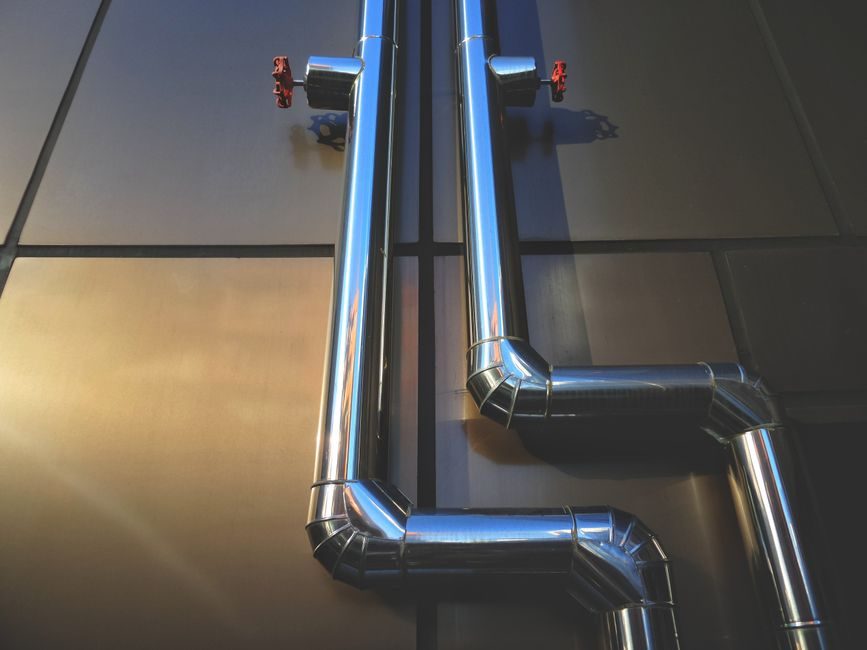
For most construction applications, austenitic 304 covers indoor architectural trim, handrails, fasteners, and cladding with a 0.2% proof strength near 215 MPa, while 316 is the default where chlorides, de-icing salts, or coastal atmospheres reach the surface [S1].
Ferritic grades such as 430 carry lower nickel content — historically the price lever in stainless — and behave as a magnetic, lower-thermal-expansion alternative for non-structural panel work; duplex 2205 nearly doubles yield strength and is the standard pick for structural members, bridge rebar, and swimming-pool atmospheres [S1].
The Four Construction-Relevant Stainless Families
Austenitic, ferritic, martensitic, and duplex families behave differently under load, weld, and corrosion, and the construction buyer maps the project to one of them before chasing a price quote [S1]. Austenitic 304/316 are non-magnetic in the annealed condition, work-harden rapidly under cold forming, and retain useful toughness down to cryogenic temperatures; their high chromium (≈18%) and nickel (8–10% in 304, 10–14% in 316) content gives the passive film that resists ordinary atmospheric corrosion [S1]. Ferritic stainless (e.g. 430) is magnetic, has lower thermal expansion, is less deep-drawable, and is usually specified where appearance plus cost matter more than heavy forming — appliance panels, decorative trim, indoor cladding [S1].
Martensitic 410/420 grades are hardenable by heat treatment, magnetic, and used where wear or cutting edges matter (anchors, security fasteners) rather than atmospheric exposure. Duplex 2205 mixes austenite and ferrite phases to give roughly 450 MPa 0.2% proof strength — about double that of 304 — plus strong resistance to chloride pitting and stress-corrosion cracking; it is the typical pick for structural rebar, bridge drainage, and process-plant skids in marine or de-iced environments [S1]. Within the broader category, an overview of the stainless-steel families helps when a buyer first opens a spec conversation with a service center.
Decision Criteria: Corrosion, Strength, Fabrication, Cost
Chloride exposure is the single most consequential criterion: 304 is acceptable in rural/urban indoor and outdoor air, 316 (with 2–3% Mo) is required for coastal, de-iced, or pool-adjacent service, and 2205 is reserved for chloride-loaded or hot chloride-bearing structural service [S1].
Fabrication route then narrows the choice. Austenitic grades tolerate the deepest draws and the most aggressive welding schedules; ferritic grades risk grain growth at the heat-affected zone and are usually welded with stabilized variants (409, 439) or a lower heat input to avoid embrittlement; duplex requires controlled heat input and a nitrogen-bearing shielding gas to keep the phase balance near 50/50 [S1]. Cost ordering in commodity-market conditions runs 430 < 304 < 316 < 2205, driven mainly by nickel and molybdenum content, so the spec should step up the cost ladder only when the corrosion/strength criteria actually demand it.
Comparison Matrix: 304 vs 316 vs 430 vs 2205
Side by side on the four selection criteria, 304 is the indoor-and-rural workhorse with the lowest cost of the four, 316 is the coastal-and-de-icing default, 430 is the cheapest decorative ferritic panel choice, and 2205 is the structural duplex where strength plus chloride resistance both matter [S1]. In practice a project's outdoor column in a coastal city ends up as 316, a stadium handrail indoors as 304, a transit-station decorative soffit as 430, and a bridge expansion joint or a swimming-pool structural tie as 2205.
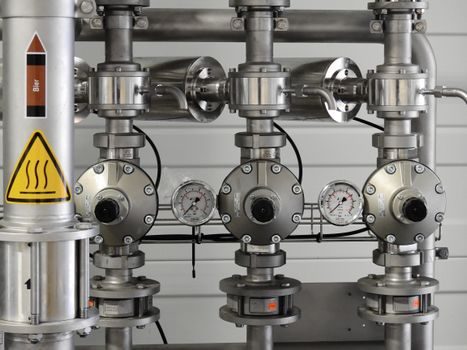
The choice also has downstream consequences for adjacent building systems: tank, vessel, and piping fabrications typically move to 304/316 austenitic stainless once hygiene or chloride resistance enters the spec, as outlined in the stainless pipe and alloy steel reference pages — and a project that picks 2205 for a beam should be aware that matching fasteners, plate, and rebar need to follow, or galvanic and corrosion mismatches will appear at the joints.
Where Each Family Fits — and Where It Does Not
Austenitic 304 is correct for indoor architectural trim, handrails, elevator panels, kitchen equipment, and most non-coastal exterior cladding. 316 is correct for coastal facades, exterior structural elements within roughly 1 km of saltwater, highway structures exposed to de-icing salts, and any application where the surface is sheltered but chloride-laden moisture can still condense on it. Ferritic 430 fits appliance-grade panels, indoor decorative cladding, and budget-driven non-structural skins; it is not correct for welded heavy sections or chloride-exposed service [S1].
Duplex 2205 is the right pick for load-bearing rebar in marine piers, bridge bearings, process-plant skids, swimming-pool reinforcement, and any structural member that sees chlorides while carrying design load; it is not a sensible pick where the project budget is tight and chloride exposure is low, because 304 or 316 will do the job at lower cost. For storage vessels in food, pharma, or building-services water systems, the related stainless steel tank reference gives a parallel view of how the same 304/316 logic carries over to hygienic or pressure-bearing service [S2].
Fabrication and Fastener Coordination
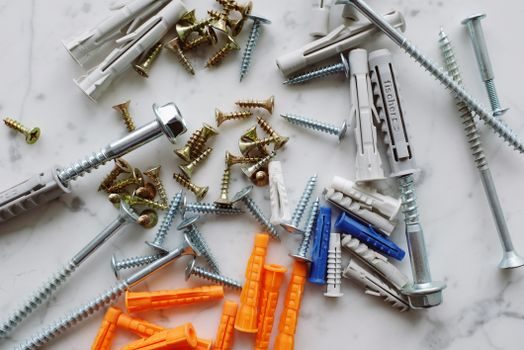
Specifying a stainless structural member without specifying matching fasteners is the most common construction-stainless failure mode. Stainless bolts and concrete anchors follow the same family logic: A2-70 (≈304) for indoor and mildly corrosive service, A4-70 (≈316) for chloride-exposed service, with a strength class (70, 80, 100) chosen to match the design load — screw precision for general engineering is typically 6g grade (IFI 2A) while coarse construction bolts are 8g grade (IFI 1A), which is why "buy what the structural member is made of" is the simplest rule [S3].
Welding procedure matters equally: 304 and 316 weld with conventional 308L/316L fillers, ferritics with stabilized grades to avoid HAZ grain growth, and duplex with controlled heat input plus nitrogen-bearing shielding to keep the austenite-ferrite balance near 50/50 [S1]. For project buyers who also select adjacent equipment, the concrete admixture selection for commercial buildings reference maps the parallel decision logic for the foundation side, and the multi-gas detector selection reference covers instrumentation when a stainless-clad process skid is in scope.
Standards, Sourcing, and Traceable Signals
Construction-stainless procurement usually follows ASTM A240 (plate/sheet), A276/A479 (bars/shapes), A312 (pipe), and A580 (wire); rebar falls under A955 and fasteners under F593/F594, with EN 10088 serving the same role in European projects.
Trackable signals to watch on a 2026 construction-stainless purchase: (1) nickel and molybdenum spot prices, which move 430/304/316/2205 relative pricing in a known order, (2) whether the mill test reports cite PREN or only chemistry, and (3) whether fasteners and rebar on the same order match the structural member's family — a 2205 rebar with A2-70 bolts is a mismatch that will show up at the first inspection.