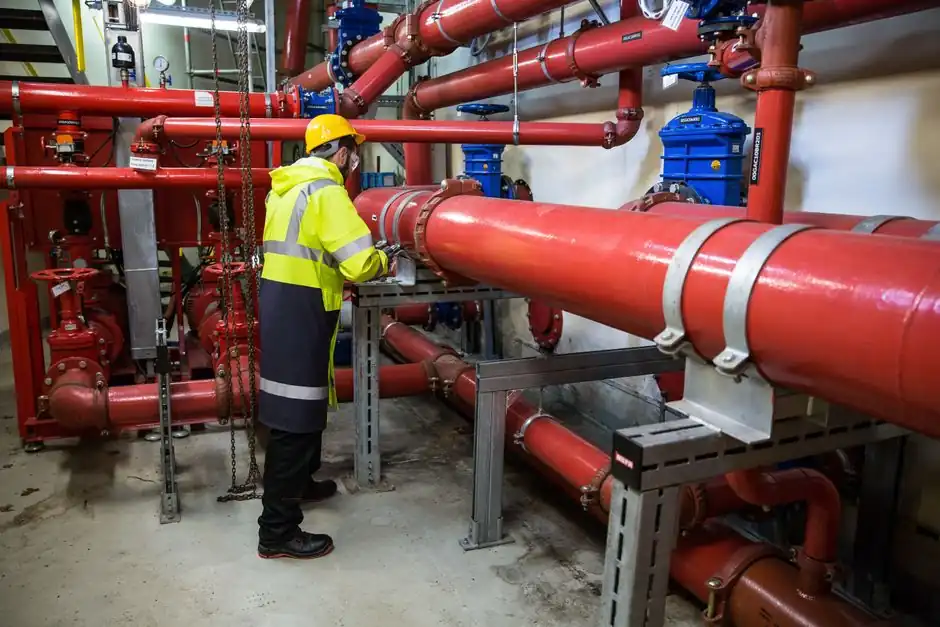
Stainless steel pipe installation is governed by a small number of hard variables: pipe grade (typically 304 or 316L), nominal diameter, joint method, minimum coupling-to-elbow spacing, and thermal expansion allowance, and a 2026 field install fails when any one of these is treated as a soft target [S2][S4].
For DN15-25 stainless runs the minimum straight length between a coupling and the next elbow is 20 mm, rising to 40 mm at DN32-50 and 60 mm at DN65-100, while 90 degree elbow centerlines need 54-355 mm of clearance depending on diameter [S2]. These are the spacings the press-fit tooling physically requires to avoid O-ring damage during jaw compression.
Tooling and Cutting: Where Field Joints Are Won or Lost
Stainless pipe must be cut with a rotary pipe cutter or a metal-cutting band saw, never an abrasive wheel that work-hardens the cut face, and the end has to be chamfered and deburred with a file before any fitting is pressed on [S1][S3]. A deburred, square end is what lets the O-ring seat concentrically; a burr lifts the seal and produces a slow leak that does not show up on a 30-minute pressure test but shows up six months later.
For 3" (76 mm) and 4" (101 mm) Transair aluminium-pipe analogues, the lug count is a fixed minimum: 6 lugs at 76 mm and 7 lugs at 101 mm, with no overlap allowed, and clamp torque is bounded between 7.37 lb-ft (mini) and 17.5 lb-ft (maxi, when the two clamp halves touch) using a 6 mm Allen key on alternating sides [S3]. The alternating pattern is not cosmetic, it equalises gasket compression around the cartridge.
Joint Method Comparison: Press, Flange, Groove, Weld, Compression, Thread
Press-fit (crimping) joints use a hydraulic jaw to compress a fitting onto the pipe with an internal O-ring; install is fast but joint strength is only about 1/3 of the parent pipe strength and the joint is non-removable, which kills maintainability on process lines [S5]. Compression fittings gain strength over crimping via a wide-band rubber seal but can rotate at the compression ring, disturbing the seal if the run is later disturbed.
Flanged joints remain the high-pressure, large-diameter default: bolted flanges with a flat gasket deliver full pipe pressure rating and are fully disassemblable, at the cost of flange plate, bolt, and gasket expense plus torque procedure [S5]. Grooved connections (mechanical couplings on roll-grooved pipe) install fast and are removable, suiting fire mains and large water lines, but grooving tolerance is tight and the joint will not hold vacuum service. Welded connections give the highest strength and a seamless seal for high-pressure and high-temperature duty, but require certified welders, purge gas on austenitic grades to prevent sugaring, and post-weld passivation to recover corrosion resistance at the HAZ. Tapered thread is the lowest-cost option for small-bore utility lines and is acceptable where disassembly is expected and pressure is modest.
On labour alone, press-fit is reported to cut install time by up to a factor of ten versus TIG welding on equivalent runs, and removes the hot-work permit entirely [S4]. That number is a vendor claim, not a measured average, so treat it as an upper bound for the simplest DN15-DN50 commercial plumbing, not for high-purity pharmaceutical pipe.
Material Grade: 304 vs 316L and Where Each One Fails
304 stainless is the cost-effective default for HVAC, potable water, and light industrial service; 316L is the spec for food processing, marine exposure, chemical splash zones, and any chloride-bearing environment, and is also the standard pick for clean-in-place pharmaceutical and brewery lines [S4]. The L in 316L is the low-carbon variant (typically 0.03% C max) that prevents carbide precipitation at welds, so any welded 316 system should be 316L, not standard 316, unless the weld is fully solution-annealed afterwards.
316L press fittings from system vendors such as Europress include a press indicator ring that pops free only when the jaw has fully completed the crimp, giving the installer a visible, post-installation joint-by-joint QC mark without a hydrostatic test [S4]. For background on the base material's corrosion and strength behaviour, the stainless steel reference covers grade chemistry, and stainless pipe covers the manufactured product forms and tolerances installers specify against.
Clearance, Supports, and Sleeves: The Geometry Rules Behind a Reliable Run
Coupling-to-elbow clearance is not a code preference, it is a tooling geometry. For a DN50 90 degree elbow the centreline needs 140 mm before the next fitting; for DN100 it is 355 mm, and the 45 degree variant trims those numbers to 118 mm and 320 mm respectively [S2]. Compress those numbers on site and the press jaw will not seat, or the operator will skew the joint to make it fit and the O-ring will not seal.
Pipe supports and hangers have to match the diameter, route, and load: stainless steel brackets with nuts, rod-type pipe clamps, and single clamps are the three common types, all in stainless to avoid galvanic corrosion at the contact point [S2]. Where the pipe penetrates a wall, floor, or foundation, a sleeve or casing is required, and the sleeve bore has to be large enough to clear the pipe plus any insulation plus thermal movement, otherwise the sleeve becomes a fixed point the pipe was never designed to have.
Thermal Expansion and Compensation
Stainless steel expands at roughly 0.0173 mm/m per degree C, so a 10 m hot run at a 60 C temperature differential grows by about 10.4 mm, which has to go somewhere [S2]. The field calculation is the linear formula ΔL = α L ΔT, and the three compensation options are natural compensation (use the route's own bends to absorb movement), expansion loops, and bellows/axial compensators on long straight runs.
For compressed air and process water, a frequently missed detail: never encase the network in a hard solid mass, because future maintenance becomes a demolition job, and insulate the stainless pipe only where the service actually requires thermal control, not by default [S3]. For process engineers cross-referencing carbon and austenitic line-pipe practice, the steel pipe and seamless steel pipe entries cover the parent product geometry that stainless shares.
Inspection Cadence, Acceptance, and When to Replace Instead of Repair
Visual and tactile inspection of stainless piping every six months is the typical baseline, with a closer look at any joint that has been disturbed, heated, or mechanically impacted [S1]. The acceptance check after a press-fit run is: indicator ring popped, jaw mark continuous around the fitting, no visible offset between pipe end and fitting shoulder, and a system pressure test at 1.5 times operating pressure held for 30 minutes with no pressure drop.
Do not attempt to repair a press-fit joint in place; it is non-removable by design, and any attempt to cut the fitting off without damaging the pipe end usually forces a cut-out and re-run [S5]. Flanged and grooved joints are the only ones designed for repeated re-make: a flange can be re-gasketed and re-torqued, a grooved coupling can be rolled back, but both still require a new gasket or seal every time. Welded joints that show HAZ corrosion or crevice attack are not field-repairable, the affected section has to be cut out and a new pup piece welded in with purging and post-weld passivation; the industrial fastener supply risk 2026 briefing also covers the bolt and gasket traceability side of flanged reassembly.
For spec-first buyers assembling a 2026 procurement packet, the pharmaceutical equipment procurement note covers the GxP and TCO layer that sits on top of a 316L sanitary pipe install, and the industrial fastener supply risk 2026 playbook is the matching reference for the flanged and grooved bolting.