Stainless steel strapping in the Type 200 to Type 300 family delivers the highest break strength of any common strapping material, with Type 201 product like the ISO Band #BA204 rated at 1,500 lb break strength and 95,000 psi tensile at 0.030 inch (0.76 mm) thickness per ASTM A666 [S4]. Aluminum strapping, by contrast, runs at roughly one-third the density of steel and is specified primarily for weight-sensitive jacketing and non-magnetic applications.
The decision between the two comes down to four engineering axes: corrosion environment, required break strength, weight per roll, and formability on site. This guide lines both materials up against those axes, with verifiable spec data drawn from manufacturer and engineering references [S1][S2][S4][S6].
Material Grades, Standards, and Stocked Forms
Stainless strapping is produced from the Type 200 to Type 300 stainless steel range, with Type 201 used for general-purpose banding, Type 304 for indoor and mildly corrosive environments, and Type 316 held for marine and chemical exposures [S1][S2]. Stocked widths run from 1/4 inch to 2 inch, with thicknesses at 0.022, 0.025, 0.030, and 0.044 inch (0.56–1.12 mm), and standard coils at 100 ft length [S4].
Aluminum strapping for industrial insulation jacketing is typically supplied as butt-strap coils, with manufacturers offering matching stainless steel strapping where greater strength or corrosion resistance is required on the same jacketing system [S6]. Band-It ValuStrap stainless strapping, for example, is a non-magnetic 200-300 AA grade used for sign, pipe insulation, cable bundling, and similar light-duty fastening, and ships in 5/8 inch x 100 ft reels [S9]. The strapping band family covers both materials under one product category.
Break Strength, Tensile, and Mechanical Comparison
A 1/2 inch x 0.030 inch Type 201 stainless band is rated at 1,500 lb break strength and 95,000 psi tensile strength, fully annealed for field forming [S4]. Steel strapping as a class has the highest break strength of the common strapping materials, which is why it is specified for heavy loads, hard corners, and sharp edges such as I-beams and steel plates [S3][S5].
Aluminum strapping yields roughly 25,000–35,000 psi ultimate tensile in typical 3003/5052 jacketing alloys, with break strength on a 1/2 inch x 0.020 inch coil in the 350–500 lb range, well below stainless but adequate for insulation and sign-fastening duty. Where the application is bundling a load with settling or thermal expansion (wooden logs, compressible insulation), stainless rigidity is a known liability, because the band will not elongate with the load and may chafe or crack the substrate [S3].
For reference, stainless steel strapping pairs naturally with stainless pipe supports and clamps in process-plant piping, where the same alloy family simplifies specification and inspection.
Corrosion Resistance and Environment Selection
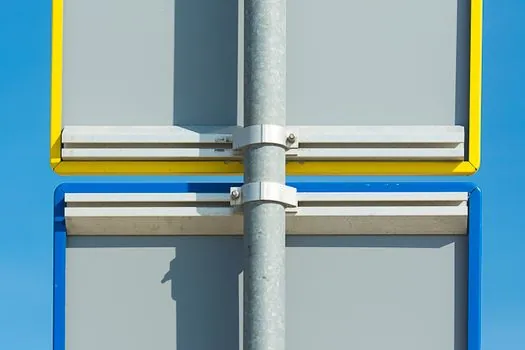
Stainless steel banding is described by multiple manufacturers as corrosion resistant and rated for both indoor and outdoor conditions, including marine, telecommunications, oil, gas, and traffic pole installations [S2][S4]. Type 316 is the marine-and-chemical pick, Type 304 covers most outdoor and washdown areas, and Type 201 is the cost-driven general-purpose grade [S2][S4].
Aluminum forms a passive oxide layer that handles atmospheric corrosion well, but it is not specified for chloride-rich or acidic condensate service without a coating or isolation. In industrial insulation systems, the supplier's data sheet lists stainless steel strapping as offering the greatest strength and corrosion resistance, with T-316 stainless available on request, and pairs it with JM aluminum butt strap for the jacketing seams [S6]. That pairing is the standard approach: aluminum for the jacket, stainless for the structural hold-down.
Weight, Formability, and On-Site Handling
Stainless in the fully annealed condition can be formed by hand around poles and pipes, but heavier 0.044 inch gauges and the harder tempers used for sign brackets require ratcheting tensioners and matching buckles [S4][S7].
Aluminum is softer, bends more easily, and seals with lower-force tools, which is why it is preferred for HVAC duct and insulation jacketing where crews are working overhead for hours. Stainless buckles, by contrast, are offered in a range of styles (Bulls Eye, Wing Seals, Standard, Screw Buckles, 316 stainless variants) to match the band width and the load, and are typically specified separately from the coil [S4]. Mechanised tensioning and sealing is done with a strapping machine when volume justifies it.
Application Mapping: Where Each Material Wins
Spec stainless strapping for oil and gas, chemical plant, marine, telecommunications tower, traffic pole, and sign installations where the band sees weathering, UV, or corrosive condensate, or where it must hold heavy or sharp-edged loads [S4][S2]. Spec aluminum strapping for industrial insulation jacketing, HVAC ductwork, indoor sign mounting, cable bundling, and any application where non-magnetic, non-sparking, or low-weight installation is a stated requirement [S6][S9].
For a sign mounted on a coastal boardwalk, Type 316 stainless in 1/2 inch x 0.030 inch with 316 buckles is the conservative pick. For a 30 ft pipe run in a chemical plant carrying a hot, halogen-bearing process fluid, the same 316 grade on the stainless pipe support and the strapping keeps the alloy family consistent for inspection and traceability. For a refinery steam-trace jacketing job, aluminum butt strap on the jacket seams with stainless hold-down bands is the common pairing per insulation supplier guidance [S6]. For a warehouse traffic sign indoors, aluminum alone is usually sufficient.
Limitations, Failure Modes, and Inspection Notes
Stainless strapping fails by work-hardening at the buckle if the band is re-tensioned multiple times; the failure signature is a clean tensile break near the seal, not a pull-out. Stainless is also not the right pick for loads that settle or expand during transit, because the rigid band will not yield and can chafe the product [S3]. Edge protection is mandatory whenever the load includes sharp corners, even with stainless [S5].
Aluminum strapping fails by fatigue cracking under cyclic temperature swings if it has been over-tensioned at install, and by galvanic interaction if it is landed directly on dissimilar metal without an isolation washer. Both materials should be inspected for surface condition at the buckle and at any point of contact with the supported asset, particularly after the first thermal cycle or the first sustained wind event on a sign installation [S4][S6].
For structural framing and equipment skids where high strength carbon or alloy steel is also a candidate, the alloy steel choices for tapered roller bearing races comparison covers a related material-selection problem with the same decision-criteria structure.
Track these signals before final spec: confirm the chloride exposure class to lock the stainless grade (201, 304, or 316); confirm the load edge geometry to decide whether edge protection is required alongside the band; and confirm the install tooling fleet, because mixing hand-formable aluminum coils with stainless-only ratchet tools is a common field delay that drives avoidable change orders.