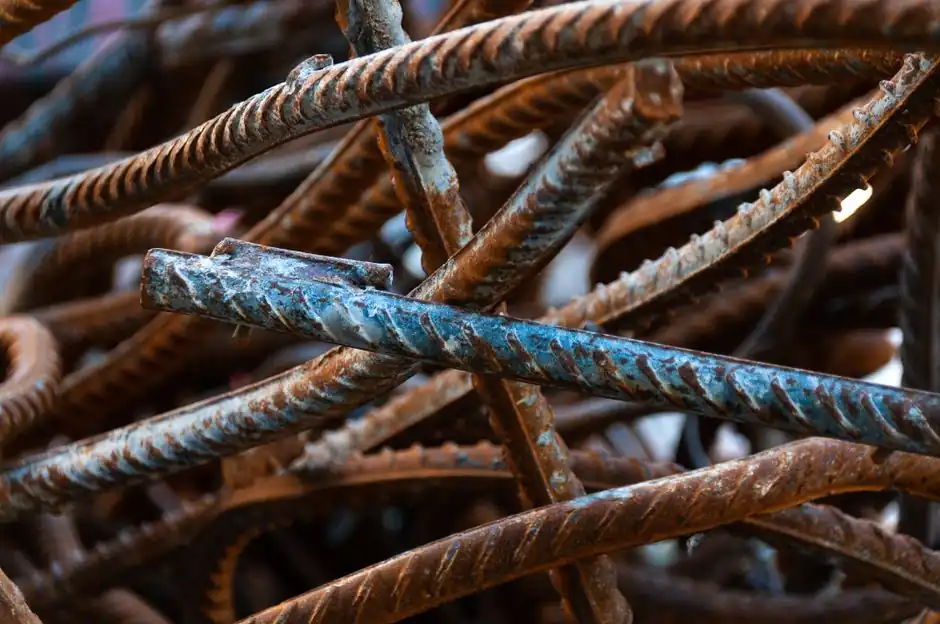
A complete rebar manufacturing chain covers two distinct equipment classes: hot-rolling mill lines for primary producers and CNC cut/bend/thread lines for downstream fabricators, with bar diameter ranges of 8-32 mm and 10-40 mm respectively [S4][S8].
Selection hinges on four hard constraints: annual throughput in tons, building power supply (380V/480V 3-phase), stock bar length (12 m vs 18 m), and the target rebar grade per GB/T 1499.2-2018 or equivalent [S2][S3].
Hot Rolling Mill Lines: Capacity, Power, and Billet Sizing
Primary rebar production runs on hot-rolling mill + continuous casting machine (CCM) packages, with published capacities of 1-35 t/h and final bar diameters spanning 6.5-32 mm depending on line size [S4].
A 5 t/h line draws 5 MW and feeds 60×60 mm billet; a 35 t/h line draws 26 MW and feeds 150×150 mm billet, with 120×120 mm and 150×150 mm cross-sections covering the 20-35 t/h bracket [S4]. Typical billet lengths run 1000-6000 mm, and 220-class mills using 50×50 mm stock finish 8-16 mm round and deformed bars at high speed [S6].
For higher-end construction, larger mills take 120×120×6000 mm or 150×150×6000 mm billets, producing angle steel plus Φ6.5-32 mm rebar at 15-35 t/h with electricity draw of 10-26 MW [S4][S7]. A 240 kW horizontal rolling-mill module in the 380V class weighs 4500 kg at 1400×800×800 mm, used as a building block for automated rod/bar lines [S5].
CNC Fabrication Lines: Cut, Thread, and Polish
Downstream, CNC rebar cutting/threading/polishing lines from manufacturers such as Shandong Zhongji Luyuan process 20-32 mm ribbed bar at 30-35 t per 8-hour shift with only 2 operators, versus 3 workers at under 1.5 t/day on manual setups, a roughly 4× efficiency gain [S3].
Cutting precision on these lines reaches ±1 mm, well inside the ±3 mm manual baseline, while rolling-process thread profiles conform to GB/T 1499.2-2018 with a third-party-verified 99.8% qualification rate [S3]. Infrared safety light curtains and emergency-stop loops cut mechanical-injury risk to zero, and operating noise is held below 75 dB [S3].
For pure cut-to-length, an integrated CNC line covers Φ10-40 mm rebar at 0.7-12 m lengths with ±2 mm precision, drawing 380V/50Hz 3-phase and running 80-120 pieces per hour [S8]. Modular core components (cutting heads, threading dies) cut daily maintenance to non-specialist level and lower long-term service cost roughly 30% versus the industry average [S3].
Construction-Site Bar Processing: Straighten, Cut, Bend, Weld
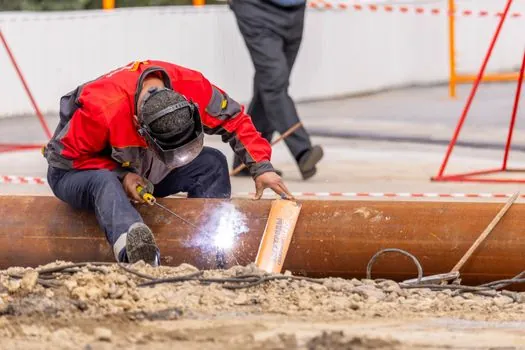
On the job site, eight equipment categories cover virtually every rebar prep step: cold-rolled ribbed bar production, straightening, cutting, straightening-and-cutting, bending, stirrup bending, welding, and metal-cage production [S1].
Cold-rolled ribbed bar lines with pre-heating deliver elongation and hardness comparable to Grade 3 (HRB400) bars, reducing total steel used in a structure [S1]. Straightening-only machines handle bundled bar up to several thousand yuan for small units and into the millions of yuan for heavy-duty models [S1].
CNC stirrup benders start around 100,000 yuan for compact residential units, with custom-shape machines at the top of the price band [S1]. For diameters above 20 mm, dedicated rebar cutting and bending machines are the standard spec; welding machines compress mesh-fab cycles from months to days by replacing manual tying [S1].
Building, Power, and Layout Constraints
Most rebar fab shops in the USA run on 480V 3-phase (575V 3-phase in Canada), and a 60 ft. (18 m) stock bar needs a 10 t overhead crane with a spreader beam or dual travelling bridges to keep a #3 (10 mm) bundle from sagging [S2].
Minimum crane-hook-to-floor clearance is 20 ft for standard stock handling, rising to 24 ft if long bar is to be moved freely around the bay; a parallel-bay layout (stock under one crane, fabrication under a parallel crane) lets a 5 t crane cover the fab bay while a 10 t crane handles stock [S2]. Forklift-only operations should plan around 40 ft. (12 m) stock and a 10 t truck rated to lift bundles above shearlines and trailers [S2].
Stock length drives layout: 60 ft. (18 m) is more efficient per cut, 40 ft. (12 m) is more manageable without an overhead crane [S2]. Long, single-bay buildings suit straight-through shops; cross-bay layouts maximise covered stock storage [S2].
Comparison: Mill Lines vs CNC Fabrication Lines
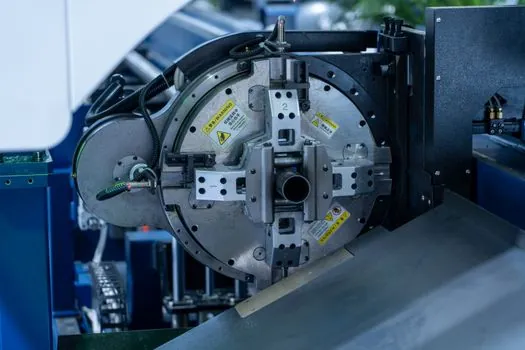
Hot-rolling mill lines and CNC fab lines target different layers of the supply chain, and the spec delta is sharp enough to drive a single-criterion selection: are you a mill or a fab shop? [S1]
Mill lines run 8-32 mm finished bar at 1-35 t/h, demand 5-26 MW, and accept 60-150 mm billet, with capital cost dominated by CCM, reheating furnace (gas/electric/oil), and rolling stands [S4]. CNC fab lines run 10-40 mm rebar at 80-120 pieces/hour (cut) or 30-35 t/shift (cut+thread+polish) on 380V/50Hz 3-phase at 18% lower energy than equivalent gear [S3][S4][S8].
Mill lines need CE/ISO9001/ISO14001/OHSAS 18001 certification and 30-60 working-day delivery, while fab lines are typically CE-marked modular units with 1-year core-component warranty [S4]. The steel rebar product itself is governed by GB/T 1499.2-2018 in China and equivalent ASTM/BS grades internationally.
Standards, Certifications, and Sourcing
Mill-scale rebar production equipment in the Chinese export market typically ships with CE, ISO9001, ISO14001, and OHSAS 18001 certifications, plus a 1-year warranty on PLC and other core components [S4]. Threading quality on CNC lines is verified against GB/T 1499.2-2018, Steel for the Reinforcement of Concrete, with rolling-process thread profiles tested at 99.8% pass rate [S3].
Mill-line delivery from Shaanxi-based suppliers runs 30-60 working days ex-works, with full installation and commissioning included in the engineering scope [S4]. Buyers building a greenfield operation should spec the OEM's modular kit around monthly tonnage target, ceiling height, and stock length before signing a building lease; second-hand buildings with under-spec power (e.g. 240V single-phase) often force costly transformer upgrades [S2].
For a broader look at how mill output feeds downstream procurement, see the Steel Sourcing Spec Guide on mill qualification and 2026 risk controls.
Common Pitfalls and Field Notes
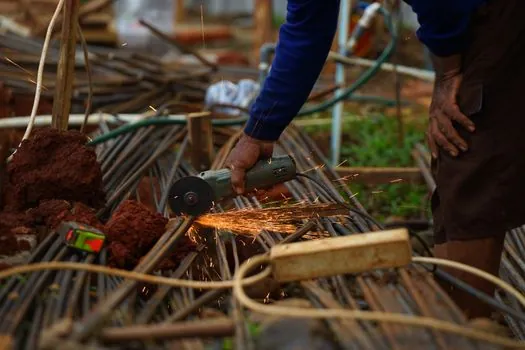
Manual threading is the bottleneck that pushes fab shops toward CNC: the CNC rebar line lifts thread qualification to 99.8% and cuts rebar rework from 12% to 0.2% on ribbed bar [S3].
On rolling-mill side, undersizing the reheating furnace or cooling bed is a frequent cause of throughput shortfall, since the published t/h ratings assume matched upstream and downstream capacity [S4]. Buyers should also confirm whether a "semi-automatic" label means manual billet handling or just manual cobble removal, because the two carry very different labour implications [S4].
Trackable signals to watch through 2026: ISO 45001 replacing OHSAS 18001 on mill-line certifications, and increased modular CNC fab-line deployment on expressway and metro contracts in China, where the Ji-Qing Expressway reconstruction and Jinan Metro Line 6 are cited as reference projects [S3][S4].
For the relevant spec sheets and selection criteria, see additive manufacturing material, and linear guide.