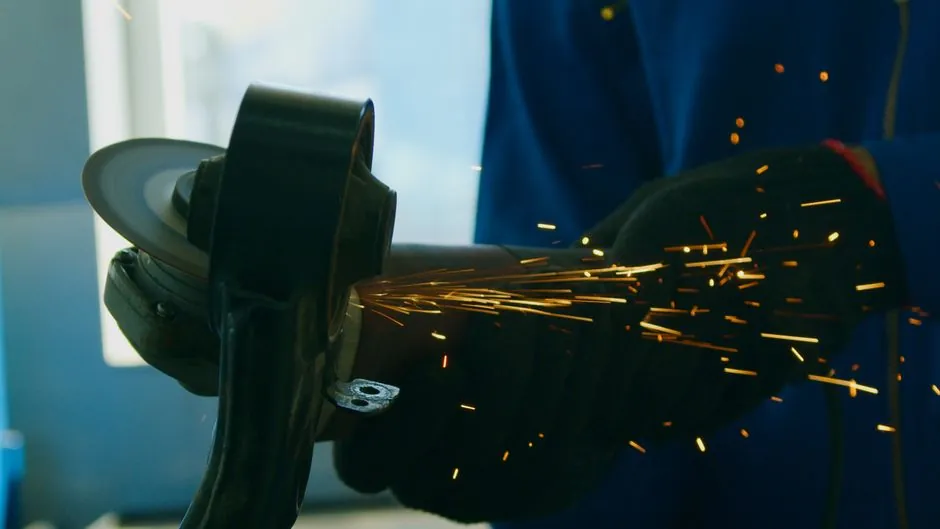
A fiberglass-reinforced nylon composite pulley line has molded-in bearings and drive adapters designed to remain attached under severe commercial lawn-mower conditions.
The decision is not simply metal versus plastic: pulley wear depends on belt tension, alignment, contamination, speed, temperature, and the belt profile, so material selection must follow the service envelope.
Pulley Material Selection Criteria
A tensioner pulley applies and maintains belt tension through a spring or hydraulic mechanism, while an idler pulley only guides and aligns the belt [S3]. This distinction matters because a tensioner imposes a controlled force and reaction load, making stiffness, bearing support, shaft fit, and wear resistance more critical than weight alone.
Industrial belt drives can transmit from fractional horsepower to more than 7,000 hp, although that power range applies to the complete belt-drive system rather than to any one tensioner pulley [S2]. A tensioner must therefore be selected for belt type, tension force, pulley diameter, shaft size, speed, duty cycle, and mounting arrangement, not merely for motor horsepower.
For a conventional V-belt installation, compare the V-belt section and groove geometry with the tensioner pulley before choosing a material. The belt tensioner also requires the correct spring force, travel, arm geometry, and bearing arrangement; changing only the pulley material does not correct excessive tension or misalignment.
Steel Versus Composite Comparison
Steel offers higher stiffness, impact tolerance, heat resistance, and repairability, but it adds mass and can corrode. The composite option has lower rotating inertia and can suppress noise, yet its temperature, chemical, dimensional, and load limits must be accepted [S1][S5].
For a direct criteria comparison, steel is the conservative choice for high radial load, shock loading, elevated temperature, contamination exposure, and long service intervals. A 33% glass-fiber-reinforced nylon pulley is attractive for light conveyors and packaging machinery where low mass, quiet operation, corrosion resistance, and accurate molded-in bearings matter more than extreme load capacity [S1][S5].
That result does not establish that composite is equivalent to steel for every tensioner. The timing pulley, flat-belt pulley, and V-belt pulley each impose different groove, tooth, or crowned-surface requirements, and the composite must be designed for the selected belt.
Composite idlers made with molded-in bearings provide maximum total indicated runout of 0.016 in, or 0.4 mm, while pressed-in bearing drive pulleys have typical total indicated runout of 0.020 in, or 0.5 mm [S5]. Pressed-in bearings can move laterally by as much as 1/16 in, allowing adjacent idlers to differ by as much as 1/8 in and causing premature belt wear [S5].
Wear, Misalignment, and Surface Failure
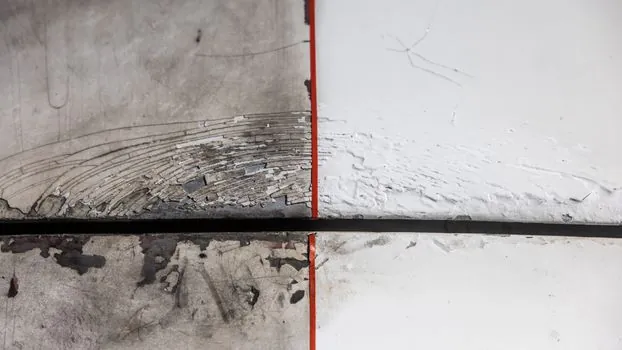
Misalignment and surface contamination can shorten belt life more decisively than the nominal pulley material. Composite idler assemblies with molded-in bearings avoid the lateral movement associated with pressed-in bearings, reducing belt edge loading and premature wear [S5].
Corroded pressed-steel pulleys can produce the same practical result by roughening the belt contact zone and accelerating belt wear [S4]. Steel therefore remains the straightforward choice where moisture, salt, chemicals, or debris cannot be excluded, unless a stainless grade or a protective system has been specified.
Composite pulleys can provide adequate grip without excessive belt slip because the wedging action of a V-belt supplies the traction; slipping normally indicates inadequate belt tension rather than a material defect [S1]. Testing cited for composite pulleys covered wrapped, raw-edge cogged, and link V-belts, and wet or fully immersed pulleys showed no additional startup slip [S1].
Failure analysis should inspect the belt flanks, groove contact, pulley runout, shaft alignment, bearing fit, tensioner arm position, and contaminant source before condemning the material. A steel pulley that has oxidized and a composite pulley with a cracked rim or damaged bearing can produce similar belt symptoms through different mechanisms.
Temperature, Speed, and Chemical Limits
Glass-fiber-reinforced nylon composite is constrained by heat, exposure time, and chemical compatibility as well as mechanical load. Source S5 identifies the specified composite line as fiberglass-reinforced nylon but does not state a 33% reinforcement level or an operating range of -29°C to 110°C.
The manufacturer reports use in commercial lawn mowers at 3,600 rpm and 170°F, approximately 77°C, under conditions that exceed the stresses encountered in most conveyors. This supports composite use in demanding rotating equipment, but it does not transfer automatically to every industrial tensioner because pulley size, belt speed, tension force, and bearing capacity remain application-specific.
Separate tests cited for composite pulleys retained unchanged axial and radial runout after operation at 93°C and survived short exposures to -54°C, including liquid-nitrogen immersion before loading to the running torque of a 50 hp motor [S1]. Those results are material and configuration specific. For continuous-duty design, use the supplier's continuous-use temperature data rather than treating a short thermal shock test as a continuous rating [S1].
Nylon is vulnerable to specific chemicals, including acetic acid, ammonium hydroxide, aqua regia, formic acid, hydrochloric acid, nitric acid, phenol, sulfuric acid, and several chlorinated compounds; damage depends on concentration, temperature, and exposure duration [S5]. Steel grades also require chemical review, so neither material family can be called universally corrosion-proof.
Application-Based Material Recommendations
Use steel for mining, heavy conveyor, hydraulic tensioner, high-temperature, high-shock, and exposed outdoor service, subject to corrosion protection and bearing specification. Composite pulleys are strongest in packaging, food processing where cleaning chemicals permit, indoor conveyors, lightweight machinery, and applications where inertia reduction has measurable value [S1][S5].
Use composite only with a manufacturer-confirmed rating for the actual speed, radial load, belt tension, temperature, and exposure duration. The published radial-load table for reinforced nylon pulleys is based on a 1,500-hour L10 life and ranges from 1,600 lb at 32 rpm to 230 lb at 12,500 rpm [S5]. These figures belong to that specific product family and must not be transferred to an unreinforced or differently sized pulley.
A roller-chain sprocket or silent-chain application also requires a different contact model from a belt pulley. Steel normally provides the greater margin for tooth wear, impact, and contamination; composite requires an explicit chain-and-sprocket compatibility assessment rather than a generic low-weight argument.
Bearing Fit, Alignment, and Sourcing
A tensioner pulley requires more than a durable rim: bearing quality, lateral retention, hub or bore geometry, shaft fit, runout, and arm alignment determine belt life. Specify a pulley that retains its bearing under operating load and controls the tensioner arm within its designed travel. [S5]
For reinforced nylon construction, molded-in bearings are identified as a product advantage over pressed-in alternatives, with total indicated runout controlled at 0.016 in maximum for the cited idler design [S5]. For higher-duty steel pulleys, request the applicable pulley diameter, groove or tooth profile, material grade, heat treatment, surface finish, corrosion protection, bearing life, and maximum permissible speed from the supplier.
Use UL Relative Thermal Index continuous-use data as the basis for a thermoplastic temperature limit where supported by the material supplier [S1]. For bearing installation, the cited composite system uses 6203-2RS sealed or 6203-ZZ shielded bearings, with grease limits of -29°C to 177°C and 30% grease fill [S5]. Bearing selection must remain subordinate to the sheave diameter, load, speed, temperature, and environment.
For replacement decisions, record the existing pulley outside diameter, groove or tooth profile, belt width, shaft diameter, overall width, bearing type, rated speed, spring or hydraulic tension, and measured runout. A lower-mass composite pulley is not a valid drop-in substitute unless its profile, bearing capacity, thermal range, and mounting geometry meet all six requirements.
Track belt wear rate, tensioner travel, pulley surface temperature, bearing temperature, and runout at commissioning and during scheduled inspections. If belt wear accelerates, verify alignment and tension before changing from steel to composite, because neither material corrects a skewed tensioner arm or an undersized pulley.