
Storage cages for hazardous chemical shipments are specified by the Dangerous Goods class of the payload, the package format (drum, IBC tote, pail, or cylinder), and the segregation rules in the receiving site’s EHS manual, with non-combustible steel construction and a liquid-tight sump as the two baseline requirements [S3][S4].
For drum and IBC volumes, the cage is functionally a secondary container around a primary package, so the cage itself does not replace UN-rated drum or IBC testing; it adds mechanical restraint, stackability, and spill capture during in-plant transfer and short-haul road transport [S3][S6]. In practice, cages for 205 L (55 gal) steel drums and 1000 L IBC totes are the most common configurations sourced by U.S. distributors [S1].
Hazard class dictates cage material and sump capacity
Flammable liquids (Class 3), oxidizing agents (Class 5.1), organic peroxides (Class 5.2), toxic substances (Class 6.1), and corrosives (Class 8) each carry their own construction rules, and a single mixed-payload cage is rarely code-compliant [S3]. For Class 3 flammable storage, cabinets and enclosures are required to use non-combustible materials, integrate a liquid-tight spill containment sump sized to the largest single package, and provide natural or mechanical ventilation to disperse vapors [S3].
Cornell EHS reinforces the segregation-first logic: storing chemicals by alphabet is a documented cause of laboratory fires, and oxidizing acids such as nitric acid must never share a shelf with flammable solvents, which directly rules out a generic multi-hazard cage [S4]. For perchloric acid, the cage must isolate the package from organic substrates because condensed vapors can form shock-sensitive perchlorate salts on ductwork and shelves, so a dedicated non-reactive (stainless or PVC-lined) enclosure is the only acceptable option [S4]. A 2026 cabinet guide echoes the same starting point, telling EHS teams to classify inventory by what can catch fire, what can react, and what can leak before picking a cabinet finish or capacity [S5].
Package geometry vs. cage footprint and stack load
Drums (typically 205 L / 55 gal, ~880 mm tall, ~580 mm diameter), pails (5–20 L), and 1000 L IBC totes (~1200 mm × 1000 mm × 1150 mm) each demand a different cage footprint, fork pocket layout, and stacking limit [S1][S6]. Steel storage cages designed for warehouses commonly use welded wire mesh with floor channels sized to accept pallet jacks and forklifts, and the heavy-duty versions are rated for multi-high stacking of filled containers [S7].
Daywalk’s 2020 product note specifies that steel cages for bulk retention are built to handle the heavyweight loading of liquid-filled drums without deformation, and that the mesh aperture is selected to prevent unauthorised access while still allowing visual inspection of labels and drum condition [S7]. For IBC totes, the cage is usually a four-post stillage with a bottom steel sump rated to at least 100% of the tote volume, because UN IBC tests cover the primary container in transit, not the secondary retention if the inner bottle fails [S6][S8].
Who a chemical-shipping storage cage is for, and who it is not for
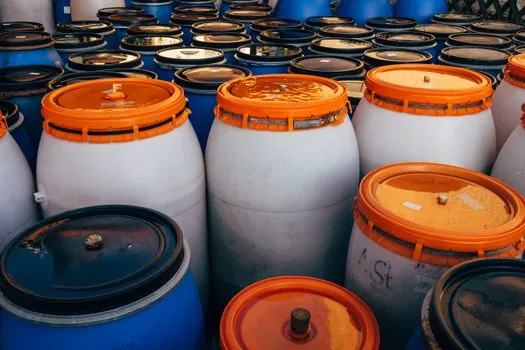
A purpose-built steel cage is the right answer for in-plant transfer of drum and IBC quantities, for staging at the loading dock, and for short-duration road transport where the inner UN packaging already carries the regulatory test load [S3][S6][S8]. It is also the right answer for a warehouse picking area that must keep mixed hazard classes physically separated on a chemical material storage rack while still allowing fork-truck access [S5].
It is the wrong answer for any application that needs to substitute for a fire-rated chemical storage building, a 10-day outdoor bulk chemical store, or a temperature-controlled cabinet for peroxide-forming reagents; those require engineered structures, not mesh cages [S2][S5]. Specifying a cage to replace a fire-rated outdoor storehouse has been a recurring audit finding in the U.S. chemical-storage market, where pre-engineered chemical storage buildings from suppliers such as U.S. Chemical Storage are sold specifically as a compliant alternative to ad-hoc containerised storage [S2].
Compatibility, segregation, and what not to mix in one cage
The compatibility matrix is the single biggest spec gate. Acids and bases must be physically separated, oxidizing acids (nitric, perchloric, sulfuric above the concentration threshold) must be isolated from flammables and from reducing agents, and cyanides and sulfides must be kept away from any acid to prevent HCN or H2S evolution inside the enclosure [S3][S4][S5]. Cornell EHS explicitly warns that alphabetical storage is a known cause of laboratory fires and toxic gas releases, and instead mandates storage by hazard class with SDS Section 7 (Handling/Storage) and Section 10 (Reactivity) cross-checked before co-location [S4].
Practical consequence for a cage spec: a four-drum stillage is acceptable for four compatible Class 3 solvents, but the same stillage holding one nitric acid drum plus three solvents is a documented failure mode, and the audit response is to relabel, reclassify, or split the cage on a segregated chemical material zone with its own bunding [S4][S5]. For the storage of reagents in the workplace, the same hazard-class segregation logic that drives cabinet selection also drives cage selection, and the chemical reagent class on the SDS is the controlling input [S4].
Construction details: mesh aperture, galvanising, fork pockets, and labeling

Three construction details separate a chemical-rated cage from a generic wire-mesh stillage. First, mesh aperture must be small enough to prevent a drum or pail from being lifted through the side under impact, while still allowing weekly visual inspection of the SDS label and the drum shell condition; common industrial sizes sit in the 50 mm × 50 mm to 50 mm × 100 mm range for drum stillages [S7]. Second, the finish must tolerate the stored chemical; hot-dip galvanising is standard for outdoor and corrosive atmospheres, while powder-coated mild steel is acceptable indoors where the inventory is dominated by flammables and non-oxidizing materials [S5][S7].
Third, fork pockets and stack frames must be rated for the combined payload; an IBC stillage holding a 1000 L tote of aqueous solution can exceed 1200 kg, which puts the cage into the heavy-duty fork-pocket class and rules out light-duty stacking frames sold for general warehouse use [S6][S7]. Each cage or stillage must also carry its own hazard-class label, capacity rating, and sump volume so a receiving EHS team can match it to the chemical material class without opening the unit [S4][S5]. A useful procurement check is to confirm the manufacturer publishes the sump volume in litres and the maximum stack load in kilograms, and that the cage is sold alongside, not instead of, the inner UN-rated drum or IBC [S1][S6].
Standards, audit signals, and what the receiving site will ask for
For shipments inside the U.S., the cage itself is not subject to UN performance testing as a packaging; that test load is carried by the inner drum or IBC. What the receiving site will ask for is evidence that the cage is non-combustible, that the sump is liquid-tight, and that the cage is segregated by compatibility class on a compliant chemical storage rack or in a compliant chemical material cabinet layout [S3][S4][S5]. OSHA 29 CFR 1910.106 and NFPA 30 are the most commonly cited U.S. references for flammable storage cabinets, while Australian operators are pointed at AS 1940:2017 (Class 3), AS 4326:2008 (Class 5.1), AS 2714:2008 (Class 5.2), AS/NZS 4452:1997 (Class 6.1), and AS 3780:2008 (Class 8) for container construction [S3].
Two operational signals from late 2025 and 2026 confirm where the market is moving. Cabinets and enclosures are increasingly being specified with self-closing or manual-close doors, adjustable shelves, raised sills, and grounding provisions rather than as bare lockable boxes, per a July 2026 chemical storage cabinet guide [S5]. At the same time, U.S. distributors are continuing to expand SKUs in drums-and-accessories (1,320 listings), safety cabinets (1,192), and cans-and-pails (537) on a single hazardous-materials storefront, which is a reliable proxy for the package formats the cage fleet must accept [S1]. For operations teams that already use a chemical storage rack system indoors, the next procurement step is to standardise on one cage footprint per package type and to issue a segregation map keyed to SDS Sections 7 and 10, rather than to specify a new enclosure per shipment [S4][S5].
Related analysis: Aluminum Veneer Panel Selection for Prefabricated Construction: 2026 Spec Map.