
Industrial buyers waste the most time on storage rack quotes when they treat the datasheet as a price list instead of a structural-mechanical document; the four blocks that decide fit are U-height and form factor, static plus dynamic load per bay, frame material grade, and the seismic or compliance line referencing a recognised standard [S1].
This applies to both IT-style cabinet racks covered in OEM datasheets such as Cisco UCS C-Series and Oracle Exadata — where rack requirements are published as a single tied bundle of dimensions, weight, power and maintenance clearance [S1][S3] — and to warehouse pallet rack, where load class and frame section replace server U-height as the deciding line.
U-Height, Form Factor and the Maintenance Envelope
The Exadata Storage Server X5-2 Extreme Flash is documented as a 2 rack unit (2U) storage server, and the rack specification table is bound to a separate "Rack Requirements" page that lists supported Oracle rack models, minimum depth, and the maintenance space that must be left at the front and rear before rails can be extended [S1]. Cisco publishes a parallel pattern: the UCS C-Series datasheet index lists C245 M8, C240 M8, C880A M8, C845A M8, C225 M8, C885A M8 and C220 M8 / C220 M7 / C240 M7 sheets, each pinning a specific 1U or 2U chassis to a rail-kit part number and a defined keep-out zone [S5]. Treat U-height as the first filter, then confirm rail-kit compatibility, then check the published front/rear clearance number — skipping clearance is the single most common install-day surprise in IT rack datasheets [S1][S5].
For a non-IT comparison, a standard selective pallet rack bay uses the upright frame height in millimetres (commonly 2,438 mm to 6,096 mm) plus the beam length in mm as its equivalent of the U-height line; form factor there is "frame pitch × bay depth × beam level count", not rack units, but the data-sheet role is identical — define the envelope before the load.
Load Ratings: Static, Dynamic and the Bay-Level Math
Cisco and Oracle IT datasheets do not publish "static/dynamic" — they publish "maximum operating weight" of the chassis (commonly 22–36 kg for 1U, 40–55 kg for 2U density servers) and a "rack unit maximum static load" of the receiving cabinet (commonly 1,000–1,500 kg for 42U vendor racks) [S1][S5].
For warehouse storage rack selection the comparison that matters is beam load (kg per pair) versus frame load (kg per upright pair) versus anchor load (kg per baseplate bolt, derived from frame load / safety factor); a heavy-duty selective bay in the 3,000–4,000 kg-per-beam band with a 24,000 kg-per-frame rated upright is a typical pallet-handling cell, while a drive-in or push-back cell drops the per-beam number to roughly 1,000–1,500 kg but extends the run length to 6–10 pallets deep. The same Excel-style comparison sheet that an IT buyer runs on chassis weight vs rack-unit load is what a warehouse buyer runs on beam vs frame vs anchor — only the units change.
Frame Material, Finish and Section Geometry
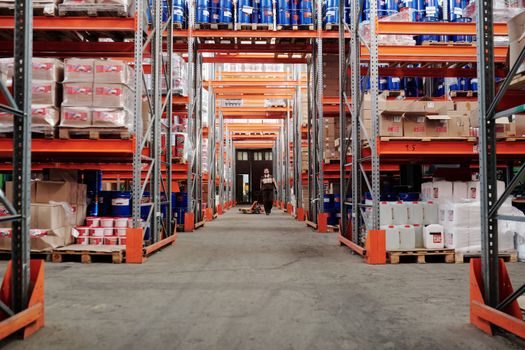
IT rack datasheets list cold-rolled steel with a typical thickness of 1.5–2.0 mm for side panels and 2.0–2.5 mm for the mounting rails, with a powder-coat or zinc-plated finish rated for the manufacturer-declared operating humidity range (commonly 10–90% non-condensing) [S1]. Warehouse rack datasheets are less standardised and the buyer has to read three sub-lines: steel grade (a domestic Q235 or Q355 is common in Asian supply, ASTM A36 / A572 Gr.50 in North-American supply, S235JR / S355JR in European supply), section profile (C-section or roll-formed sigma post, with sigma post carrying roughly 10–15% more frame load at the same steel weight), and the finish (powder-coat to 60–80 µm for indoor, hot-dip galvanisation to 60–120 µm for cold-store or outdoor cells). A storage cage variant for parts containment typically uses 50×50 mm wire mesh welded into a 25×25 mm or 50×50 mm aperture on the same frame section as the parent rack.
For IT racks the analogous "section geometry" line is rail-kit style: square-hole, round-hole, or threaded (M6 cage-nut) pattern, with cage-nut rails rated for repeated re-configuration and round-hole rails generally the lowest cost but limited to fixed-position gear [S5].
Compliance, Seismic and the Standard Reference
Seismic-rated IT rack datasheets publish a Shake-table certification zone (commonly Zone 1–4 or IBC seismic design category A–F) plus a load derate factor (commonly 0.5–0.75 of the static load) [S1]. Warehouse rack datasheets reference regional standards: RMI/ANSI MH16.1 in North America, EN 15635 plus EN 15512 in Europe, AS 4084 in Australia, and GB/T 28576 in China; the datasheet should list which standard the per-beam and per-frame numbers were tested to, because a beam rated to RMI is not directly comparable to a beam rated to EN 15512 without applying the manufacturer-published conversion [S3].
For IT racks Cisco publishes a Safety and Compliance Guide in parallel to the data sheet, and Oracle ties rack installation to the same separation (Exadata publishes Rack Requirements, Maintenance Space Requirements and Configuration Restrictions as three linked pages) [S1][S3][S4]. If the standard reference is missing from the datasheet PDF, treat the load numbers as marketing — ask for the test certificate number before paying.
Decision Comparison: IT Rack vs Pallet Rack vs Storage Cage on Four Criteria
The four criteria that survive contact with procurement are: (1) load class per cell, (2) standard reference, (3) typical lead time from a domestic China supplier, (4) primary failure mode. A 42U 1,500 kg-static IT cabinet references IEC 60297 or the OEM's own mechanical spec, ships in 2–4 weeks from inventory, and fails first at the cage-nut rail or the castor under shock load. A 3,000 kg-per-beam selective pallet rack references EN 15512 / RMI MH16.1, ships in 3–5 weeks for a domestic China order, and fails first at the beam-end connector or the base-plate anchor under a forklift impact. A drive-in rack with 1,000–1,500 kg-per-beam ships in 4–6 weeks, references the same standards, and fails first at the rail/roller interface or the front column if the cell is hit by a misaligned truck. A storage cage on a 1,000–2,000 kg frame references a wire-mesh plus frame standard combination and ships in 2–3 weeks, failing first at the welded mesh-to-frame joint on impact. [S1]
Reading the Datasheet: Sequence That Saves a Re-Quote
The shortest path through any storage rack datasheet is: U-height or frame height and form factor first, then static and dynamic load per bay, then material grade and finish, then the compliance/seismic line and its standard reference, and only then weight, power, colour, accessories and warranty [S1][S5]. Skipping straight to price is the documented cause of every "the rack arrived and the rails do not fit" re-quote that warehouse and IT buyers report in equal proportion [S1][S3]. For warehouse projects, two further checks save the most time: confirm the per-frame load is the manufacturer-tested number (not a calculated sum of beam loads) and confirm the base-plate anchor pattern matches the floor slab's bolt-in template before the order is released.
Trackable next signals: the OEM datasheet index for IT racks — Cisco lists C245 M8 and C240 M8 as the most recently revised rack-server data sheets on 16 March 2026 [S5], and warehouse rack buyers should watch for the next MH16.1 / EN 15512 revision cycle because the load-conversion factor between regional standards is updated alongside the standard, not alongside the datasheet.
For related coverage, see Glass Curtain Wall 2026: Specs, Cost Bands and Sourcing Signals.