DirectIndustry's stretch-wrapper category lists 132 manufacturers offering 743 products as of 2026-07-10, while Alibaba's supplier index for stretch-film wrapping machines returns 1,832 matched suppliers on 2026-06-10 — together the clearest current read on how fragmented this equipment class is [S1][S2][S5].
Chinese manufacturers dominate the SKU count: Shandong Sinolion Machinery alone lists 75 products, Shanghai Fhope Machinery 101 products, Shandong Dyehome Intelligent Equipment 20 products, and Dongguan Xutian Machine 16 products on DirectIndustry's index page — a concentration that maps directly to the lower price tiers on Made-in-China.com [S2].
Price Tiers and Where Each Band Sits
Made-in-China.com lists entry-level mechanical stretch wrapping machines at US$500.00–2,000.00 per piece (1-piece MOQ) under Taizhou Shengbai Electronics on 2026-05-18, while a higher-tier stretch-film slitting/rewinding line is quoted at US$10,000.00–11,000.00 on 2026-07-10 [S3][S8].
The pricing spread on Alibaba runs across the same envelope: 1,832 suppliers matched on a 2026-06-10 search, with the cheapest pallet-wrapper SKUs clustered around the US$500–2,000 mark and integrated automatic palletizing-wrapping lines reaching well above US$10,000 once conveyors, top-sheet dispensers, and integrated stretch film pre-stretch carriages are added [S5][S8].
For a process engineer, the price tells you the duty class: sub-US$2,000 buys a mechanical-brake turntable for light, stable loads in the 1,200–1,650 mm pallet range; US$5,000–11,000 buys powered pre-stretch (200–250% ratio) and motorised film carriages; above that, you are paying for rotary-arm or rotary-ring architectures that handle unstable or extra-tall loads. See the wider wrapping machine family for the architectural comparison.
Machine Architectures: Turntable, Rotary Arm, and Rotary Ring
Three architectures define the supplier landscape, and each maps to a different load profile: turntable, rotary-arm, and rotary-ring wrappers [S1].
Turntable wrappers dominate the low- to mid-tier — Shandong Sinolion's T1650F-L runs a 1,650 mm table width, 2,745 mm length, and selectable heights of 2,200 / 2,800 / 3,200 mm; Shandong Dyehome's TP1650F-M and TP1650F-R share a 1,650 mm table diameter, 0–12 rpm rotation, and 1.55 kW motor — well-suited to glass, hardware, ceramics, chemicals, food & beverage, and building materials [S1].
Rotary-arm wrappers cover the heavy/unstable load segment: Sinolion's R1800FZ-PL-FM1800 accepts 1,200 × 1,200 mm pallets up to 1,600 mm wrapping height with an open-door pre-stretch film carriage offering 250% stretch ratio (1 m to 3.5 m of film) plus a swappable 200% sprocket, while the S1800EZ-PL runs 14–35 µm film at 500 mm width on a 3" core [S1].
Rotary-ring wrappers sit at the high-throughput end: Sinolion's AWR|PRO handles 2,000 × 1,400 mm pallets up to 2,400 mm wrapping height and is positioned for order-picking and logistics lines where the load cannot be rotated [S1]. Compare this to the shrink wrapping machine class when heat-shrink rather than stretch is the required end-pack.
Pre-Stretch Film Carriage: 200% vs 250% Ratio
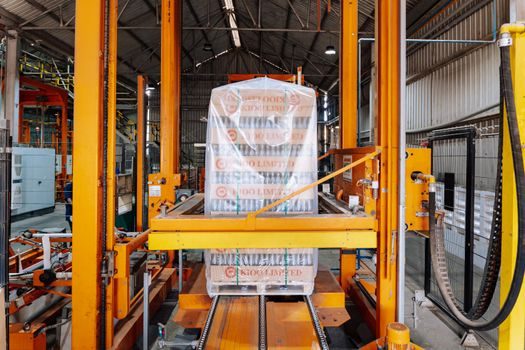
Pre-stretch ratio is the single biggest film-cost lever on any stretch wrapper, and current OEM offerings cluster at 200% and 250% mechanical pre-stretch [S1].
Sinolion's R1800FZ-PL-FM1800 ships with an open-door pre-stretch film carriage rated at 250% stretch (1 m of film becomes 3.5 m of wrap) and includes a spare 200% sprocket for operator swap — a deliberate dual-ratio design that lets a plant tune film yield versus load containment without buying a second machine [S1].
Film specification on the same Sinolion platform: 3" core, 500 mm web width, 240 mm max outer diameter, 14–35 µm thickness — the window that covers the bulk of LLDPE stretch film on the market. Stretch film gauge choice and pre-stretch ratio interact: pushing from 23 µm at 200% to 17 µm at 250% keeps equivalent containment while cutting film mass per pallet by roughly 30%.
Throughput, Utilities, and Floor-Space Footprint
Turntable rotation speed is a useful proxy for single-pallet cycle time: the Dyehome TP1650F-M and TP1650F-R both run 0–12 rpm on a 1.55 kW motor, so a 12-revolution bottom-wrap programme on a 1,650 mm turntable takes roughly 60 seconds at the top of the band, plus 5–10 seconds for film cut-and-clamp [S1].
Compressed-air utility on the Sinolion S1800EZ-PL is explicitly specified in the manufacturer's datasheet, which is the cue to check plant air supply (typical 0.6–0.8 MPa) before specifying an automatic cut-and-clamp arm [S1].
Power draw stays modest — 1.55 kW on the standard turntable class — but a rotary-arm or rotary-ring with powered pre-stretch will draw 2–4 kW once the carriage drive and ring motor are added. Floor space is the real constraint: a 1,650 mm turntable with 2,745 mm length needs roughly 3 × 3 m of clear floor with fork-truck access, while a rotary-arm in the 1,600 mm wrap-height class needs 4 × 4 m to clear the arm sweep. Plants running shrink wrapping machine tunnels alongside should budget separate floor zones — heat and film waste rule out shared cells.
Geographic Concentration and Sourcing Channels
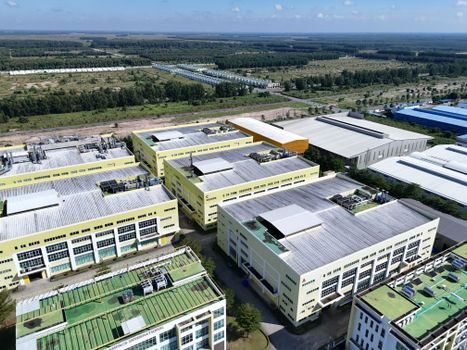
China holds the densest supplier cluster in the 2026 index, with at least 30 of the 132 DirectIndustry-listed brands operating from Shandong, Shanghai, Jiangsu, Guangdong, Zhejiang, or Anhui [S2].
India is represented through packaging-machinery specialists such as Pack Mach Systems, which lists rotary-arm reel wrappers, double-head automatic reel wrappers, and single-head radial reel wrappers for cable-coil and reel-format loads on 2022-05-21 — a useful regional option for South Asian buyers [S9].
Europe splits between German engineering houses (Affeldt Maschinenbau, AUTEFA Solutions, BEUMER Group, Humboldt Verpackungstechnik, LOESCH Verpackungstechnik, Mosca, Möllers) and Italian stretch-wrapper specialists (Robopac, COMARME, Cyklop Italy, Marchetti Packaging, Messersì Packaging, Oemme, ITALDIBIPACK, BARBERAN) [S2]. Robopac alone lists 22 products on the index page, putting it in the top five global SKU counts alongside the Chinese majors [S2].
For sourcing, the 2026 buying path looks like: shortlist from the DirectIndustry 132-brand index, request formal quotes via Made-in-China.com's RFQ basket or Alibaba's Buying Request Hub, then validate the shortlist on the supplier's own site — Hangzhou Sili Intelligent Technology (est. 2014-11-04, 10–30% repeat-buyer rate) and Shandong Dyehome Intelligent Equipment both maintain English-language factory pages with full model lists [S5][S6][S7].
Selection Criteria: Matching Architecture to Load
Selection comes down to four decision criteria, and the answer changes with each load profile [S1][S2].
First, load stability: stable, uniform pallets (cartons, bagged goods) → turntable at the lowest cost; tall, top-heavy, or unstable loads (beverage, chemical drums) → rotary-arm, since rotating the load risks product damage. Second, throughput: under 30 pallets/hour → turntable is sufficient; 40–80 pallets/hour with no rotation → rotary-ring; above 80 pallets/hour with continuous flow → integrated wrapping machine cell with conveyors and top-sheet dispenser.
Third, film yield: 200% pre-stretch suits standard LLDPE load containment; 250% pre-stretch cuts film cost per pallet by 25–30% but requires a higher-grade film and tighter tension control. Fourth, ceiling height and floor load: a 2,400 mm rotary-ring (AWR|PRO class) needs roughly 3.5 m of clear ceiling and a reinforced floor for the 800–1,200 kg machine mass, while a 1,650 mm turntable fits through a standard 2.4 m doorway and weighs 350–500 kg [S1].
The 2026 supplier base is broad enough that any of the three architectures can be sourced at sub-US$11,000 from a Chinese OEM, while European equivalents (Robopac, FROMM, Mosca) typically price 2–3× higher but offer longer documented service life and CE/UL documentation bundles. Plants that already run a coding machine on the outfeed should specify the wrapper-conveyor interface at the RFQ stage, not after delivery.
Watch-Points When Reading Supplier Spec Sheets
Three failure modes show up repeatedly in this equipment class, and supplier datasheets will not flag them for you [S1][S8].
First, the 200%-vs-250% pre-stretch claim is meaningless without a film-grade reference: a 250% pre-stretch on a 14 µm economy LLDPE tears at the carriage rollers, so the 250% rating is only valid on 20–23 µm film from a qualified stretch film supplier. Second, the "max pallet size" figure is usually the diagonal, not the length × width — Sinolion's 1,200 × 1,200 mm rating assumes square pallets, and 1,200 × 1,000 mm rectangular pallets will not wrap the corners correctly on some carriages [S1].
Third, the turntable diameter and pallet size interact: a 1,500 mm turntable (Dyehome TP1650F-L's lower setting) takes pallets up to roughly 1,200 × 1,200 mm safely, but a 1,200 × 1,400 mm pallet will overhang and hit the safety rails at the 12 rpm top speed [S1]. For plants that have standardised on the 1,200 × 1,000 mm EUR-pallet footprint — common in European storage rack system layouts — the 1,650 mm turntable class is the right fit, not the 1,500 mm.
Track these signals next: Alibaba's supplier count crossing or falling back through 1,800 active SKUs, the appearance of new Chinese provincial manufacturing clusters (Anhui and Hebei both gained suppliers during 2024–2025), and any CE/UL re-certification filings on the European OEM side as the next EU Machinery Regulation cycle settles. cutting machine and core machine lines that feed into the same converting cell tend to move on similar lead times, so a stretch-wrapper RFQ is a good moment to bundle the upstream inquiry.