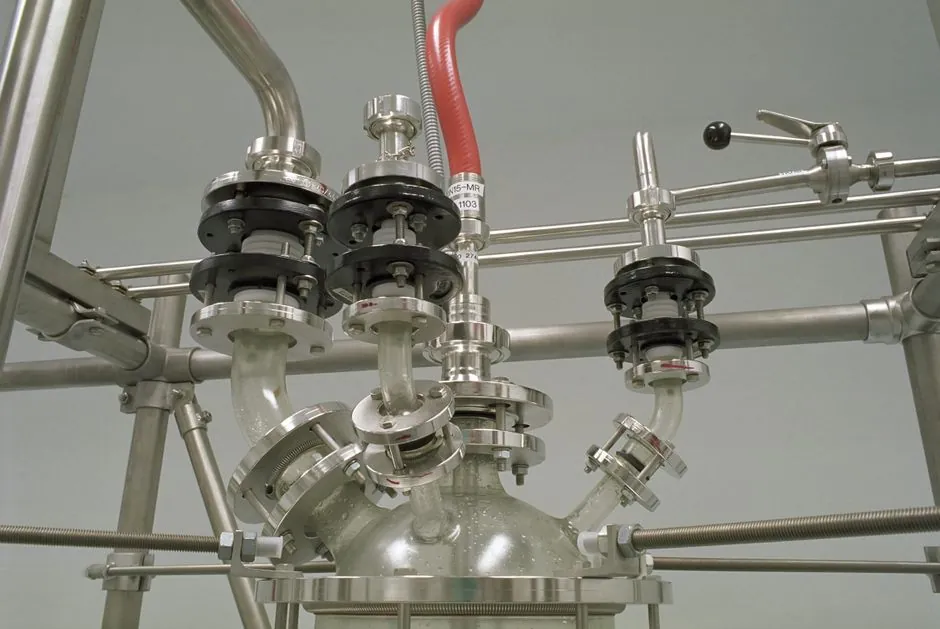
Field service data from major automatic tank gauge vendors shows that the magnetostrictive level probe is a sealed, single-piece assembly whose internal waveguide wire, pickup coil, and pulse driver are potted inside a stainless measuring tube [S5].
The unit enters the tank through a 2" or 4" riser at the top of the tank, where the only serviceable interface is the head and conduit seal above the bung [S3]. Once that head is removed, the operator is committed to pulling the whole probe shaft out through the same opening, with floats and temperature thermistors attached [S1].
Why the inner element is not a serviceable subassembly
The magnetostrictive measurement is absolute because the sensor measures the time-of-flight between a current pulse launched down the magnetostrictive wire and the torsional pulse returned from the float magnet, not a stored mechanical position [S7].
That waveguide wire is held under tension inside the stainless tube and is terminated at both ends with damping elements that suppress the reflected pulse; cutting into the tube to extract the wire would destroy the calibrated time-domain behavior the probe depends on [S5].
OEM documentation for the MAG Plus type lists the probe as one line item with no published sub-component part numbers for the waveguide or pickup, and field-repair manuals from the same vendor treat the tube, head, and floats as a single replaceable length class to be swapped as a unit [S1].
The accepted field procedure: lift and replace
Standard service workflow starts with de-energizing the ATG console, relieving any product pressure on the riser, and unthreading the probe head compression fitting to break the tank seal [S3].
The probe shaft is then withdrawn vertically through the riser with the floats still on the wire, which constrains the minimum practical riser ID to roughly 50-100 mm depending on float diameter; under AST installations the probe is typically specified for tanks up to 12 ft (3.66 m) in diameter with rigid stainless construction [S1].
Reinstallation is the reverse: lower the new probe, torque the head per the OEM spec, re-pressurize the riser with a leak-test (commonly 5 psi air or 3 ft of product head, vendor-dependent), and re-commission inventory offsets on the ATG before returning the tank to service [S3].
What the sealed-tube design actually protects

Potting the waveguide inside a hermetic tube blocks fuel vapors, water-phase ingress, and biofilm that would otherwise damp the torsional pulse and shift the time-of-flight reading by millimetres to centimetres over months of service [S5].
It also lets the probe carry an intrinsic safety rating for Class I, Division 1 / Zone 0 group environments inside the tank, since no user-accessible electrical path reaches the product; the explosion-protection certification is invalidated the moment the tube is breached, regardless of how cleanly the work is done [S3].
For the same reason, the temperature-sensing thermistor chain embedded in the probe cannot be spliced in-line; a damaged thermistor requires full probe replacement because the chain is calibrated as a multi-point string with matched resistance tables, not individually replaceable elements [S4].
Limits and failure modes that drive replacement, not repair
Common end-of-life triggers in fuel and chemical service include float waterlogging, magnetostrictive wire fatigue at the float coupling, and riser-thread corrosion that seizes the head, each of which forces extraction of the complete assembly rather than a targeted internal repair [S4].
Confined-space entry is explicitly avoided by current inspection practice: a March 2026 study in the journal Sensors demonstrated that an external 8x8 magnetostrictive transducer array can map internal corrosion on the tank shell and bottom extension without emptying the vessel, reducing the incentive to open the tank for any reason other than swapping the level probe itself [S2].
Where the unit must be removed, downstream inventory reconciliation is straightforward because the MAG Plus family reports absolute level, not a relative position, so a freshly installed probe of the same length class returns accurate volume within one thermal cycle without re-zeroing the tank strapping table [S7].
Selection criteria when specifying the replacement
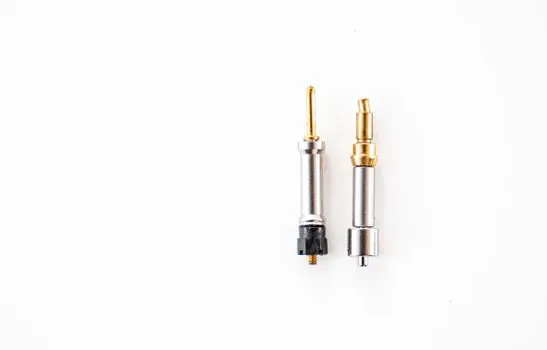
Matching the original probe length and float kit is the dominant selection rule, because length drives the calibrated time base and the float kit defines product, water, and interface detection channels on the ATG [S1].
For gasoline and diesel UST service the typical build is a 4-digit resolution rigid stainless probe with product and water floats plus a 5-thermistor temperature chain, factory-set for 0.5 in (12.7 mm) level resolution over lengths up to about 12 ft (3.66 m) of active measuring range [S1].
Side-by-side comparison of the main service options on four decision criteria:
Pull and replace full probe through existing riser: works on any sealed-tank application, requires zero confined-space entry, restores calibration automatically, but needs the replacement unit on hand and a compatible float kit [S1][S7].
External guided-wave magnetostrictive corrosion scan: keeps the tank in service entirely, maps shell and floor thinning, but does not repair or replace the level probe; it is a screening tool, not a fix [S2].
Defer the swap and rely on redundant ATG leak detection: viable where 0.2 gal/h statistical leak detection is mandated and the probe is treated as secondary, but it leaves inventory and water-detection functions on a degrading sensor [S1].
Each of these is a decision-tree branch, not a comparable hardware swap, and the practical answer to the original question remains the same: the sealed magnetostrictive sensing element is not a field-replaceable cartridge, and the supported path is full probe extraction through the riser followed by a like-for-like reinstall. Operators planning a service event should stock a replacement of the same OEM length class and float configuration, and treat the riser compression seal and head O-ring as the only consumable service parts.
Trackable next signals: confirm whether any 2026-2027 OEM release publishes a modular waveguide cartridge that can be withdrawn through a 2" riser without breaking the tube seal, and watch for revision of PEI/RP100 or equivalent recommended-practice guidance covering sealed-probe extraction tooling.
Spec-level background on the components involved: proximity probe, magnetostrictive level transmitter, and filter element.
Background reading: Single-Stage Harmonic Reducer Selection: Ratios Up to 160:1.