
A toroidal conductivity meter reading tracks acid strength linearly from about 1 wt% upward, while below 0.1 wt% the same loop collapses and a pH meter is the only measurement that resolves concentration usefully [S4].
Strong acids such as HCl and H2SO4 fully dissociate, so almost every dissolved molecule contributes H+ plus its conjugate base; that ionic mass is exactly what a conductivity cell counts, and a calibration curve of mS/cm versus wt% is repeatable to within roughly ±2% across 0.5-10% acid once temperature is compensated [S3][S4].
Where conductivity cleanly tracks acid strength
Industrial electrodeionization and pickling baths exploit that fact: a 4-electrode toroidal sensor with 0.001-2,000 mS/cm range, PEEK body, and Class I Div 1 hazardous-area rating is now specified for electrolyte-loop monitoring in water-electrolysis plants, where strong acids must be dosed without sending the cell voltage outside its safe operating window [S1].
Where conductivity fails and pH stays necessary
Below about 50-100 ppm acid, the conductivity signal is swamped by dissolved CO2, trace ammonia, or the deionized-water background of 0.055 µS/cm (18.2 MΩ·cm), so the same cell that reads 200 mS/cm in 1% HCl cannot resolve a 10 ppm HCl swing [S3].
Weak acids invert the relationship: ethanoic (acetic) acid at the same mass concentration as HCl produces fewer free ions, lower conductivity, and a higher pH, because dissociation is partial; a conductivity loop used for HCl control would therefore under-report acetic acid by a factor of 3-10x and mis-feed the dosing pump [S4].
Decision criteria: pH, conductivity, or both
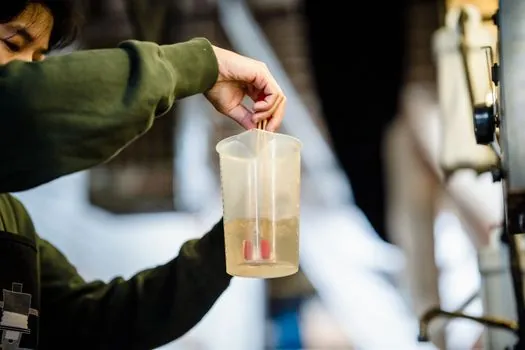
Three criteria decide which sensor (or which pair) fits a given acid loop: signal selectivity, range, and contamination tolerance. Strong mineral acids above 0.5% win on conductivity, since the signal is selective to H+ and linear, while trace acid below 100 ppm and any weak-acid stream force a pH meter installation [S3][S4].
For mid-range loops (0.05-0.5% strong acid) the engineering call is a redundant pair: conductivity as the fast, drift-free trend signal feeding a control valve positioner, and pH as the selectivity check that alarms on weak-acid or organic contamination the conductivity loop would otherwise miss [S1][S3].
Process integration and standards context
Inline conductivity sensors rated 0.001-2,000 mS/cm with PEEK housings and integrated NTC 30K temperature compensation are now commonly installed in hazardous-area electrolyte loops alongside pressurized-reference pH electrodes carrying Class I Div 1 approvals, the combination being treated as a single analyser skid in current OEM guidance [S1].
Wiring the pair back to a control cabinet is straightforward: both sensors accept 4-20 mA with HART, and the same multi-core control cable run can carry both loops if the cabinet segregates the analogue and the HART segments, which avoids the ground-loop drift that otherwise degrades pH at high source impedance [S1].
Limits, failure modes, and what to watch
For more on how inline measurement choices feed into wider plant data architectures, see the practical comparison of paper chart recorders and modern data loggers, which sets out the same sensor-replacement logic for compliance-grade streams. Hydrogen-handling electrolyte loops also need to be evaluated against the safety-instrumented controls covered in the personnel vs process guard-locking decision map, since acid dosing interlocks and access-control logic are usually specified together.