A single-stage strain wave gearhead achieves reduction ratios of 30:1 to 160:1 in one stage, with zero backlash and peak torque ratings from 450 in-lbs to 60,500 in-lbs across standard size families [S3].
The working envelope of a cup-type strain wave reducer spans motor inputs from 10 W up to 15,000 W, with the same 3-part topology (wave generator, flexspline, circular spline) delivering 30:1, 50:1, 80:1, 100:1, 120:1, and 160:1 stock options [S1][S3].
Operating Principle and Tooth Geometry
The strain wave mechanism reduces speed by counting the tooth-count difference, not the total number of meshing teeth: with the circular spline fixed and a 200-tooth flexspline carrying 2 fewer teeth than the rigid internal ring, the flexspline rotates backward by exactly 2 teeth for every full revolution of the elliptical wave generator, producing 100:1 reduction in a single compact stage [S2].
The "S-tooth" profile engages roughly 30% of total teeth simultaneously, widening the tooth root and raising root radius to cut stress concentration, which translates directly to high torque capacity, high torsional stiffness, and a flexspline strain of about 0.3% at the major ellipse axis [S1].
Single-Stage Ratio Range and Family Sizing
Standard cup (CSG) and shaft (CSF) families publish stock ratios of 30:1, 50:1, 80:1, 100:1, 120:1, and 160:1; the high-precision CSF-GH gearhead line offers 50:1 to 160:1 ratios in the same envelope with a proprietary S-tooth mesh for sub-arc-minute repeatability [S1][S9].
Size scaling runs from compact size 3 units up to size 58 units, with the larger sizes carrying the higher peak torque ratings (the 60,500 in-lbs ceiling comes from the largest frame sizes) [S3][S7]. For applications needing only 4:1 or 5:1, dedicated low-ratio stages exist, but anything above 10:1 in a planetary reducer requires a two-stage carrier stack, which is precisely the envelope a strain wave unit covers in one stage [S6].
Comparison: Harmonic vs Planetary vs Cycloidal at 50:1-160:1

At a 100:1 reduction target, a single-stage strain wave unit fits in one cup with near-zero backlash, while a planetary gear reducer must be stacked into a two-stage carrier (first stage ~10:1, second stage ~10:1) to reach equivalent ratio, accepting the backlash of two meshes; a cycloidal reducer can also reach 30:1 to 160:1 in one stage but uses an eccentric cam drive and needle bearings rather than elastic flexspline deflection, giving different torsional stiffness and life characteristics [S5][S6].
The decision matrix at 50:1-160:1 comes down to: zero backlash and compact envelope (harmonic wins), peak shock tolerance and longer flex-life under reversing loads (cycloidal has an edge on life when properly lubricated), and lowest cost at moderate ratios below 30:1 (planetary still dominates) [S1][S5][S6]. Harmonic units fit the same NEMA-mounting footprints as a gear reducer for stepper or servo motor integration, making them a drop-in for retrofit axes [S4].
Failure Modes and Flexspline Life
Flexspline fatigue life sets the gearbox life, typically 7,000 to 35,000 hours depending on load profile, because the thin cup deflects elastically every input revolution; shock loading past rated peak torque produces tooth-tip fatigue cracks at the major axis within a few hundred hours [S2].
Wave generator bearing wear degrades the ellipse geometry and shows up as audible ratcheting under torque before the unit loses positioning accuracy, while lubricant degradation (grease grade SK-1A or equivalent) is the other dominant failure driver, since the same grease carries the entire tooth-mesh load and, once it shears, tooth wear accelerates rapidly [S2].
Application Fit and Motor Pairing
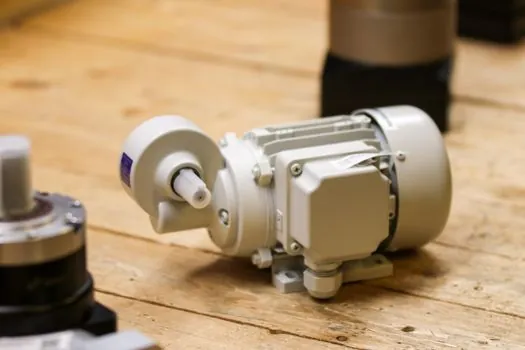
Strain wave gearheads are specified where the application demands zero backlash, high ratio in a single stage, and a compact coaxial envelope: industrial robot joints, surgical robotics, semiconductor wafer-handling stages, spaceflight actuators, and machine tool rotary axes [S1][S2].
For stepper and servo motor pairing, the cup (ZXS-series) and shaft variants both accept standard servo input couplings across NEMA 17, 23, 24, 34, and 42 frame steppers, with stock ratios of 30:1, 50:1, 80:1, 100:1, 120:1, and 160:1 in the 30:1 to 160:1 catalog window [S4]. Closed-loop stepper retrofits on encoder feedback axes often pair a harmonic cup with an NEMA 23 or 34 closed-loop motor, where the single-stage ratio removes the inertia and backlash that a two-stage planetary would add.
Use Cases and Selection Boundaries
Choose a strain wave reducer when the ratio exceeds 30:1, backlash must be below 1 arc-minute, and envelope diameter matters more than absolute cost; the technology has become the reference fit for collaborative robot joint modules, where the 30:1 to 160:1 ratio window covers the full torque/speed map of a 6-axis cobot [S1][S2].
Do not specify it for continuous high-RPM input above the rated speed of the wave generator bearing, for applications requiring shock loads well beyond peak torque, or for cost-driven axes under 10:1 where a single-stage planetary reducer does the job at one-third the unit price; harmonic pricing is justified by the flexspline machining and the precision bearings, not by the steel mass [S1][S5][S6].
Spec Verification Checklist

Confirm rated peak torque (in-lbs or Nm) at the specific ratio ordered, repeatability in arc-minutes, torsional stiffness in Nm/arc-min, and flexspline life in hours at the application's load profile; these four numbers, drawn from the OEM data sheet, separate a 50,000-hour industrial harmonic from a 5,000-hour economy unit [S1][S3][S9].
For servo integration, verify mounting flange, input bore, and output shaft or cup dimension against the motor and driven load; a ratio calculation tool cross-checks tooth count and tooth-count difference against the published reduction (Nf/d, with d = 2 in most catalog units) [S2][S8]. Track the wave generator bearing condition during commissioning by monitoring current ripple on the servo drive: a rising ripple at constant load is the first indicator of ellipse deformation before any audible ratcheting appears [S2].
Two follow-up signals to watch: any 2026-vintage catalog update from Harmonic Drive LLC adding ratios above 160:1 as stock items (currently the documented ceiling is 160:1 in single stage, with 320:1 appearing in third-party educational materials) [S2][S3], and published flexspline life curves at elevated ambient temperatures above 40°C, where grease life shortens faster than the steel cup's elastic limit.