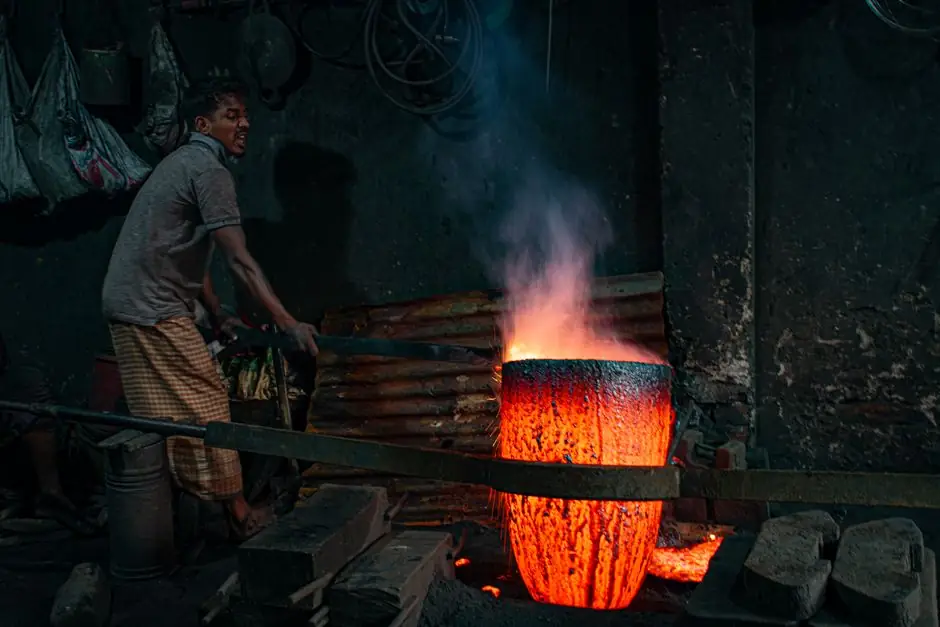
T6 solution treatment for aluminum castings is specified at 500-550 °C (typically 530-540 °C) with a 1-12 h soak, held within ±5 to ±6 °C of setpoint and 10-25 °F (6-14 °C) below the alloy's eutectic, then water-quenched at 66-100 °C and artificially aged at 154-227 °C to reach ~235 MPa UTS, 165 MPa yield, 70-105 BHN [S3][S5][S6].
The cycle is a three-step recipe: solutionize above the solvus to dissolve soluble phases into a single-phase field, quench fast enough to retain those solutes in supersaturated solid solution, then age at lower temperature to precipitate fine strengthening phases [S1][S4]. Furnace control, not just setpoint, is the variable that separates a T6 that meets print from one that has to be scrapped, which is why AMS 2750 / CQI-9 instrumentation governs every modern T6 line [S1][S4].
Solutionizing Temperature Window: 500-550 °C, Sourced to the Alloy's Eutectic
The published T6 solutionize window for cast aluminum is 500-550 °C, with the midpoint near 530-540 °C for the common 3xx.x/356/A356 type alloys [S6]. A TPi Cast practice cited 538 °C (1,000 °F) for 12 h on general castings, while a ScienceDirect overview referenced 470 °C / 6 h for one specific wrought/cast variant, and an MDPI 2025 study of T6 optimization on a foundry alloy ran 535 °C / 5 h [S2][S3][S7]. The operating rule is to hold within 10-25 °F (6-14 °C) below the alloy's eutectic or incipient-melt temperature: any tighter is technically ideal, any looser risks grain-boundary melting, blistering, and scrap [S4][S5].
For reference alloys the eutectic sits around 555-575 °C, which is why production lines peg setpoint to 530 ± 5 °C; for A206 / 2xx.x the solvus is higher, so setpoints drift to 525-540 °C, and for high-copper variants the safer setpoint is the lower end to avoid incipient fusion at Cu-rich boundaries [S4]. Heat-treat metallurgist Jon Dossett's guidance in Modern Casting is unambiguous: the safest band is the "10-25 °F below eutectic" rule, and that rule is the single reason furnace control tolerance of ±5 °F to ±10 °F ( ±3 to ±6 °C) is treated as a hard specification, not a preference [S4][S5].
Soak Time, Quench Transfer, and the Drop-Bottom Furnace
Soak times span 1-12 h depending on section thickness, alloy, and prior microstructure, with 5-12 h being typical for sand and permanent-mold castings in the 5-25 mm wall range and 1-3 h common for thin-walled die-cast or strip-cast product [S6][S7]. After the soak, the quench transfer is the second most failure-prone step: the time from furnace door opening to full immersion must be minimized, which is why drop-bottom furnaces (DBFs) are purpose-built so the hearth literally drops out, sending the load into the quench tank in under 1 second for batches of 50-100 lb (23-45 kg) [S4].
Quench media for castings is hot water or a water-glycol blend held at 66-100 °C (150-214 °F); cold water risks thermal-shock distortion, while 70 °C water is the most cited baseline for A356-class castings, with the MDPI 2025 study explicitly using 70 °C water quench as the reference condition [S3][S7]. Polymer quenchants (PAG) are used where distortion control is critical (aerospace structural castings, thin-wall housings), at 5-15 % concentration, with the same 60-100 °C window [S4]. The quench is followed by a straightening operation prior to aging, because the temperature differential between the solutionized casting and the bath leaves residual stress that must be mechanically corrected before precipitation aging locks the geometry in [S3].
Artificial Aging Step: 154-227 °C and the T6/T7/T71 Split
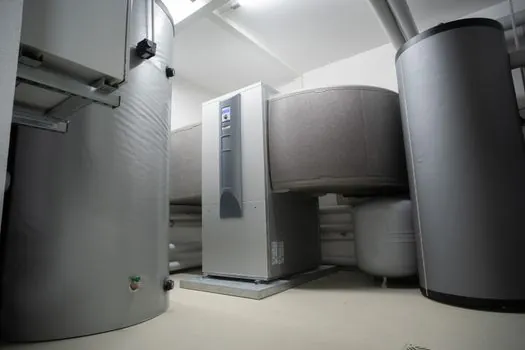
Artificial aging for T6 is a low-temperature, long-time precipitation step in the 115-200 °C band, with the canonical T6 cast cycle cited at 154-160 °C for 3-24 h and AZoM's reference for precipitation treatments covering 115-200 °C / 1-30 h depending on the alloy and target [S2][S3][S8]. T6 for castings most commonly runs 154 °C (310 °F) for 3-5 h, while T7 raises the aging to 227 °C (440 °F) for 7-9 h to over-age the matrix for improved dimensional stability at the cost of some peak strength [S3]. T71 is the compromise: 204 °C (475 °F) for 3-6 h, used where the foundry needs T7-like stability without the full T6 strength penalty [S3].
Mechanical-property targets are the audit number for a correctly executed T6. TPi's published targets for T6 cast aluminum are 235 MPa UTS, 165 MPa yield, 3.5 % elongation, 70-105 BHN, versus 215 MPa / 200 MPa / 3 % / 60-90 BHN for T7, and 160 MPa / 110 MPa / 45-75 BHN for the lower-temperature T51 stress-relief temper [S3]. The aging temperature is the single biggest lever between T6, T7, and T71: raising aging temperature from 154 °C to 227 °C trades roughly 20 MPa of tensile strength for an additional 35 MPa of yield strength, with elongation and hardness moving modestly [S3].
Comparison: T51 vs T6 vs T7 vs T71 on Decision Criteria
The four tempers commonly ordered for cast aluminum are T51 (stress relief only), T6 (peak strength via full solution + quench + age), T7 (over-aged for stability), and T71 (compromise). A side-by-side on four decision criteria, drawn from foundry-published property data, is the cleanest way to pick between them [S3]:
- Strength ceiling (UTS / yield): T6 leads at 235 / 165 MPa, T7 follows at 215 / 200 MPa, T51 sits at 160 / 110 MPa. T71 is between T6 and T7, closer to T7 [S3].<br>- Dimensional stability under thermal soak: T7 > T71 > T6 > T51; T7 and T71 are specified for parts that will see sustained elevated temperature in service (engine blocks, turbo housings) [S3].<br>- Distortion risk from quench: T6 highest (full water quench, ~150 °C ΔT), T7/T71 similar to T6, T51 lowest because there is no quench step [S3].<br>- Typical service: T6 = structural (automotive chassis nodes, aerospace structural, robotics arms); T7/T71 = power-train, brake, and engine blocks; T51 = non-structural (instrumentation, medical, semiconductor) [S3].
For new spec work, T6 is the default unless the part will spend time at >150 °C in service; the foundry heat-treat line for T6 must include a drop-bottom or fast-transfer furnace, a polymer or hot-water quench rated for 66-100 °C, and an aging furnace surveyed to AMS 2750 with a documented TUS [S4]. Standard furnace temperature uniformity per AMS 2750 is the audit gate, and the drop-bottom sub-1 s transfer is the mechanical reason T6 production lines are capex-heavy, not the heating elements themselves [S1][S4].
What Goes Wrong: Incipient Melt, Distortion, and Quench Sensitivity
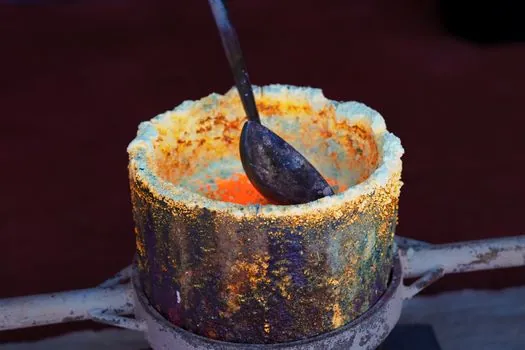
The three primary failure modes for an out-of-spec T6 are incipient grain-boundary melting, quench distortion, and over-aged/under-aged mechanical properties. Incipient melting happens when setpoint drifts above the alloy's eutectic, or when thermocouple placement is poor and a hot spot inside a thick section overshoots setpoint by more than ~10 °C; the visual signature is blistering and intergranular voids, and the only fix is to drop setpoint and re-test, the part is unrecoverable [S4][S5]. Quench distortion is the second most common reject: thin-wall castings (<5 mm) warp on water quench, and the standard mitigation is a polymer (PAG) quench or a stepped water-air-water cooling ramp, which slows the surface cooling rate while still meeting the >100 °C/s critical cooling rate for Al-Mg-Si systems [S4].
Mechanical-property misses (UTS or yield below spec) usually trace to one of three causes: solutionizing soak that was too short to dissolve coarse Mg2Si or Al2Cu networks, a quench transfer that was too slow (>5 s from door-open to immersion drops hardness by 10-15 %), or an aging step that was either truncated or carried out at the wrong temperature (a 10 °C error in aging setpoint shifts peak hardness by 2-4 BHN) [S4][S5][S7]. Furnace control tolerance is the dominant variable across all three: a ±5 °C furnace is the practical floor for T6 production, and ±3 °C is becoming the new standard for tight-spec aerospace castings [S5].
Furnace Hardware: Drop-Bottom, Box, and Continuous T6 Lines
For batch T6 processing at 1-5 t/day throughput, the dominant cell is a drop-bottom solutionizing furnace paired with a hot-water quench tank and a separate batch aging oven, all surveyed to AMS 2750 with class-1 or class-2 instrumentation [S1][S4][S5]. For higher throughput (automotive engine blocks, cylinder heads, wheels), continuous or cell-type furnaces with chain, rotary, or close-proximity layouts sit at the mold output and use radiation plus nozzle-flow convective heating to cut solutionize time; CEC's published process data cites installations running 50+ million aluminum cylinder heads and engine blocks per year on such lines [S1].
For a casting line sized at 1-2 t/h, the practical recommendation is: one drop-bottom solutionizing furnace rated to 600 °C with a uniformity survey to ±5 °C, a 4,000-8,000 L quench tank with temperature control to 70 ± 5 °C, a transfer time <2 s, and a batch aging oven rated to 300 °C with ±3 °C uniformity [S1][S4][S5]. For foundries without the volume to justify a dedicated drop-bottom, a box furnace with a circulating fan and a fast door (under 5 s open-to-close) is workable for prototype and low-volume work, with a corresponding yield penalty of 2-5 % from slower transfer [S4][S5]. Standards governing the line are SAE AMS 2750 for furnace temperature uniformity, CQI-9 (the automotive heat-treat quality system layer on AMS 2750), and per-customer specifications (e.g., the Ford, GM, and Boeing material specs) that tighten the temperature bands further [S1][S4].
Related Process Adjacencies: Aging Ovens, Quench Tanks, and Material Selection
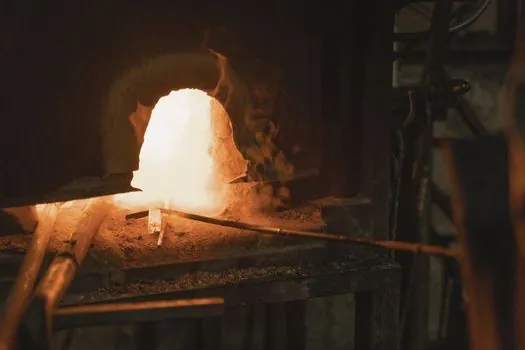
The T6 solutionizing furnace is one node in a longer casting-and-finishing chain, and a few related reference points are worth noting for spec writers. For the aging step itself, dedicated aluminum age ovens with low thermal mass and tight uniformity (±3 °C at 160 °C) are the standard replacement for general-purpose batch ovens, and a related item in the aluminum alloy selection matrix is matching the heat-treat window to the alloy's solvus and eutectic temperatures. [S4]
For the quench, hot-water and polymer quench tank sizing has more in common with the broader heat-treat field than foundries often admit, and the same control principles that govern a heat treatment furnace line (recirculation, instrumentation, survey frequency) apply to a quench tank. For shops that also run a gas aluminum melting furnace upstream of the T6 line, the energy integration opportunity is to feed the solutionizing furnace from the melt furnace's off-gas heat, an approach several CEC and Wisconsin Oven installations cite as 15-25 % energy savings on the solutionizing step [S1].
For a spec-driven reference to the broader process chain, the article on Tilting gravity die casting machine: controlled-pour mechanism and 2026 spec snapshot is a useful parallel read because T6 is typically specified for gravity-die cast structural parts in automotive and aerospace. For cost context, Gravity Die Casting Machine Price by Tonnage: 2026 Cost Bands and Selection Map is the most relevant cross-reference because T6 grade alloys drive a different machine spec than as-cast alloys. Finally, the gray-iron-side article Gray Iron Green Sand Molds: GCS Target and Process Levers is included only as a reminder that the T6 line is aluminum-specific, not transferable to iron.
Trackable signals for the next 6-12 months: AMS 2750 revision activity (CQI-9 alignment), tighter ±3 °C furnace uniformity becoming a procurement spec for new automotive T6 lines, and the spread of PAG quench above 30 % concentration for high-strength structural castings to control distortion at the cost of cooling rate.