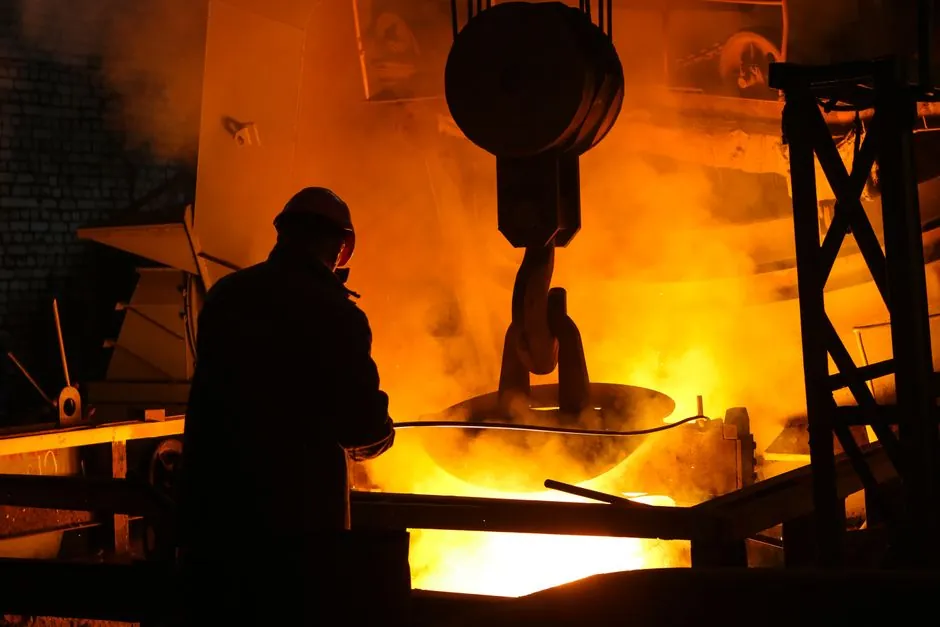
Hand-shank ladles top out near 20 kg of molten metal per operator, with a long handle keeping radiant heat off the worker, while geared crane ladles span 450 kg to 75,000 kg on the same iron-pour duty and tilt through a worm-and-wheel gearbox [S3][S4].
Foundry ladles are rated by working capacity, not shell size, so the hand-shank vs geared-crane split is fundamentally a load, duty, and alloy question rather than a plant-layout preference [S3].
Where the line sits: operator-limit and the 20 kg threshold
Hand-shank ladles are sized to what a single worker can safely handle, with a long handle functioning as both a heat shield and a lever for tilt control; Wikipedia puts the typical hand-carried upper end near 20 kg (44 lb) of molten metal, though small hand-held units may also be ceramic crucibles fitted with carrying devices [S3]. The handle is the heat-management device, and capacity is capped by the operator, not the shell. Above that threshold, control and safety collapse, which is why foundries switch to crane-mounted equipment.
Geared crane ladles start at 450 kg (990 lb) on the Workhorse heavy-duty line and run to 75,000 kg (165,000 lb) molten cast iron, all lifted from a square or vee bail with a worm-and-wheel gearbox doing the tilt [S4]. TeeMark's geared crane ladle line independently documents a 1:4 gear ratio on smaller models, self-braking, and a capacity ceiling of 30,000 lb per unit, which lines up with the same single-operator-with-assist class [S1]. The dividing line is mechanical advantage, not ergonomics, once the load exceeds what arms and a pry-bar can manage.
Geared crane ladle architecture: worm gear, trunnion, and lining
Modern Equipment's Series 1080 and 1090 geared tapered ladles use worm-and-worm-wheel gearing specifically to reduce operator work to a minimum, with the worm gear giving the self-locking behaviour that holds a ladle at any angle without a brake [S2]. Acetarc's Workhorse uses a bolt-on trunnion carried on a large-diameter spigot so the lifting load never transfers through the fixing bolts, with grade 8.8 HT screws only locating the trunnion on a machined pad [S4]. That detail matters for a vessel whose own molten-metal weight can exceed 75 t and where a bolt shear event is a catastrophic failure, not an inconvenience.
The gearbox can be manually operated, electric-motor driven, or pneumatic; TeeMark and Acetarc both list all three options on the same shell [S1][S4]. Lining is either pre-formed (Foseco Insural) on lower-duty units or refractory concrete, with traditional pre-cast firebrick now mostly superseded in many plants [S3][S4]. Shell shape is a tapered cone on most tapered lines for shell rigidity, with straight-sided, drum, U, and bottom-pour variants used for special functions such as slag-free pouring and ductile-iron treatment [S2][S4].
Decision matrix: hand-shank vs geared crane on five criteria
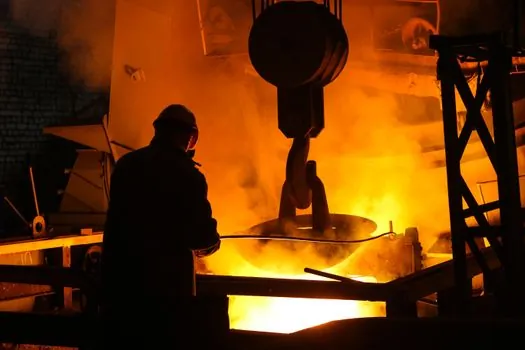
1) Load capacity: hand-shank up to ~20 kg per operator; geared crane 450 kg to 75,000 kg [S3][S4]. 2) Operator count: hand-shank needs 1-2 people, geared crane needs one operator at the hand wheel plus a crane driver, with both roles often filled by the same person on small shells [S2][S4]. 3) Duty cycle: hand-shank is intermittent, geared crane is rated for continuous use on heavy-duty lines and continuous non-ferrous / intermittent ferrous on medium-duty lines [S4]. 4) Alloy range: hand-shank is restricted to lower-melt alloys in practice, geared crane covers aluminium through steel and ductile iron treatment including bottom-pour [S2][S3][S4]. 5) Control precision: geared worm-and-wheel units self-lock at any angle, while hand-shank tilt is a live hand-lever with no positive lock, which is the underlying reason foundries step up to a gearbox once the pour stream becomes critical.
Per-use-case call: pick hand-shank for short transfers of aluminium or small iron pour-offs in a non-continuous jobbing shop; pick geared crane for anything above 20 kg, anything running more than one shift, anything pouring steel or ductile iron, and any pour where a held angle matters for stream control.
Standards, materials, and quality gates that bind the spec
Acetarc publishes ISO 9001:2015 approval, Pressure Equipment Directive (PED) trained staff, full material traceability with test certificates, and uses grade 8.8 HT screws on the bolt-on trunnion, which is the kind of paperwork chain a foundry's CE / PED inspector will look for before sign-off [S4]. Modern Equipment notes that all gearing parts and bearings are kept in stock for fast turnaround and that the company will not approve any third-party component compatibility, a sourcing constraint that affects spares strategy for older fleets [S2].
On the hand-shank side there is no equivalent certification chain, because the vessel is too small to fall under PED; the practical control is operator training and the foundry's internal hot-metal handling procedure. The Foundry Manual Part 3 wording applies to both classes, requiring ladle equipment to be designed for high structural strength and, in the case of geared ladles, for foolproof mechanical operation, a direct acknowledgement that the geared class carries a higher consequence of failure and must be designed accordingly [S5].
Failure modes and limits a spec writer must price in
Three failure paths dominate: refractory washout, trunnion bolt shear, and gear backlash. Refractory washout is the dominant wear mode on all ladle classes and the reason foundries stock spare bottoms and plug assemblies for tight-cover designs; TeeMark specifically lists spare bottoms and refractory plug assemblies as standard accessories [S1]. Trunnion bolt shear is mitigated by spigot-carried loads on the Acetarc design, with the grade 8.8 HT screws only locating the trunnion, never carrying the molten-metal weight [S4]. Gear backlash on worm-and-wheel units is held by the self-locking geometry, but on smaller 1:4-ratio hand-wheel units the operator still feels the load, which is why TeeMark describes the ratio as a quick-response feature and pairs it with a self-braking system [S1].
Medium-duty Westminster units from Acetarc are explicitly not recommended for steel or special-alloy work where the metal is at elevated temperature, even though they share the same oil-bath gearbox as the heavy-duty line, a duty-rating limit that buyers regularly miss [S4]. The capacity number alone is not the spec; the alloy and the pour temperature are.
Sourcing signals and what to track next
Two verifiable signals to watch: first, the Modern Equipment / JWM parts-and-service channel, which is the only authorised source for Series 1080 / 1090 / 1160 / 1170 / 1189 gearing and bearings, and where Modern will not warrant third-party replacements [S2]. Second, Acetarc's medium- vs heavy-duty split, where the Westminster (up to 4,500 kg) and Workhorse (450 kg to 75,000 kg) lines share a gearbox but diverge on shell and trunnion design for duty cycle and alloy temperature, so any RFQ should specify alloy, pour frequency, and target shell life in years, not just the kg number [S4]. For a fuller cross-reference on casting-line economics that sits one level downstream of the ladle decision, see the gravity die casting line cost breakdown and the gravity die casting machine price by tonnage map. For a broader view of the hand tools, casting ladle, and foundry categories this equipment belongs to, those encyclopedia entries cover the upstream vocabulary used in most ladle RFQs.