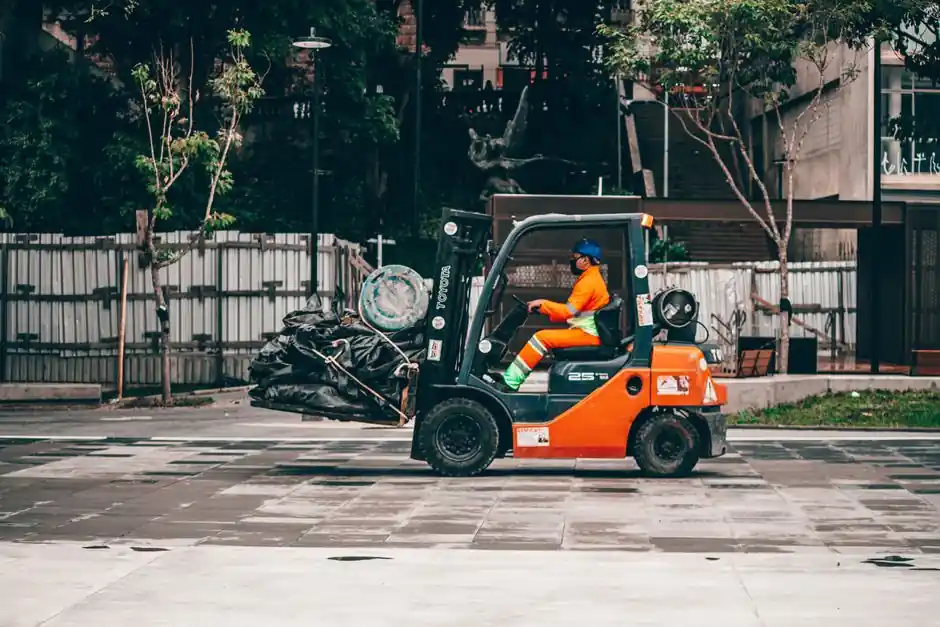
A telehandler generally provides the stronger outdoor platform for uneven terrain, combining a telescopic boom, larger tires, and higher ground clearance with the ability to reach farther than a conventional forklift [S4][S6][S7].
A rough-terrain forklift is the more focused choice for repetitive pallet transport and controlled outdoor work, while telehandlers demand greater operating space and typically a larger investment [S1][S2].
Terrain Capability, Reach and Operating Space
Telehandlers are engineered for outdoor movement across dirt, gravel, mud and uneven surfaces, using large all-terrain tires and higher ground clearance [S6]. Their boom extends upward and outward, allowing them to handle tasks beyond the reach of conventional forklifts, especially on uneven or demanding job sites [S4]. That geometry places loads across obstacles or onto elevated structures where a vertical mast cannot.
Rough-terrain forklifts are a simpler outdoor option with large pneumatic tires and four-wheel drive on many models [S3][S4]. They perform well on packed crusher-run surfaces and moderately uneven ground, but users report that pneumatic-tired machines can become trapped by divots and that grass can produce deep ruts [S3].
Operating space is a practical constraint. A telehandler needs room for boom movement and often outriggers, while its additional size and reach make it a less natural fit for narrow aisles or confined yards [S1][S4]. For more detail on the vehicle classes, compare the rough-terrain forklift with the telehandler.
Decision Matrix: Ground Clearance, Reach and Load Handling
On uneven terrain, the telehandler leads on forward reach, elevated placement and access across obstacles; the rough-terrain forklift leads on straightforward pallet handling and tighter process control [S2][S5]. A rough-terrain forklift is not a general off-road vehicle: a field discussion warns that using one on grass may create ruts that are difficult to climb out of when loaded and may collect water in rainy conditions [S3].
The comparison changes with the load. Telehandlers accept pallets, buckets, truss booms and work platforms, with attachments enabling construction, agricultural and maintenance work [S4]. Conventional and rough-terrain forklifts are optimized for forks and palletized loads, using straight-line mast movement for repeatable handling [S2][S5]. Any telehandler lift must remain within the machine-specific load chart because capacity falls as boom extension increases [S4].
Cost follows configuration and capability rather than a single purchase-price rule. Telehandlers are typically larger and represent a greater investment than traditional forklifts [S1]. For operating economics on the forklift side, the related analysis of engine and hydraulic costs in rough-terrain forklifts provides a separate decision reference.
Best Applications by Work Pattern
Choose a telehandler when the load must be placed above ground, beyond an obstacle or across a gap. Typical applications include placing bricks, steel beams and prefabricated panels on upper floors, positioning trusses, handling pallets over broken ground and clearing debris with attachments [S4]. These tasks combine mobility, reach and attachment flexibility in one machine.
Choose a rough-terrain forklift for repeated movement of pallets or bulk materials between yards, loading areas and outdoor storage. Its vertical mast suits straight lifting, and its configuration is easier to integrate into repetitive handling routines [S2][S5]. It is also a sensible choice when the route is mostly packed stone, firm soil or a constructed yard rather than deeply rutted terrain [S3].
Neither machine replaces a crane merely because its boom extends. A telehandler offers long forward placement but remains a material-handling machine with a defined load chart and stability envelope [S4]. Where the task requires a controlled crane lift, dedicated rigging capacity, or access beyond the telehandler chart, use the appropriate lifting equipment.
Load Capacity, Stability and Operating Constraints
Nominal capacity alone is not a purchase criterion. Telehandler capacity must be checked at the actual horizontal reach and boom angle, with load charts used to determine capacity as the boom extends [S4]. Forklift capacity similarly depends on load center, mast configuration and attachment; the separate guide to derating forklift capacity for every attachment covers that calculation.
Ground strength matters as much as machine specification. Grass that supports a pickup may still deform under a much heavier loaded forklift, while pneumatic tires on packed crusher run can work well [S3].
For a telehandler, set up on stable ground, deploy the specified stabilizers where required, and keep personnel outside the load path. For a rough-terrain forklift, use the axle and tire arrangement for the route rather than assuming that a large tire makes the machine suitable for unrestricted off-road travel [S3]. Braking performance also becomes critical as loaded vehicle mass and ground speed increase.
Controlled Yards Versus Difficult Sites
A conventional forklift is the better technical match for warehouses, distribution centers, manufacturing plants and loading docks. Its straight-line mast movement, compact footprint and repeatable pallet handling suit smooth floors and narrow aisles [S2][S5]. It is not a competitive choice where the primary requirement is travel over broken ground or placement beyond the fork face.
A rough-terrain forklift is not a conventional indoor forklift simply fitted with outdoor tires. It is the middle option for yards and construction environments where palletized loads must be moved over moderately uneven surfaces but extended reach is unnecessary [S4]. A telehandler is the upper-reach option for construction, agriculture and industrial maintenance where attachments and elevated placement justify the additional size and investment [S1][S4].
The selection rule is straightforward: choose the forklift when the dominant cycle is pick, lift, travel and place; choose the telehandler when the dominant requirement is reach, attachment change, obstacle crossing or elevated placement. Include travel surface, maximum working height, required forward reach, load weight and attachment in the final comparison.
Procurement Checklist and Sourcing Record
Specify the route before selecting the machine. Record the steepest sustained grade, deepest rut, maximum mud or standing-water exposure, surface bearing capacity and whether the machine must cross soft grass. A site dominated by firm crushed stone favors a rough-terrain forklift; mud, deep ruts and irregular ground favor a telehandler, subject to its outrigger and stability requirements [S3][S4].
Record rated capacity at the operating reach, chassis width, tire type, drive configuration, turning radius, boom lift and forward reach, attachment options, ground clearance and service support. For telehandlers, include the load chart and outrigger operating rules; for forklifts, include axle load limits, load center, mast and fork specification [S3][S4].
Comparative guidance in this guide comes from manufacturer and supplier material published from 2021 through 2026, including JCB, Bobcat, HELI, Hillview, Christopher Equipment and Herculift comparisons [S1][S2][S4][S5][S6][S7]. Final capacity and operating limits must come from the selected model’s manufacturer rating plate and load chart, not from cross-brand buying-guide ranges.
A defensible purchase requires one field trial on the worst operating surface: compare travel time, rut recovery, load control, cycle accuracy and attachment handling, then reserve the machine only after confirming the model-specific load chart and support configuration.