Thermal dispersion mass flow meters use the cooling effect of a flowing gas on a heated sensor to derive a direct mass flow reading, and the working principle has been refined for over four decades: US patent 4,972,708 (filed 1989-06-22) already describes thin-film measuring resistors on a ceramic insulating member glass-soldered to a ceramic support tube for corrosive and hot gas service, with the entire thin-film element protectively covered by the ceramic or the glass solder [S4].
For industrial buyers, the practical decision tree in 2026 narrows to four hard criteria: insertion versus inline geometry, minimum and maximum line size, the gas mix (clean dry air/nitrogen versus wet, dirty, corrosive, or combustible streams), and the I/O/protocol stack including 4-20 mA, HART, Foundation Fieldbus, PROFIBUS, and Modbus on the same transmitter, all of which are standard on mainstream thermal flow transmitter electronics [S3]thermal mass flowmeter working principle.
Insertion vs. inline: geometry drives the rest of the spec
Insertion probes are the workhorse for large ducts, with mainstream models covering line sizes from 1 inch (25 mm) up to 12 inches (305 mm) and above using dual-element averaging arrays; inline bodies are reserved for small line sizes from 1/4 inch to 2 inches (6 to 51 mm) where a defined flow body conditions the velocity profile and fixes probe insertion depth for out-of-the-box accuracy [S3].
The Honeywell SMARTLINK METER applies the latter approach, using a constant temperature differential (ΔT) technique with two matched platinum RTD elements in a stainless probe inside an in-line flow body, calibrated factory-direct for air or natural gas and outputting 4-20 mA for flow, air/fuel ratio, or fluid temperature [S1]. For engineers comparing insertion versus inline, the rule of thumb is: pick inline when the line is below 2 inches and accuracy under ±1 to ±2 % matters, pick insertion above 2 inches and accept ±2 to ±3 % as the typical envelope, then move to dual-element averaging (ST102AA, ST112AA) for stacks of 12 inches and larger to cancel out swirl and asymmetric velocity profiles [S3].
Clean gas, wet/dirty gas, and corrosive or hot gas: one technology, three material stacks
Thermal dispersion is fundamentally a clean-gas technology: a heated platinum or thin-film element loses heat to the bulk gas at a rate proportional to mass flow, and any fouling, condensation, or coating on the element directly biases the reading, so mainstream insertion meters are explicitly designed for air, nitrogen, natural gas, methane, digester/biogas, and similar single-gas or defined-mix service [S1][S3]. For aggressive service the sensing element itself is rebuilt: the 1990 Wiegleb/Heimel/Ross patent specifies thin-film resistors on a ceramic insulating member, glass-soldered to a ceramic support tube, with the ceramic and the glass solder layer protectively covering the entire thin-film resistor from the flow medium, a construction aimed at long-term corrosion resistance with high sensitivity [S4].
An insertion meter specced for digester gas, hot combustion flue, or wet chlorine-trace streams needs the thin-film/glass/ceramic element stack, not a standard 316L probe, otherwise drift and element failure both become lifecycle issues [S4].
Process temperature, pressure compensation, and the optional pressure channel
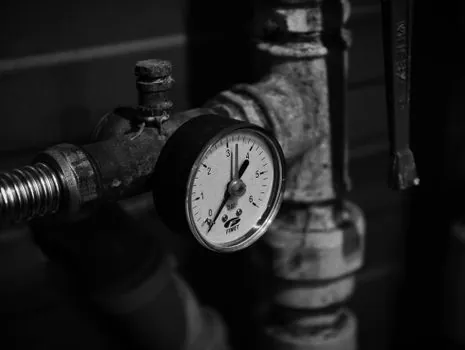
Thermal mass flow output is a function of mass flow and gas properties, so temperature compensation is built in (the SMARTLINK METER uses a reference RTD to track fluid temperature and maintain a constant ΔT above it [S1]), but pressure is a separate, often-missed variable: changing process pressure changes gas density and changes the heat-transfer coefficient, which biases the mass reading. FCI's STP100A, STP102A, STP110A, and STP112A product lines all add a built-in pressure measurement channel on the insertion probe to compensate for line pressure variation without a separate pressure transmitter, in line sizes from 2.5 inches (63 mm) up to 12 inches (305 mm) dual-element [S3].
Buyers should treat pressure compensation as mandatory for any line that operates more than ±5 to ±10 % off the calibration pressure, and for variable-pressure gas service such as digester gas, landfill gas, or downstream of a variable-speed compressor, the dedicated STP series is the simpler, more reliable path than pairing a thermal flow element with a separate pressure transmitter and a multi-variable calculator [S3].
I/O, protocols, and agency pedigree: the second shortlist
Modern thermal flow transmitters integrate surface-mount, RoHS-compliant electronics and offer the full protocol stack: standard analog 4-20 mA and pulse, plus digital bus options including HART, Foundation Fieldbus, PROFIBUS, and Modbus on a common platform, with FCI's AST (in-situ automated sensor test) available on ST80 and ST100 series to verify sensor health without breaking the process [S3]. Hazardous-area and metrology pedigree is broadly the same across premium suppliers, with approvals from FM, FMc/CSA, ATEX, IECEx, EAC, NEPSI, Inmetro, UKEX, and ECAS, plus functional-safety rating to SIL per IEC 61508, pressure equipment compliance to PED, and emissions certification per EN 15267 QAL1 for CEMS service [S3]. The SMARTLINK METER addresses a more compact industrial niche, with a rugged NEMA 4X (IP66) enclosure, redundant on-line test, and fail-safe alarm, limit, and test status indication on its LCD and membrane keypad [S1].
The I/O/agency layer matters because the wrong protocol pair can quietly kill a project: HART is FSK overlaid on a 4-20 mA loop and is not the same physical layer as Foundation Fieldbus or PROFIBUS PA, so buyers must match the transmitter variant to the host DCS or PLC card, not assume a single SKU covers both worlds [S3]. For a gas mass flow controller selection criteria comparison, treat the thermal mass flow controller as a separate, closed-loop valve-plus-meter assembly, and treat the thermal mass flow meter alone as the measurement-only building block.
Comparison: the four real options lined up on duty
Four thermal mass flow architectures dominate 2026 industrial spec sheets, and the choice falls out cleanly once the duty is fixed: (a) inline 1/4 to 2 inch (6 to 51 mm) thermal meter, best for compact skids and OEM machines on clean air/nitrogen; (b) single-point insertion probe in 1 inch to 12 inch (25 to 305 mm) lines for general-purpose air, compressed air, or natural gas with ±2 to ±3 % accuracy; (c) dual-element averaging insertion in 12 inch (305 mm) and larger ducts, used to cancel asymmetric and swirling velocity profiles at the cost of higher probe cost; (d) thin-film/glass/ceramic element insertion for corrosive or hot gas service, built per the Wiegleb/Heimel/Ross construction with full element coverage by ceramic and glass solder [S3][S4].
Selection shortcuts: insertion single-point (ST100A/ST110A) for 2.5 inch+ clean gas; insertion with pressure compensation (STP100A/STP110A) for variable-pressure digester/biogas or post-compressor lines; dual-element averaging (ST102AA/ST112AA) for large stacks, fermenter off-gas, or CEMS ducts; thin-film/glass/ceramic element for hot, wet, or corrosive gas where standard 316L probes will drift. The vortex flowmeter selection guide for steam, gas, and liquid is the right contrast when the duty is saturated steam or wet liquid, conditions thermal mass meters cannot handle.
Limitations and failure modes engineers should plan for
Thermal mass meters are not a universal answer. The technology assumes a defined gas mix, because the heat-transfer coefficient is gas-specific: a meter calibrated on air will read incorrectly on pure nitrogen, on argon, or on a 50/50 nitrogen/helium mix unless recalibrated, and any change in the gas composition is read as a flow change, which is a real, common failure mode in mixed-gas and digester-gas service [S3]. Condensation on the sensor at the dew point causes immediate drift; particulates, oil aerosols, and salt or HCl traces in the stream foul the element over weeks to months and produce slow positive bias; and the technique does not work in liquids because the heat-transfer regime changes and the element can be destroyed by liquid carryover.
Practical mitigation: install a coalescing filter and a moisture separator upstream of the sensor, set the operating temperature above the gas dew point with margin, and use the AST in-situ verification function on ST80 and ST100 series to detect sensor drift before it becomes a process error [S3]. The coriolis flowmeter selection criteria article covers the alternative when the duty is a true mixed gas, a liquid, or a slurry, and a high-accuracy ±0.1 to ±0.5 % reading is mandatory.
Sourcing, standards, and final shortlist logic
Procurement checks before signing a PO: confirm the calibration gas on the calibration certificate matches the actual process gas, confirm the agency approval matrix covers the installed location (ATEX or IECEx for Europe/Asia-Pacific, FM or FMc/CSA for North America, EAC for Russia/CIS, NEPSI for China, UKEX for UK, Inmetro for Brazil, ECAS for UAE), confirm functional-safety rating per IEC 61508 if the meter is part of a SIF, and confirm EN 15267 QAL1 if it is used in a CEMS or regulatory emission-monitoring stream [S3].
Final shortlist: for clean dry air or natural gas in lines of 1/4 to 2 inches, choose an inline meter with factory air or natural gas calibration and 4-20 mA + HART; for general industrial air/compressed gas from 2.5 to 12 inches, choose a single-point insertion probe with the right protocol variant for the host DCS; for 12 inches and larger ducts with profile distortion, choose a dual-element averaging insertion meter, optionally with the in-line VeriCal verification function; for variable-pressure digester, landfill, or post-compressor gas, choose a single-point or dual-element insertion meter with built-in pressure compensation; for corrosive or hot gas, choose a thin-film sensor on a ceramic/glass-soldered support per the established Wiegleb construction [S1][S3][S4]. Watch the next 6 months for additional IEC 61508 SIL 3 variant announcements on the ST100 platform, and for further roll-out of dual-element averaging probes below the current 12 inch (305 mm) threshold.
Detailed specification references: gas mass flow controller, and thermal imager.