A thickness gauge measures one dimension, the distance between two surfaces or the depth of a coating, on a part that is otherwise trusted. A coordinate measuring machine (CMM) maps many dimensions of the same part against 3D tolerancing and CAD, and is the only practical tool for GD&T work on machined, turned, or sheet-metal components [S1][S5].
Mixing them up is a common engineering mistake: an ultrasonic wall-thickness reading on a corroded pipe is not a substitute for a CMM sweep of a turbine blade, and a portable CMM probe is the wrong instrument for routine coating-thickness checks on a structural steel member. Both lines have matured into modular, multi-sensor platforms, which is what makes the decision harder than it was ten years ago [S1][S2].
What each instrument actually does in a production environment
A thickness gauge, whether digital dial, eddy-current/magnetic, mechanical blade set, or ultrasonic-thickness-gauge type, returns a single scalar value with a stated accuracy band and a defined minimum measurable thickness on a given substrate [S3][S6]. Manufacturers including Cygnus, DeFelsko, Elcometer, and ACS-Solutions build units dedicated to pipe wall, plate, and coating work, with calibration routines and probe families matched to the material and temperature window [S3][S4].
A CMM returns an XYZ point cloud and derived dimensions, with quoted accuracy specified in accordance with the relevant ISO 10360 series acceptance test for length-measurement systems. Optical and video-based CMMs such as the Werth VideoCheck V HA and gantry machines like the Hexagon GLOBAL Advantage extend the same machine concept to large turned parts, shafts, gears, tools, and aero/automotive components [S1][S2]. Keyence's portable XM-Series handheld CMM, meanwhile, pushes the same measurement principle out to the shop floor for any operator to run against a CAD model [S5].
Decision frame: pick by measurement intent, not by habit
The first selection gate is the question being asked. If the answer is "how thick is the wall here, on this pipe, in service," the answer is a thickness gauge, almost always ultrasonic for metallic piping and eddy-current or magnetic for non-magnetic coatings on steel [S3][S4][S6]. If the answer is "does this part match its 3D CAD model within GD&T tolerance," the answer is a CMM, whether fixed gantry, optical, or portable arm [S1][S2][S5].
Three decision criteria separate the two cleanly:
1. Dimensionality: thickness gauges report one value per measurement cycle; CMMs report XYZ and derived features. A bore depth plus a counterbore diameter on the same part is two thickness measurements, not a CMM substitute.
2. Substrate and access: ultrasonic thickness gauges are specified for in-service pipe surveys, underwater hull surveys, and hazardous-area work, where bringing a multi-axis machine is impossible or unsafe [S4]. CMMs need a stable fixtured part in a temperature-controlled environment for the high-accuracy tiers [S1][S2].
3. Reporting need: thickness gauges write a wall-thickness log against nominal and minimum allowable values for fitness-for-service; CMMs generate a 3D inspection report that compares measured features to nominal CAD and flags GD&T deviations [S1][S2][S5].
Multi-sensor CMMs and the modern thickness-gauge overlap
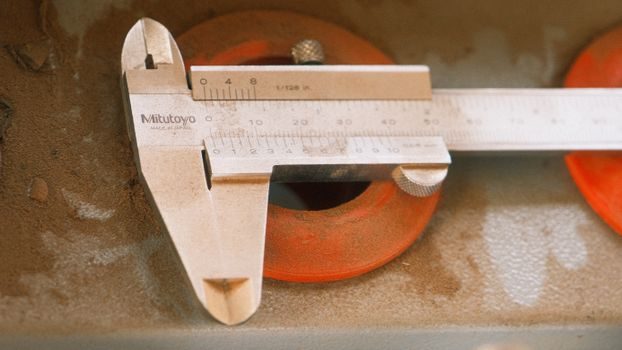
Werth's VideoCheck V HA and Hexagon's GLOBAL Advantage are described by their manufacturers as multi-sensor CMMs, combining optical, laser, and tactile probing on a CNC granite or gantry frame so a single machine can measure turned parts, shafts, tools, wheels, and gears, and handle large aero/automotive envelopes [S1][S2]. The relevant comparison page in the contour-measuring-machine family documents how the same multi-sensor approach serves profile and contour work, where a single-axis thickness probe would have given only a fraction of the data.
Keyence's XM-Series portable CMM is positioned as a shop-floor system "anyone" can use to capture 3D/GD&T features, compare to CAD, and generate detailed inspection reports on the spot, blurring the line between "shop tool" and "metrology lab" [S5]. Even so, the unit is sold as a coordinate measurement system, not as a thickness gauge, and the spec sheets do not pitch it for wall-thickness NDT. ITM's catalogue keeps thickness gauges, including mechanical dial units for compressible materials and ultrasonic-thickness-gauge units for NDT, in a separate category from CMMs, reflecting how the two communities still source and qualify the equipment [S6].
Coating, pipe, and underwater niches that thickness gauges own
For coating work, dual-technology coating thickness gauges (magnetic plus eddy-current) are the standard, with ranges such as 0–1250 µm / 0–50 mils for the discontinued Reed ST-156 (now superseded by the dual-technology R7800) typical of general-purpose units. The Elcometer and DeFelsko lines in the DirectIndustry index cover coating-thickness work across both ferrous and non-ferrous substrates, with automatic calibration and a choice of integrated or separate probes [S3].
For pipe wall surveys, ultrasonic thickness gauges from ACS-Solutions, Beijing Dragon Electronics, Cygnus, DeFelsko, and Elcometer are listed, with measuring range, accuracy, resolution, and rate all configurable against the application; the index surfaces units with mechanical, magnetic, electronic, and pulse-based probes under the same category [S3]. Cygnus's underwater thickness-measuring machine is described specifically for pipe, wall, and material work in submerged conditions, a duty cycle that no CMM is engineered to handle [S4].
Limits, failure modes, and what each instrument cannot do
An ultrasonic thickness gauge is only as good as the coupling, the probe frequency, the surface condition, and the velocity calibration for the alloy in question. A reading through a heavy coating on a rough external pipe surface can overstate the remaining wall by several hundred micrometres if the gauge is in coat-then-wall mode and the operator has not accounted for the coating velocity, a known failure mode the standard practice for fitness-for-service work addresses but cannot eliminate [S3][S4].
A CMM is constrained by fixturing, part temperature, probe access, and the volumetric accuracy figure published in the ISO 10360 acceptance test. Optical CMMs on turned parts, gears, and shafts lose data in shadowed regions and on highly reflective surfaces, which is why Werth lists multi-sensor options on the VideoCheck V HA, and why Hexagon positions the GLOBAL Advantage for large aero/automotive parts where a fixed gantry provides the working volume [S1][S2]. A handheld CMM such as the Keyence XM-Series trades some absolute accuracy for portability and operator reach, so it is rarely the right tool for tight µ-level length-measurement jobs [S5].
The two failure modes are different, but the practical conclusion is the same: specifying a CMM where only a thickness is in question is a 5–10x cost error, and specifying a thickness gauge where a full GD&T report is needed is a data error that no amount of averaging will fix.
Where to deepen the spec next
For a CMM decision, the vision measuring machine selection gate post on this site lays out the four checks to run before asking for a quote, and it is the natural next read for anyone weighing optical versus video CMM platforms. For a coating or wall-thickness decision, the contour-measuring-machine reference clarifies where profile and thickness methods begin to share sensor hardware, and the ultrasonic-thickness-gauge page documents the NDT-specific selection rules that do not apply to a CMM. Two trackable signals: the ISO 10360 acceptance-test claims on each CMM datasheet, and the material-and-pipe-entry list of any ultrasonic thickness gauge shortlisted for service work, are the documents that will catch a wrong-instrument call before a purchase order goes out [S1][S2][S3][S4][S5].