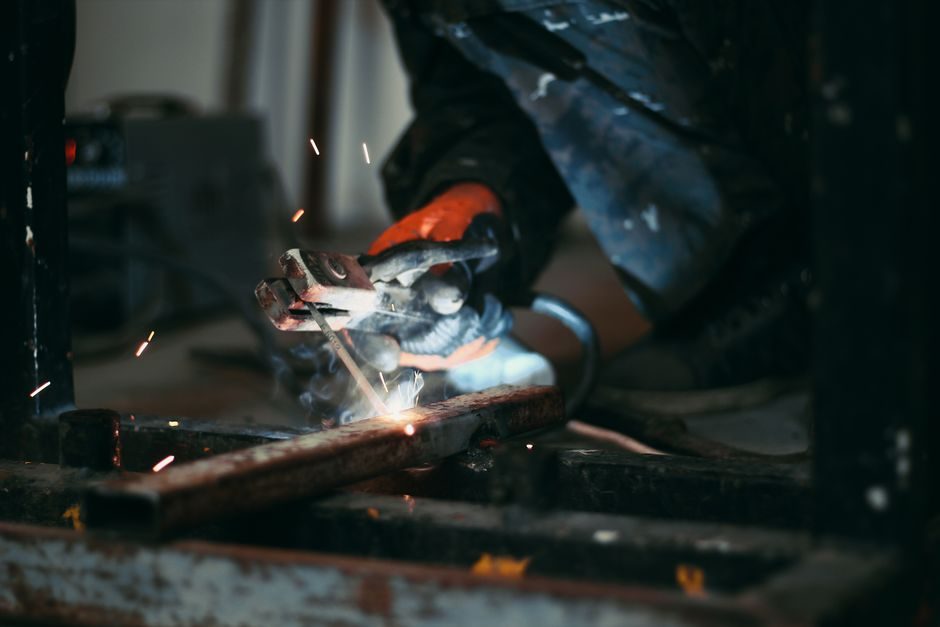
For 2026 procurement, the deciding variables on a TIG welder are output current type (AC/DC versus DC-only), inverter topology, process coverage (TIG/MMA/MIG/pulse) and input supply — not brand. Published 2026 model sheets from TELWIN and Schnelldorfer Maschinenbau on DirectIndustry bracket the working envelope at 8 kW (DC-only) to 17.3 kW (AC/DC pulse, 400 V three-phase) [S4][S5].
The choice that wastes the most money is buying a manual TIG box for a tube-mill duty cycle, or buying a multiprocess inverter for a thin-sheet stainless bench job. ELENA ONE from Schnelldorfer is sold as an automatic longitudinal seam welder in three welding lengths — 600 mm, 1100 mm and 1300 mm — built specifically for thin-section sheet tube production [S1]. TELWIN's SUPERIOR TIG 422 WAVE AC/DC AQUA at 12.9 kW / 17.3 kW and INVERPULSE 40.40 WAVE at 9.3 kW / 15 kW instead target flexible manual shops and light fabrication [S2][S4].
What the TIG process actually demands from the power source
TIG (GTAW, gas tungsten arc welding) uses a non-consumable tungsten electrode and an inert shielding gas — typically argon — to produce a stable, spatter-free arc with precise heat input, which is why it is the default for stainless steel, copper, aluminum and thin-wall tube [S7][S8]. Because the arc is sustained by a constant-current source, the power source must hold amperage within tight limits even when the operator's hand distance varies; HF (high-frequency) start or lift-arc ignition is used so the tungsten is not contaminated by strike [S8].
For thin stainless (under 2 mm) the source must support pulsed DC, low minimum current and a fast-response arc — SUPERIOR TIG 422 WAVE AC/DC AQUA advertises advanced thermal control, synergic curves and ATC (Advanced Thermal Control) for thin materials, with a 230 V single-phase / 400 V three-phase dual input [S4]. ELECTROMIG 550 SYNERGIC (TIG/MAG/MMA/spot) is rated 11 kW / 15 kW on the same dual-voltage platform and lists 40 pre-set synergic curves plus adjustable wire up-slope, reactance and burn-back — useful when the same bench also runs MIG [S3].
Matching machine class to the workpiece and duty cycle
Three classes cover almost every spec line: a DC-only manual inverter for steel and stainless fabrication, an AC/DC pulse manual inverter for aluminum and mixed metals, and an automatic longitudinal seam welder for tube production. The TELWIN SUPERIOR TIG 421 DC ACC (8 kW, 400 V three-phase) sits in class one with PULSE / EASY PULSE plus a THINSPOT utility for rapid spot welding of thin sheet — the lowest-power member of the 2026 family [S5]. The 422 WAVE AC/DC AQUA extends the same platform to aluminum, copper, steel and stainless with 12.9 kW / 17.3 kW output and a trolley-mounted water-cooled configuration [S4].
For tube and vessel seams, a dedicated longitudinal seam welder is the correct tool, not a handheld TIG. ELENA ONE is a longitudinal seam welder with three welding-length options (600 mm, 1100 mm, 1300 mm), automatic mode, and the manufacturer states 25+ years of design experience behind the build [S1]. Its sibling ELENA II S-Series and the LINEARWELD EXTL are positioned by the same vendor for custom and longer welding lengths, so the procurement spec is always: welding length > 1300 mm pushes the buyer out of the ELENA ONE envelope and into custom-engineered seam welders [S1].
Decision criteria: a side-by-side comparison
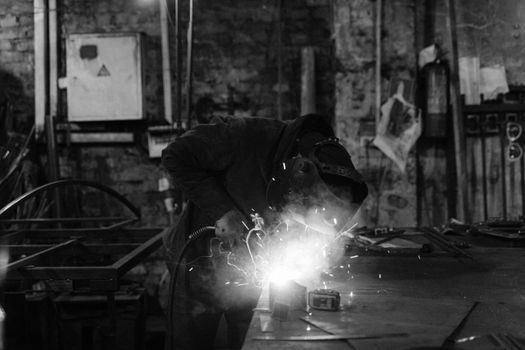
Five 2026 spec sheets line up cleanly against the criteria that actually drive cost and capability [S1][S2][S3][S4][S5]:
ELENA ONE (Schnelldorfer): automatic, longitudinal, three welding lengths (600/1100/1300 mm), TIG/seam, no portable input listed — purpose-built tube welder [S1]. SUPERIOR TIG 421 DC ACC (TELWIN): DC-only, 8 kW, 400 V three-phase, TIG/arc/pulse/MMA/spot, manual, no AC — lowest-cost precision DC [S5]. SUPERIOR TIG 422 WAVE AC/DC AQUA (TELWIN): AC/DC, 12.9 kW / 17.3 kW, dual 230 V / 400 V, trolley, water-cooled — broadest manual mix, covers aluminum and copper [S4]. INVERPULSE 40.40 WAVE (TELWIN): MIG/TIG/MAG/pulse, 9.3 kW / 15 kW, dual voltage, Wave OS with EASY/EXPERT modes, USB data export, ROOT-MIG/ATC/DEEP MIG arcs — heavy multiprocess fab cell [S2]. ELECTROMIG 550 SYNERGIC (TELWIN): MIG/TIG/MAG/MMA/spot, 11 kW / 15 kW, 40 synergic curves, ATC, 4-roller wire feeder, MMA hot-start/arc-force/anti-stick — best when MIG is the dominant process and TIG is a secondary [S3].
The decision rule of thumb: choose DC-only when only steel and stainless are welded, AC/DC when aluminum or copper is on the bill of materials, multiprocess (TIG + MIG/MAG) only when the same power point must serve both processes, and a dedicated seam welder when the work envelope is a straight tube or vessel seam longer than 600 mm [S1][S2][S4]. INVERPULSE 40.40 WAVE's 9.3 kW figure corresponds to the 230 V single-phase tap; the 15 kW figure is the 400 V three-phase tap — never specify the higher output on a 230 V shop supply [S2].
Who should buy what, and who should not
A job-shop fabricator doing mostly stainless tube and occasional carbon-steel plate should buy a 400 V three-phase DC TIG such as the SUPERIOR TIG 421 DC ACC at 8 kW, or step up to the 422 WAVE AC/DC AQUA if aluminum is added to the mix [S4][S5]. An installer/maintenance van that needs one box for steel, stainless and aluminum at customer sites wants the dual-voltage 230 V / 400 V inverter class — INVERPULSE 40.40 WAVE or ELECTROMIG 550 SYNERGIC both fit, with the INVERPULSE the stronger pick when TIG pulse and double-pulse (PULSE/POP) are required for visual weld seams [S2][S3]. A tube producer with a 24/7 duty cycle and welding lengths up to 1300 mm buys the ELENA ONE automatic seam welder; manual TIG is wrong here because human hand-speed variation defeats the seam-quality spec [S1].
Buying classes to avoid for the wrong use case: a multiprocess MIG/TIG inverter for a precision thin-stainless bench is overkill — the 4-roller wire feeder, gas pre-flow and inductance settings add zero value and clutter the UI. Likewise, a DC-only box for a shop that routinely welds 5xxx or 6xxx aluminum will fail because DC TIG does not clean the oxide layer; AC balance is mandatory for aluminum, and only the AC/DC class supplies it [S4][S8].
Process-mix trade-offs and electrical realities
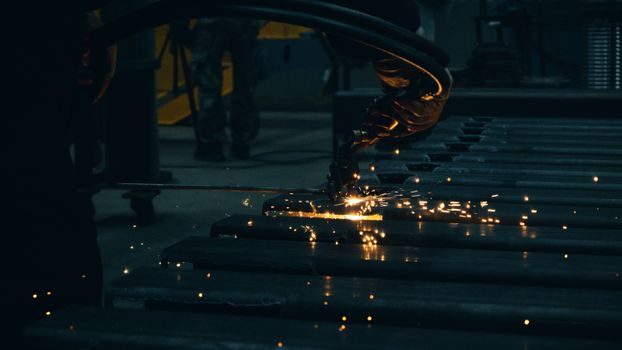
All five machines are inverter-based with 50 Hz / 60 Hz output frequency, which means they tolerate engine-driven generator input within stated voltage tolerances — TELWIN lists +/-15% generator tolerance on the ELECTROMIG 550 SYNERGIC, with thermostatic, overvoltage, undervoltage, overcurrent and VRD protections as standard [S3]. VRD (Voltage Reduction Device) is a separately listed safety feature on the INVERPULSE 40.40 WAVE, dropping the open-circuit voltage to a safe level when the torch is idle — relevant for shipyard, mining and on-site work [S2].
Process count is not free. ELECTROMIG 550 SYNERGIC ships 40 pre-set synergic curves and lets the operator store custom curves to USB; INVERPULSE 40.40 WAVE exposes ROOT-MIG, ATC, DEEP MIG, PULSE and POP arcs in addition to the same synergic model and adds cloud-based traceability (optional) [S2][S3]. The TELWIN SUPERIOR TIG 422 WAVE AC/DC AQUA is the only one of the five that lists a trolley and water-cooled (AQUA) configuration, so it is the right pick for sustained high-amperage aluminum work where torch overheating would otherwise limit duty cycle [S4].
Standards, shielding gas and process boundaries
Shielding gas is part of the spec, not an afterthought. TIG uses an inert gas — argon for steel, stainless and titanium; argon/helium mixes for higher thermal input on copper and thicker aluminum — and the choice is driven by the base material rather than the power source [S8]. The pulsing feature on SUPERIOR TIG 421 DC ACC and 422 WAVE AC/DC AQUA is what gives the operator the heat-input control needed on thin stainless and aluminum without warping the workpiece [S4][S5][S7].
TIG is the default for stainless because it delivers a clean, oxide-free weld bead with no spatter and no flux — the reason it remains the spec-line choice for food-grade, pharmaceutical and architectural stainless assemblies [S7]. For thin-sheet stainless tube the THINSPOT function on the SUPERIOR TIG 421 DC ACC is a documented rapid-spot utility, while a tube mill running longitudinal seams is a different machine class altogether (ELENA ONE) and should not be substituted with a bench-top TIG [S1][S5].
Sourcing checklist before issue of PO
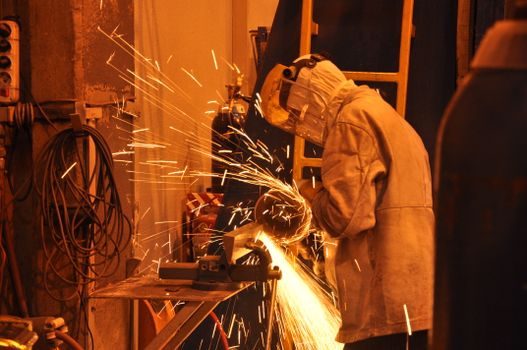
Before raising a purchase order, lock four numbers and one standard: maximum welding current at the chosen supply voltage (e.g. 9.3 kW at 230 V vs 15 kW at 400 V on the INVERPULSE 40.40 WAVE), input phase and tolerance, welding length in mm for any seam welder (600/1100/1300 mm on ELENA ONE), and process list (TIG / MMA / MIG / MAG / pulse / spot) [S1][S2]. Operator-safety items to call out on the PO are VRD, ATC on thin materials, and any trolley or water-cooled (AQUA) accessory the duty cycle needs [S3][S4].
One trackable signal for the next 6 months: the 2026 TELWIN catalogue is split between manual welding (SUPERMIG 505i XD, ELECTROMIG 550 SYNERGIC, INVERPULSE 40.40 WAVE) and the SUPERIOR TIG family, with the AC/DC AQUA variant the only trolley-mounted water-cooled TIG in the published set [S2][S3][S4]. The other trackable signal: Schnelldorfer's ELENA line is published in three welding lengths only (600/1100/1300 mm) — any spec above 1300 mm must be routed to a custom-engineered seam welder such as the LINEARWELD EXTL rather than treated as an ELENA ONE option [S1].
For component-level specifications, see linear guide, and crossed roller guide.
For related coverage, see MIG welding machine price and cost guide: 2026 tier map.