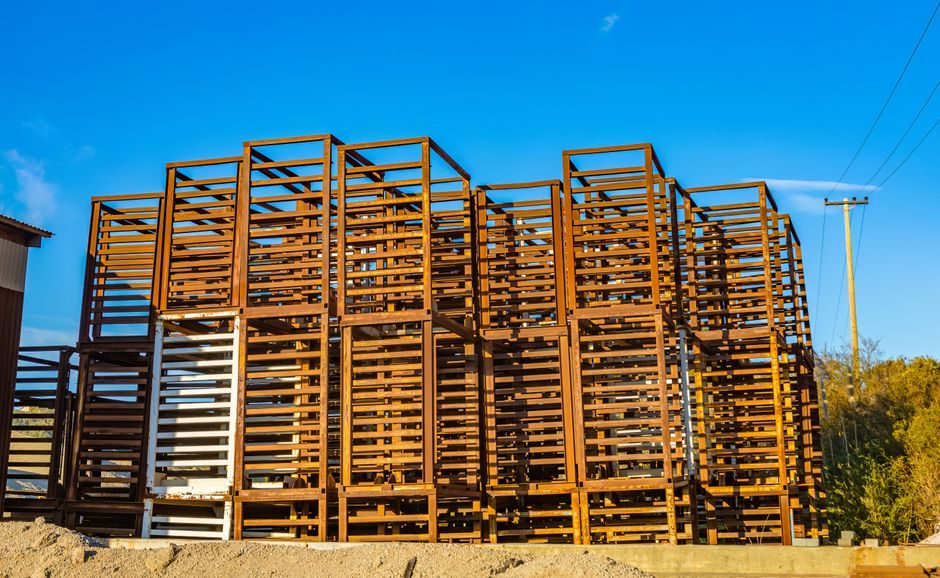
Chinese mill listings dated 2026-04 through 2026-06 converge on a single dominant cuplock tube geometry: 48 mm OD × 3.2 mm or 3.25 mm wall high-grade steel, with verticals stocked at 0.5 / 1.0 / 1.5 / 2.0 / 2.5 / 3.0 m and ledgers in 800 / 1500 mm standard cuts [S1][S4].
Minimum order quantities split into two commercial tracks: a 20 m.t. heavy-tonnage lane for ringlock verticals from CNBM-affiliated exporters (Qingdao loading) and a 5,000-piece lot lane for finished cuplock bays from Tianjin-shipped suppliers with 5,000,000 pc/month stated capacity [S1][S3].
Tube Geometry and Steel Grade as the Selection Anchor
Cuplock verticals and ledgers in the current 2026 supplier pool are specified at 48.3 mm OD with 3.2 mm wall as the baseline and 3.25 mm as the thicker alternative — both use Q235 or Q345 carbon steel per current Chinese mill datasheets [S1][S4][S5]. Cast or pressed-steel rosettes (rings) weld to the verticals at 500 mm nominal spacing, and ledger connection pegs are also cast-steel, which is the load path that differentiates cuplock from plain tube-and-coupler [S1][S9].
EN 12811-1 certification is the most commonly declared compliance mark on cross-border cuplock datasheets; surface finish options span paint, electro-galvanized, and hot-dip galvanized, with the latter commanding the premium for coastal and chemical-plant duty [S1][S4][S5][S6].
What Cuplock Is and What It Is Not
Cuplock is a node-locked modular system: a fixed top cup, a fixed bottom cup, and a swiveling ledger blade that drops in and locks with a single hammer blow — no loose wedges, no screws, no separate clamps at the node [S6]. The adapter plug (cup) is the only consumable wearing surface, and the post + ledger + diagonal brace + base jack + U-head jack kit is the full bill of materials from any mill [S6].
It is not the right pick when you need a free-angle tube-and-coupler (right-angle coupler) layout, when scaffold-to-formwork tie patterns exceed the 500 mm rosette grid, or when the spec demands a 60 mm OD ringlock profile from European Tier-1 catalogues — that is a different system that shares the rosette idea but uses larger tube and a different ledger-blade geometry. For typical access, shoring, and large-area formwork support up to 80 kN fresh-concrete pressure as quoted by Chinese mill literature, cuplock is the lower-cost modular path [S3].
Decision Matrix: Cuplock vs Ringlock vs Frame vs Tube-and-Coupler
Selection on modular scaffolding really comes down to four engineering axes, and the 2026 supplier data maps cleanly across all of them. The matrix below is the one to fix in a spec memo before you issue an RFQ. [S1]
System: Cuplock — Tube OD × wall: 48 × 3.2 / 3.25 mm [S1][S4] — Node connection: fixed top + bottom cup, single-blade ledger [S6] — Best fit: shoring + access + circular façade, fast erection on large footprints [S3].
System: Ringlock (often cross-listed by Chinese mills) — Tube OD × wall: 48 × 3.2 mm [S1] — Node connection: 8- or 4-way rosette, wedge head — Best fit: heavy-duty shoring, complex geometry, multi-direction ledger entries per node. Note: Chinese export catalogues frequently interlist the two names.
System: Speedy / Frame scaffolding — Frame size: 2000 / 1500 × 1219 mm [S9] — Node connection: welded frame with cross brace pin — Best fit: simple façade access, low-skilled crews, short cycle times.
System: Tube-and-coupler (right-angle / swivel / sleeve) — Tube OD × wall: 48.3 × 3.2–4.0 mm — Node connection: separate forged or pressed couplers — Best fit: irregular geometry, inspection platforms, when the rosette grid of a modular system does not match the tie pattern.
Real Use Cases Sourced from the 2026 Supplier Pool
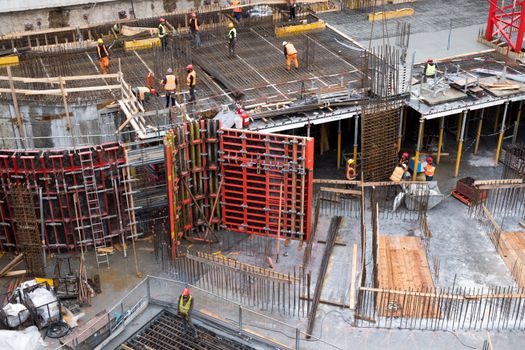
Large-area formwork support is the headline application: cuplock adapts to curved wall geometry with pre-assembled panels and built-in plywood, rated for 80 kN fresh-concrete pressure per the Chinese mill product copy [S3]. This is the use case driving the 5,000,000 pc/month capacity at Tianjin-shipped mills [S3].
Mobile and modular setups are the second workload, where a system-scaffold hire option is offered in selected regions to lower capex for short-cycle projects [S3]. Truss-style cuplock configurations for stage and event rigging are a third lane, with Guangdong-based truss mills pricing 10 m lengths at US$ 12.00–18.00 per meter FOB and a 10 m MOQ [S7]. General construction access at 1,000-piece MOQ for vertical standards at US$ 1.65/piece is the entry tier from Wuxi-based exporters [S8].
Component Weights, Bay Brace Library, and Load Math
Bay brace weights in the 2026 CNBM ringlock/cuplock datasheet are tabulated by horizontal × vertical cut and are useful for truck-loading and erection-rate planning. A 3050 × 2000 mm brace weighs 10.87 kg; a 2440 × 2000 mm brace weighs 9.62 kg; a 1220 × 2000 mm brace weighs 7.62 kg; the lightest 610 × 2000 mm brace weighs 6.90 kg [S1].
Standard ledger lengths cluster at 800 / 1500 mm, with the 1500 mm ledger the most-shipped cut for 1.5 m bay grids; base jacks and U-head jacks are 600 mm × 3.5 mm wall as the standard catalog offering, with solid-barrel variants available for heavy shoring [S1]. For typical 1.5 m × 1.5 m × 1.5 m bay geometry, expect ~7–8 kg of diagonal brace per bay plus 4–5 kg of ledger pair — a useful sanity check against supplier invoices.
Surface Finish, Corrosion Logic, and Where Hot-Dip Wins
Three surface treatments show up across all six mill listings sampled for this article: painted, electro-galvanized, and hot-dip galvanized [S1][S4][S5][S6]. Painted is the cheapest and the right pick for interior dry-fit work with short rental cycles. Electro-galvanized is the middle tier, adequate for urban sites with moderate humidity and rainfall.
Hot-dip galvanized is the right pick for coastal projects, chemical-plant turnaround duty, shoring exposed to wet concrete runoff, and any scaffold expected to sit more than 12 months outdoors. The cost premium is real but the lifecycle math is straightforward: HDG cuplock is re-deployable across 8–10 site cycles versus 2–3 for painted, and tube OD × wall is held identical, so the only change is coating thickness and zinc mass per unit area.
Commercial Terms, MOQ Lanes, and Logistics
Two MOQ lanes dominate the 2026 cuplock export market and they are not interchangeable. The 20 m.t. lane is the heavy-tonnage play: 3,000 m.t./month stated supply capability, Qingdao loading, TT or LC payment, pallet packing, targeting ringlock/cuplock verticals and accessories from CNBM-affiliated mills [S1][S9].
The piece-count lane is the finished-bay play: 5,000-piece MOQ, 5,000,000 pc/month capacity, Tianjin loading, again TT or LC [S3]. A third tier sits at 1,000-piece MOQ for finished scaffolding at US$ 1.65/piece from Wuxi-based mills, which is the most accessible lane for mid-sized contractors testing a new supplier [S8]. Truss mills run an even lower entry at 10 m MOQ for stage/event configurations [S7].
Failure Modes, Inspection Points, and What to Reject on Receipt
Three failure modes account for the majority of cuplock in-service problems, and all three are detectable at goods-in inspection. Second, tube ovality beyond ±0.5 mm on the 48.3 mm OD; the cup-lock swedge must seat cleanly, and out-of-round tubes bind and prevent full locking. Third, base-jack thread engagement: a jack with the thread run-out too close to the collar cannot take the rated leg load without bending. [S2]
EN 12811-1 declaration on the datasheet is a baseline, not a guarantee — request the mill test certificate (MTC) per heat with each shipment and verify that the Q235/Q345 grade matches the plate on the tube. For shoring duty above 60 kN/leg, insist on solid-barrel jacks rather than tube-barrel, as the 3.5 mm wall tube barrel is the weaker of the two catalog options [S1].
Standards, Certification, and the Spec Sheet to Demand
EN 12811-1 is the dominant performance standard declared across the 2026 Chinese cuplock export pool [S1][S9]. It is the right baseline to demand in your RFQ for European and Middle East projects, and it dovetails with EN 12810-1 for facade scaffold configurations. For Asian domestic projects, JIS A 8951 and the Korean KS F 8001 are the usual parallel paths, and for North American shoring duty, ANSI/ASSE A10.8 and OSHA 1926.451 subpart L are the relevant frames — confirm with your project jurisdiction rather than assume one standard covers all.
For cross-checking scaffolding component specifications against your bill of materials, weigh-count the components on the supplier datasheet and reconcile against your BOM before payment. The cross-listed "ringlock" SKUs in Chinese catalogues are typically the same node geometry as cuplock under a different trade name, so confirm with the mill which standard rosette spacing (commonly 500 mm) and which tube OD (48.3 mm) you are actually buying before locking the PO.
Selection Workflow: From RFQ to Goods-In
Issue the RFQ with five non-negotiable fields: tube OD × wall (48.3 × 3.2 mm or 48.3 × 3.25 mm), steel grade (Q235 or Q345), rosette spacing (500 mm typical), surface finish (painted / EG / HDG), and EN 12811-1 declaration. Ask for MTC per heat, third-party inspection rights, and a sample brace for weight verification against the published table (10.87 kg for a 3050 × 2000 mm brace is the benchmark). [S3]
Lock the commercial terms around the MOQ lane that matches your tonnage — 20 m.t. for verticals-only procurement, 5,000 pieces for finished bay kits, 1,000 pieces for entry-level sourcing, 10 m for truss-stage configurations. Specify pallet packing, FOB or CIF incoterm, TT or LC payment, and a loading port (Qingdao for CNBM lane, Tianjin for finished-bay lane). At goods-in, do the three-point check: rosette weld, tube ovality, jack thread run-out — and reject on any of the three.
For a complementary cost benchmark on adjacent B2B categories, see the storage rack system price and cost guide for 2026 specifiers and the aluminum extrusion pricing and cost guide 2026, both of which use the same MOQ + per-piece + FOB logic and are useful cross-checks when you are building a modular kit that mixes scaffolding, racking, and extruded components.
For component-level specifications, see linear guide, and crossed roller guide.