On a packaging line, the timing pulley is the single component that determines whether a conveyor indexes a pouch, jar, or carton to within ±1 mm of its target, and the wrong pitch series is the most common reason a synchronous belt drive fails inside 1,000 hours instead of the rated 3,000 [S4].
Packaging conveyors typically run 0.2–3 kW per drive, at belt surface speeds of 5–25 m/s, with acceleration profiles that punish any pulley pair with fewer than six teeth in mesh on the smaller pulley [S4]. A 20-tooth drive mated to a 40-tooth driven gives a 2:1 speed reduction and 2× torque multiplication, the same ratio math used in CNC axes, robotic joints, and 3D printer motion systems [S3]. When you are sizing a timing pulley for a horizontal form-fill-seal or a rotary pouch filler, the variables that matter are pitch, tooth count, face width, profile (trapezoidal vs. curvilinear), flange configuration, and material, in roughly that order.
Pitch and Profile: HTD 3/5 mm vs. GT2 vs. Trapezoidal MXL/XL/L
Curvilinear profiles (HTD and Gates GT2/GT3) carry 20–40% more torque than trapezoidal MXL/XL/L/H at the same pitch and width, distribute contact stress across the tooth face instead of concentrating it at the root, and run quieter, which is why they are the current engineering default for new packaging-line builds [S3]. Standard pitches stocked for packaging include HTD 3 mm, HTD 5 mm, GT2 3 mm, GT2 5 mm, and the legacy trapezoidal T2.5/T5/T10 series, plus the inch-based XL and L [S4][S6].
For small tabletop labellers and mini-pouch machines under 0.5 kW, MXL at 2.032 mm pitch or XL at 5.08 mm pitch in aluminum or molded plastic is still common because the pulleys are light and cheap, but they are the wrong choice the moment the line needs to absorb indexing shock without shearing teeth [S3]. If your line runs near those ceilings, GT2 is the safer pick; if it runs slow and torque-heavy, HTD 5 mm is the workhorse.
Tooth Count, Teeth-in-Mesh, and Center Distance Rules
SDP-SI's design guide rule 5 is the one packaging engineers skip and then pay for: a belt must have at least six teeth in mesh with the smaller pulley to deliver rated horsepower, because the shear strength of a single tooth is only a fraction of belt break strength [S4]. For MXL pitch belts the smallest recommended pulley is 10 teeth; for larger pitches Table 8 in the same reference applies [S4].
Flanging is not optional in long-span packaging conveyors: at least one pulley must be flanged, and when center distance is 8× or more the diameter of the smaller pulley, or the drive runs on vertical shafts, both pulleys need flanges, because synchronous belts produce a slight side thrust in motion [S4]. A second geometric rule, the pulley diameter should never be smaller than the belt width, prevents the belt from folding over the rim at the tight end of a path [S4]. Pulley face width should be belt width plus 1–2 mm clearance per side, and wider belts at equivalent torque last longer because load spreads across more teeth [S3]. On an HTD 5 mm system with 20 teeth driving 40 teeth, the pitch diameter equals (tooth count × pitch) / π, so a 20T 5 mm pulley sits at roughly 31.8 mm pitch diameter, the kind of number you need before you cut the frame.
Material Selection: Aluminum, Steel, Stainless, and Plastic

Aluminum (6061 / 6063) timing pulleys are the default for packaging OEMs because they hit the sweet spot of low inertia, low weight, and anodized corrosion resistance for dry zones, and they machine cleanly to HTD and GT2 profiles [S3]. For washdown zones in food, beverage, and pharma packaging, 304 stainless is the conservative pick and 316 stainless is the spec when chloride cleaners or salt-air exposure are in the environment, though both add cost and inertia.
Reinforced plastic pulleys (often nylon or acetal with a metal insert, or phenolic composites) are used on lightweight conveyors and in wet zones where metal-to-belt galvanic concerns exist, but they have lower torque ceilings and higher thermal expansion, so the rule is to use them only where the OEM has published a torque rating for the specific pitch and tooth count [S3][S7]. For conveyor sections that pass through an oven, a tunnel, or sit near a hot-fill station, steel or high-temperature polymer pulleys are required because standard nylon softens above ~80–100 °C and aluminum anodizing degrades above ~200 °C in continuous service. Note: do not pair a timing belt with Fibrex glass-fiber tension members over a sharp bend or through a rough edge, because the fibers break and the belt loses its length stability [S4].
Matching the Pulley to Packaging Subsystems
A horizontal form-fill-seal (HFFS) typically needs two or three timing-belt drives: a main film-feed pull belt, a fin-seal draw belt, and an end-seal draw belt, all indexed off a common cam or servo. For film-feed, where start-stop accuracy drives pouch-length tolerance, GT2 5 mm or GT2 3 mm with a small drive pulley (18–24 teeth) on a stepper or servo is common, because GT2's lower backlash compared to trapezoidal profiles is the deciding factor for cut registration [S3][S4].
For the infeed and outfeed conveyors on a packaging machine, HTD 5 mm or 8 mm pulleys with 24–40 teeth are typical, because the loads are steady and the belts are long, which lets you spec fewer teeth in mesh on the smaller pulley without violating the six-tooth rule. A vacuum-packaging machine chamber conveyor sees lower speeds and higher clamping force, so an HTD 5 mm pulley in steel or anodized aluminum is the common call. Across all of these, the timing belt drive is rated for a 3,000-hour minimum useful life when sizing, alignment, and tension rules are followed, and the synchronouss drive efficiency stays above 95% [S4]. On lines that need zero backlash for cut-to-print accuracy, profile pulleys can be cut without clearance between belt tooth and pulley, at the cost of belt life [S4].
Common Failure Modes and What They Tell You
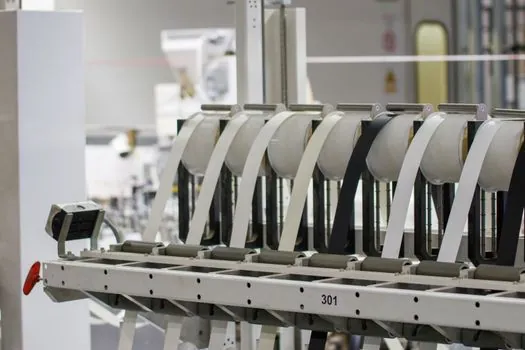
Belt tooth shear on the smaller pulley is the diagnostic for undersized pitch, insufficient teeth in mesh, or shock loads that the tension member cannot absorb, a known risk on stepper-driven packaging indexes because the belt cannot stretch to swallow the deceleration pulse [S4]. Tooth-root cracking is the failure mode of trapezoidal profiles running near their torque ceiling; switching to HTD or GT2 at the same pitch typically fixes it because the curvilinear shape moves peak stress off the root [S3].
Belt tracking off the pulley, flanged-side wear, and edge fraying point to shaft misalignment, missing flanges on long center distances, or a pulley face narrower than the belt [S4]. Noise above the rated dB curve for a given belt speed is a tension problem, since higher initial tension directly raises noise, and a switch to GT2 noticeably drops it [S4]. Premature wear on pulleys in washdown zones is a material call: aluminum is fine for rinse-down but not for daily caustic or chlorine wash, where 316 stainless or a food-grade polymer insert is required.
Sourcing and Specification Discipline
When you write the spec, lock down: pitch (HTD 5 mm, GT2 3 mm, etc.), number of teeth, pulley face width, bore and keyway or bushing series, flange configuration, material and finish, and the matching belt part number from the same vendor, because mixing profiles across the same drive is a common packaging-line retrofit error [S3][S4]. For a packaging conveyor handling finished goods into shippers, you can review logistics and packaging requirements for downstream handling, and the choice of packaging material for primary packs is what usually sets the speed and accuracy window the pulleys must hit.
Trackable signals to watch: the migration from T-series and XL to HTD 5 mm and GT2 3/5 mm across new OEM machine builds, and the rising use of 316 stainless pulleys in food and pharma packaging washdown zones, both consistent with the engineering shift to curvilinear profiles over the past decade [S3]. Related driveline components on the same packaging line, including couplings between motor and reducer, follow their own sizing logic as covered in jaw coupling selection for textile mills, and the takeaway for any driveline on a packaging line is the same: spec the smallest pitch and shortest center distance that still deliver six teeth in mesh, then validate with the belt maker's published service factor.