
Toxic gas detectors specified in 2026 are dominated by three sensor families — electrochemical (EC) for ppm-level CO, H2S, Cl2, NH3 and O2; metal-oxide semiconductor (MOS) for low-cost broad-range screening; and photoionization detector (PID) for sub-ppm volatile organic compounds — with selection driven primarily by target gas, required TLV fraction, and hazardous-area certification rather than unit price [S1][S2][S5].
The core buying decision is sensor chemistry first, certification second, form-factor third; price bands for a certified fixed-point unit run roughly $400 (single-gas EC, basic enclosure) through $1,500 (multi-gas EC + PID) to $3,500+ (extractive ATEX pump-through with auto-calibration) [S1][S2]. For a deeper pass through selection criteria, see the 2026 spec gate map.
Sensor Family Comparison: EC vs MOS vs PID on Five Decision Criteria
Electrochemical cells deliver 1–2 ppm resolution on CO, H2S, Cl2, NH3, NO2 and SO2 with typical 24-month service life in clean atmospheres, and they draw 1–5 mW — a level Analog Devices uses in its reference low-power toxic-gas design built around the ADuCM360 + EVAL-CN0357-ARDZ shield [S3][S5].
PID sensors ionize VOCs (benzene, toluene, isocyanates) with a 10.6 eV lamp to read 0.1–2,000 ppm isobutylene-equivalent, but require weekly bump tests and a $200–$400 lamp replacement every 12 months [S1]. MOS sensors respond to reducing gases at 100–1,000 ppm thresholds, are the cheapest path, and are common in security-grade screening rather than TLV-fraction worker protection [S1][S2]. Across five engineering axes the trade looks like this:
EC wins on selectivity, power, and TLV-fraction resolution; PID wins on VOC coverage and sub-ppm range; MOS wins on unit cost and field ruggedness but loses on selectivity. For a portable, body-worn worker monitor in a refinery turnaround, the established engineering practice is an EC cell for H2S/CO + a PID channel for benzene — never a single MOS cell as a stand-alone life-safety device [S5].
Certification and Hazardous-Area Matching
European chemical-plant builds in 2026 default to ATEX category 2 or 3 (zone 1/2) for fixed toxic-gas detectors, with the PD-12 series from New Cosmos illustrating the extractive Ex d IIB + H2 T4X path for hydrogen-bearing atmospheres [S2].
For North-American projects, the equivalent is NEC Class I Division 1 groups matched to the gas family; for global EPC work, IECEx certification on the same hardware is now the common ask, and dual-marked ATEX + IECEx units carry a 10–20% price premium over single-jurisdiction equivalents [S1][S2]. Extractives, not diffusion heads, are specified for cylinders, confined-space entry, and any location where the gas density is close to air or where access for bump-testing is poor — the PD-12C variant adds a decreased-flow-rate alarm specifically for that maintenance signal [S2].
Output Protocol and Integration
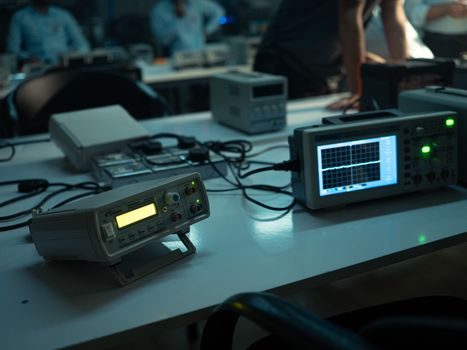
4–20 mA analog with HART remains the dominant plant-floor signal for fixed toxic-gas detectors; a second analog channel or a relay output is typically reserved for the alarm trip, with HART carrying diagnostics, remaining sensor life, and last-calibration timestamp [S1][S5].
Newer EC reference designs from Analog Devices expose the 16-bit ADC reading over SPI to a host MCU, with gas concentration computed in firmware from the EC cell's nA-per-ppm sensitivity constant stored in EEPROM [S3][S5]. For DCS integration, Foundation Fieldbus and PROFIBUS PA are options on higher-end extractive units, but the majority of installed toxic-gas points still terminate at a safety PLC over 4–20 mA + HART, and a wireless IEC 62990-compliant HART add-on is the typical 2026 retrofit path rather than a full instrument replacement [S1].
Use Cases, Limitations and Failure Modes
Fixed toxic-gas detectors are specified for: (a) continuous worker-exposure monitoring against OSHA PEL / ACGIH TLV fractions; (b) leak detection around pumps, compressors and chemical transfer skids; (c) confined-space entry pre-testing with an extractive pump-through [S1][S2][S5].
Common failure modes to budget for: EC cell electrolyte dry-out at 24 months (replace, do not recalibrate); MOS sensor poisoning by silicone vapors (irreversible — replace); PID lamp contamination in humid service (clean window, then bump test); and interference from cross-sensitive gases — a typical H2S EC cell will respond to SO2 and NO2 at 10–30% of its H2S sensitivity, which is why a single-sensor unit is never the right pick for an unknown mixed-gas stream [S3][S5]. The Bruker RAID-AFM toxic-gas product line, originally developed for security/industrial screening, illustrates the ruggedized direction the category is moving — the AFM (ion mobility spectrometry) head delivers ppb-level resolution at the cost of a much higher bill of materials than a four-electrode EC cell [S1].
Sourcing Levers, Calibration Cycle and Total Cost
Total cost over a 10-year service window is dominated by sensor replacement and calibration gas, not the unit price — assume 2 EC cells replaced per detector per 10 years ($80–$200 each), and bump-test gas ($25–$40 per cylinder) consumed quarterly, per point [S5].
Lead time for a certified fixed-point extractive unit in mid-2026 sits at 8–12 weeks from the major Japanese and European vendors, with the New Cosmos PD-12 and Bruker RAID-AFM lines among the in-stock options on industrial distributor portals [S1][S2]. For volume orders above 50 points, distributors typically bundle calibration-gas cylinders and a 2-year service contract; for fewer than 10 points, OEM direct with field service is usually a worse cost position than a local industrial distributor. For readers cross-shopping toxic against combustible instruments, the combustible vs general gas detector spec cut lines the LEL and TLV-Fraction decision paths side by side.
Trackable signals to watch into H2 2026: ATEX-aligned extractive units with built-in decreased-flow alarms (PD-12 pattern) replacing diffusion heads in confined-space service [S2]; and low-power EC front-ends such as the ADuCM360 + CN0357 reference enabling 12-month battery-life portable toxic monitors that were not commercially viable before 2024 [S3][S5].
For component-level specifications, see toxic gas detector, linear guide, and crossed roller guide.