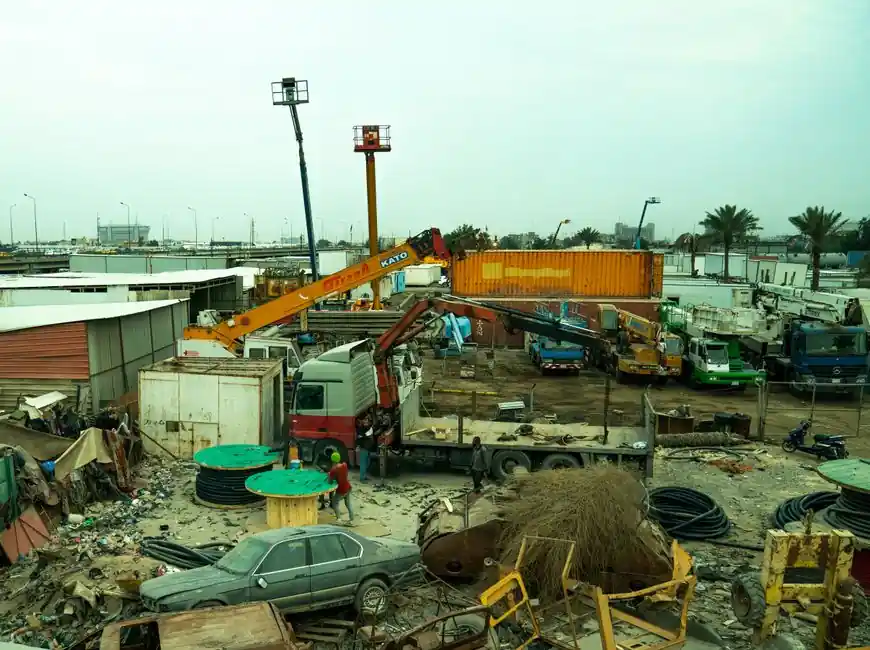
A truck crane inspection program that meets OSHA 1926.1412 must run at five mandatory intervals, post-assembly, each shift, monthly, quarterly, and annually, with each tier requiring a qualified or competent person and a written record retained on the machine [S2]. The same regulation defines the qualified person by recognized degree, certificate, or demonstrated ability, and the competent person by authority to identify hazards and take prompt corrective action, and the difference matters because each tier has its own signer [S2].
U.S. Bureau of Labor Statistics data referenced by MaintainX shows 297 crane-related fatalities between 2011 and 2017, averaging 42 deaths per year, with most incidents traceable to defects a routine inspection is designed to catch [S5]. For a truck-mounted crane, the practical risk surface is wider than for a stationary overhead unit because the carrier, outriggers, and ground all participate in the lift, which is why checklist coverage has to span chassis items alongside load-handling items.
Five inspection tiers and what each one must catch
OSHA 1926.1412 fires on seven triggers: post-assembly, each shift, monthly, every three months (with three months of documentation on file), annual or comprehensive, after modification, and after repair or adjustment [S2]. The each-shift inspection is the operator's daily walk-around, while the annual comprehensive is a third-party or in-house qualified-person audit with full disassembly-level access to brakes, hooks, and structural members [S2]. The North Carolina Department of Labor publishes customizable checklists covering both general industry and construction crane categories, which operators can adapt to a dump truck-mounted boom configuration [S1].
A truck crane is not a generic mobile crane for checklist purposes: Crane Institute of America sells a dedicated "Boom Truck Crane Annual/Periodic Inspection Checklist" alongside separate checklists for articulating boom, telescoping boom, lattice boom, and tower cranes, and the separation exists because the carrier frame, outrigger geometry, and load-moment-indicator (LMI) logic all differ [S3]. Picking the wrong template is one of the more common audit findings because monthly and annual forms for an articulating boom crane miss truck-specific items such as the subframe, turntable bearing, and outrigger pads.
Daily pre-use items: fluid, structure, and safety devices
The Mitti pre-use template splits the daily inspection into four blocks, visual (fluids, hydraulics, tires, boom, wire rope, blocks, hooks), cab readiness (manuals, load and hand-signal charts, fire extinguisher, glass), gauges and indicators (LMI, drum rotation, boom length and angle), and operational tests (counterweights, main and auxiliary hoists, anti-two-block, swing brake, lights, horns) [S4]. Operators must record their name, date, crane make and model, and any failure that surfaced, and the completed form rides with the machine [S4]. Anti-two-block deserves its own line because bypassing or defeating the anti-two-block device is a well-documented root cause of two-block contact fatalities on telescoping boom machines [S4].
Outrigger setup is the most failure-prone item in field practice: Nationwide Crane Training flags unlevel cranes and unstable ground as common causes of mobile crane tip-overs, especially when the carrier drives off an excavation edge or sets up on saturated soil [S2]. The pre-shift visual must therefore include pad condition, box-beam extension, and load-chart confirmation that the chosen radius and boom length are within the chart for the actual outrigger spread, not a nominal one. Pre-lift checks layered on top of the daily inspection are covered separately in our truck crane safety guide for crews that want the operator-side procedure on the same page.
Wire rope, slings, and below-the-hook devices

The MaintainX complete guide calls out slings, shackles, and lifting devices as items that need their own inspection loop, and the operator must verify below-the-hook devices have a current inspection tag before any lift, with spreader bars and lifting beams checked for straightness, weld condition, and capacity marking [S5]. Wire rope discard criteria, broken wires, reduction in rope diameter, corrosion, and birdcaging, sit on the monthly or quarterly form, not the daily form, because the wear accumulates between shifts rather than within them.
Hook inspection is a separate discipline: OSHA's annual comprehensive requires measurement of hook throat opening and, for top hooks, the twist angle, and a hook that has opened more than 15 percent from nominal throat is out of service, not just flagged. Hesco and Crane Institute both sell annual hook-and-block inspection sheets precisely because the check requires a caliper and a documented baseline, neither of which fits a clipboard-only daily form [S3][S6].
Documentation, frequency, and when to escalate instead of repair
Service classification drives frequency on top of OSHA's baseline: severe-service cranes (two-shift operation, dusty or corrosive environments, critical lifts) need more frequent inspection cycles than the same make and model running occasional light lifts in a climate-controlled space [S5]. A CMMS makes the difference between a defensible program and a paper one, because it produces searchable audit trails, photos attached to deficiencies, and pattern detection that flags a component failing repeatedly across inspection cycles [S5]. MaintainX specifically recommends tracking defects as data rather than isolated incidents, because recurring hydraulic contamination points to airborne particulates or chemical exposure, not a bad seal [S5].
Hard escalation rules belong in the program. Two failure modes should trigger immediate lockout, not repair, boom-section cracking visible to the eye, and any anti-two-block device that fails a functional test, because the cost of a false negative is measured in fatalities [S2][S4]. Lesser items, slow hydraulic leaks, minor gauge inaccuracy, frayed but within-spec wire rope, can be tagged for next-shift repair with the machine still in service. The checklist's job is to separate these two buckets consistently, because a program that flags everything as critical stops production, and a program that flags nothing as critical is what the 42-deaths-per-year statistic is built from [S5].
Comparison: daily, monthly, and annual checklist scope
Three checklist tiers, daily, monthly, and annual, map cleanly to OSHA's shift, periodic, and comprehensive triggers, and the decision criteria below line them up against who signs, what they check, and what triggers lockout. Operators should pick the form that matches the tier they are running, not the union of all three, because overlap invites skipped sections. [S2]
Daily form: signed by the operator (competent person), scope is visual and functional (fluids, tires, controls, LMI, anti-two-block, swing brake, lights, horns), and the lockout trigger is any safety-device failure (anti-two-block, horn, LMI, swing brake) [S2][S4]. Monthly form: signed by a qualified person, scope adds wear-surface items (wire rope, sheaves, hook throat, outrigger pads, hydraulic hose exterior), and the lockout trigger is any discard-criterion hit on rope or hook [S3]. Annual comprehensive: signed by a qualified person with documentation on file for three months of prior data, scope covers structural members, turntable bearing bolts, brakes opened for inspection, load chart accuracy, and full annual hook and block measurement, and the lockout trigger is any structural crack or hook throat opening beyond tolerance [S2][S3][S5]. The boom-truck-specific form at Crane Institute tracks the carrier-side items, subframe welds, outrigger beams, and turntable, that the generic mobile-crane annual form leaves blank [S3].
Track two signals going into the next inspection cycle: whether the same component fails across two consecutive cycles, which means the program needs root-cause analysis rather than another replacement, and whether operator-completed daily forms are arriving complete and on time, because a daily-checklist completion rate under 90 percent is the leading indicator the program is paperwork-only rather than functional. Program owners who want a wider view of mobile-equipment inspection practice can also read the related truck crane safety reference for the operator-certification side of the same problem.
Detailed specification references: reach truck.