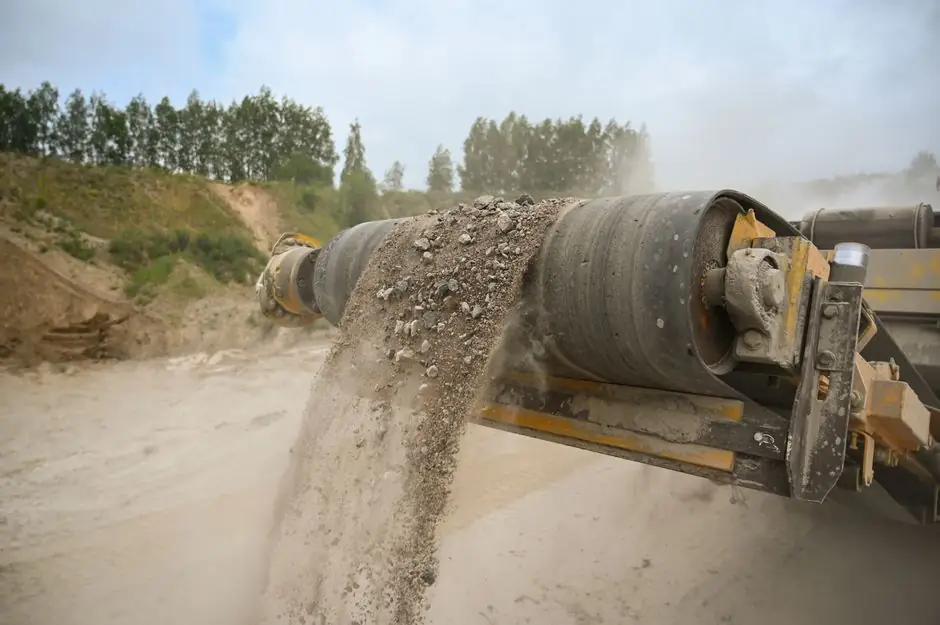
Quarry-spec hydraulic excavators span 50-250 tonnes operating weight, 300-1,500 HP engine output, and 12-22 m³ bucket capacity, with maximum dig depth exceeding 40 ft on large mining-class machines [S2][S6].
The size class and the rock face drive the spec, not brand loyalty. In a mid-sized aggregate quarry, a 13-tonne excavator with a 0.5-0.8 m³ bucket is the workhorse; a 90-tonne Cat 390F class machine with 4-6 m³ bucket is the step up for hard-rock faces [S5]. At the top end, Komatsu's PC3000-11 mining excavator runs 810 kW (≈1,086 HP) at 1,800 rpm with a 16 m³ bucket and 250-261 t operating weight, while Hitachi's flagship EX-7 series reaches 1,119 kW (1,500 HP) at 564,383 lb (256,000 kg) [S1][S6][S7].
Operating Weight and Engine Power Across the Quarry Range
Operating weight is the master variable: it scales bucket capacity, breakout force, ground-bearing pressure, and haul-truck match [S3]. Hitachi's EX1200-7B (117,000-120,000 kg backhoe/shovel) uses 760 HP (567 kW) for a 30 ft 9 in (9.38 m) dig depth; the EX2000-7B steps to 1,000 HP (746 kW) at 194,000-195,000 kg with a 26 ft 7 in (8.09 m) dig depth [S1]. Liebherr's mining-excavator platform reaches 205 t (backhoe) to 210 t (face shovel) at 810 kW engine rating at 1,800 rpm [S7].
For aggregate and dimension-stone quarries, the practical sweet spot sits in the 50-90 t class. Dozr's spec guide documents large-class dig depths over 40 ft, maximum dump heights of 37 ft, and engine power from 300 to 2,000 HP, with the upper tier reserved for quarrying and mining [S3]. A small excavator (70-120 HP, 16-20 ft dig depth) is unsuitable for hard-rock quarrying; quarry-spec excavators typically start at around 500 HP and 25 ft dig depth [S4].
Bucket Capacity, Dig Reach, and Face Geometry
Bucket capacity tracks operating weight almost linearly. The Komatsu PC2000-11 takes a 12 m³ bucket at 201.5 t operating weight; the PC3000-11 jumps to 16 m³ at 250-261 t; the PC4000-11 escalates to 22 m³ at higher class weight [S6]. Hitachi's larger mining shovels pair their operating weight with a backhoe digging reach of up to 54 ft and a shovel reach of about 44 ft 3 in (13.49 m) on the EX2000-7B [S1].
Quarry face geometry dictates boom choice. A shovel (face-shovel) configuration gives a lower profile and faster truck-loading cycle at the bench face; a backhoe (or "trackhoe") configuration gives a deeper dig depth and is used where the machine sits on the bench top. On the EX1200-7B, the backhoe dig depth is 30 ft 9 in versus only 15 ft 8 in in shovel mode, while the backhoe reach (50 ft 4 in) exceeds the shovel reach (37 ft 9 in) by roughly 12 ft 7 in [S1]. For hard-rock aggregate faces, the face shovel is standard because it loads 30-50 t haul trucks in 3-4 passes; the backhoe is reserved for overburden removal and slot cuts.
Selection Criteria: Quarry Size, Rock Hardness, Truck Match
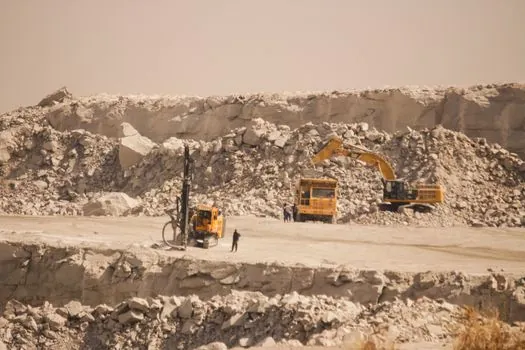
Three criteria drive the spec sheet. First, quarry output: a 13-tonne excavator fits a mid-sized quarry producing a few hundred tonnes per day, while operations over 5,000 t/day justify 90-tonne-plus machines with 4-6 m³ buckets [S5]. Second, rock hardness: granite and basalt faces require the higher breakout force of the 90-250 t class with reinforced buckets and often a hydraulic breaker in the secondary fleet; limestone and sandstone can be served by 50-90 t machines with standard GP buckets [S4][S5].
Third, haul-truck match. The rule of thumb is 4-6 bucket passes to fill a rigid-frame haul truck, so a 40 t truck pairs with a 4-6 m³ bucket, and a 100 t truck requires a 16-22 m³ bucket on a mining-class excavator [S2][S6]. A mismatch is the most common cause of quarry inefficiency: an undersized excavator queues trucks, an oversized one burns fuel and accelerates undercarriage wear. For related materials-handling decisions in industrial settings, the PVC-U pipe selection for industrial facilities: spec-first decision map lays out a similar matching framework for piping, and the Dust Detector Selection: Methods, Fractions and Specs for 2026 covers the environmental monitoring side that every hard-rock quarry also has to spec.
Who a Quarry Excavator Is (and Is Not) For
A 50-250 t hydraulic excavator with 12-22 m³ bucket capacity and 300-1,500 HP is built for hard-rock aggregate quarries, dimension-stone quarries, and pre-strip mining operations where the daily tonnage justifies the capital and fuel cost [S2][S6]. The 13 t class is the right answer for small aggregate pits, sand and gravel operations, and municipal quarrying where the bench height is under 6 m [S5].
It is not for trenching, landscaping, or general construction. A 1-2 t mini-excavator cannot fracture competent rock and will be destroyed by a face shot. It is also not for underground mining without a low-profile (LHD-compatible) variant. For operations where the rock is highly fractured or the face is below 4 m, a wheel loader with 25-32 yd³ bucket capacity and up to 1,739 HP (CAT's largest) is often a lower cost-per-ton option [S4].
Failure Modes, Limits, and Operating Constraints
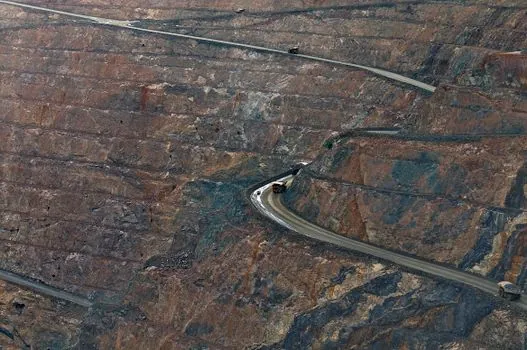
Three failure modes dominate quarry excavator downtime. First, ground-bearing pressure: a 250 t excavator at full load concentrates roughly 150-200 kPa on the tracks, so bench floor compaction and a level set-up are non-negotiable. Second, dust ingestion: air-filtration service intervals in quarry dust are typically halved versus general construction. Third, boom and bucket wear: high-abrasion granite faces will consume a bucket in 3,000-5,000 hours versus 8,000-10,000 hours in limestone. [S5]
Engine power ratings carry a caveat. Operating weight also varies by attachment: a backhoe configuration is 2,000-3,000 kg heavier than the same machine in shovel configuration on the EX2000-7B class [S1][S7]. For comparison, the Liebherr R 9100 / R 9150 / R 9200 / R 9250 mining-excavator family ranges from 100 t to 250 t class with face-shovel and backhoe variants each rated at 1,800 rpm [S7].
Standards, Sourcing, and Sizing Reference
There is no single ISO standard for quarry excavator selection, but several governing the components: ISO 6015 for excavator hydraulic performance and force measurements, ISO 10265 for the operator's field of vision, and ISO 12100 for general machine safety [S2]. Engine emissions for the EU market follow EU Stage V (Regulation 2016/1628) for engines 19-560 kW, and EPA Tier 4 Final for the North American market; both are referenced on the spec sheets of every mining-class excavator on the market. For bucket-capacity verification, ISO 7451 is the standard method for rating excavator bucket payloads.
Spec sourcing for a quarry purchase should start with the manufacturer's official product page (Hitachi, Komatsu, Liebherr, Caterpillar, Volvo CE) and cross-check with an independent size guide like Dozr's 2023 spec survey [S3]. The next spec node to track is the 2026 model-year emissions updates under EU Stage V and EPA Tier 4 Final, and the rollout of factory-fit payload monitoring on the 90-250 t class, which started on the Cat 390F class and is now appearing on Komatsu PC2000-11 and PC3000-11 platforms [S5][S6].
A final cross-check signal: watch the OEM telematics platforms (Komatsu KOMTRAX, Cat Product Link, Hitachi Global e-Service) for the 2026 factory-fit payload accuracy data. A 2-3% improvement in bucket-payload accuracy on a 22 m³ bucket at 1.6 t/m³ rock density translates to 700-1,000 kg more per cycle, or roughly one extra truck load per 50 cycles.
Spec-level background on the components involved: excavator, pressure transmitter, and flow meter.