
Landfill and transfer-station duty is a 20-50 ton lifting class job, dominated by 25-50 t telescopic and knuckle-boom truck cranes from XCMG, Zoomlion, and Foton-chassis specialists [S3][S5][S6]. The working envelope at a typical municipal solid waste transfer station sits at 8-12 m radius and 6-10 m hook height, which is well inside the comfort zone of a 25-ton class machine but outside the practical envelope of sub-12 t units [S3][S6].
Three structural choices drive the spec: boom type (telescopic vs knuckle), chassis (4x2, 6x4, 8x4, all-terrain), and duty cycle rating. A 25-ton telescopic boom truck crane on a 6x4 chassis is the most common baseline, while a 12-ton knuckle boom truck crane covers container-handling at smaller transfer stations [S6]. Landfill operators also need a chassis matched to unpaved haul roads, which is why off-road and all-terrain 8x4 configurations get specified above 40 t [S3].
Working envelope: why reach matters more than peak capacity
At a transfer station, the typical lift is a 4-6 ton loaded container or compactor bin at 8-12 m radius, repeated 30-80 cycles per shift [S6]. XCMG's XCT25L5_Y delivers 25 t maximum capacity but only ~5-7 t at 10 m radius, which is the actual usable figure for a 20-cubic-yard bin lift [S3]. The XCT60_Y at 60 t peak lifts roughly 12-15 t at the same 10 m radius, a ratio that holds across the 25-60 t telescopic class [S3].
Knuckle-boom units trade vertical reach for compact stowage: a 12-ton articulated crane on a 4x2 chassis folds to a 2.5 m body envelope, which lets the truck enter covered tipping halls where a telescopic unit cannot [S6]. For open-air landfill cells, telescopic boom geometry wins on vertical clearance for loading 40-cubic-yard open-top roll-offs. Capacity utilization rarely exceeds 60 percent of nameplate on landfill duty, so overspec by one size class is the norm rather than the exception.
Chassis and driveline: matching the road, not the brochure
Landfill sites are unpaved, often with 150-300 mm of loose cover material, so a 6x4 or 8x4 drive configuration with single reduction drive axles is the minimum [S3][S6]. Foton, Dongfeng, and T-King chassis are the dominant OEM platforms for the 6-16 t small-crane class used at regional transfer stations [S2]. Above 25 t, an all-terrain chassis with hydraulic outriggers spanning 5.8-7.2 m is the typical spec; below 16 t, a standard commercial truck chassis is acceptable [S2][S6].
For a transfer station feeding a dump truck fleet, the crane truck and the haul truck should share wheelbase and tire spec so that spare-tire and axle-servicing inventories consolidate. The Foton chassis used on the 6-16 t crane class is widely supported in regional service networks, which is a downtime consideration that outweighs a 3-5 percent purchase-price advantage on a less common brand [S2].
Engine, emissions, and dust exposure
Modern truck cranes in the 25-60 t class run a 6-cylinder diesel in the 9-13 liter displacement range, typically 250-380 kW rated, paired with a 9-12 speed manual or automated manual transmission [S3]. China Stage IV and EU Stage V emission equivalents are now the default export spec for new builds from XCMG and Zoomlion; confirm the tier in the OEM data sheet rather than relying on the brochure headline [S3][S5].
Dust is the dominant environmental stressor, not rain or cold. Air filtration should be upgraded to a two-stage dry-element pre-cleaner plus the standard engine filter, and hydraulic tank breathers should be fitted with desiccant caps. Knuckle-boom models expose fewer hydraulic lines than telescopic models, which is a measurable maintenance advantage in dusty conditions [S6].
Comparison: telescopic vs knuckle vs all-terrain for landfill duty
Three configurations cover roughly 90 percent of landfill and transfer-station specifications, and the choice comes down to reach, footprint, and cycle time. The table below lines them up on the four criteria that drive purchase decisions in this segment.
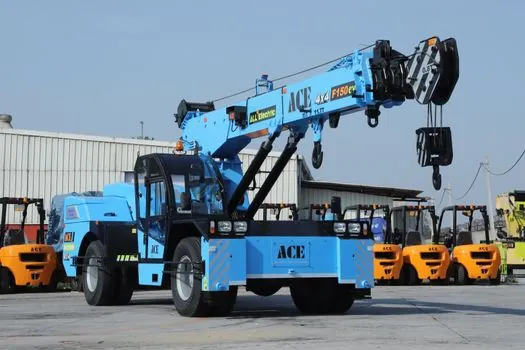
A 25 t telescopic on a 6x4 chassis (XCMG XCT25L5_Y class) is the default at mid-size transfer stations: 28-32 m main boom plus 8-15 m fly jib, 5-7 t at 10 m radius, and a body envelope near 11 m when stowed [S3]. A 12 t knuckle boom on a 4x2 chassis (Foton or similar) fits where overhead clearance is restricted, lifts 4 t at 6 m, and stows under 2.5 m [S2][S6]. A 40-60 t all-terrain (XCT60_Y class) covers the largest transfer stations and rail-side intermodal facilities, lifts 12-15 t at 10 m, and runs an 8x8 chassis with 7.2 m outrigger spread [S3].
For pure landfill cell work where reach is vertical and footprint is not constrained, telescopic wins. For covered transfer halls with low clearance, knuckle wins. For intermodal or heavy-bulk handling, all-terrain wins on capacity and on cross-country mobility.
Standards, certification, and operator gates
Three compliance gates matter for landfill deployment. First, OEM quality certification: XCMG and Zoomlion export units carry CE marking and ISO 9001 factory certification, and Jining Far East's small-crane line cites ISO and CE compliance for the 6-16 t class [S2][S5]. Second, operator certification: in the US, NCCCO Mobile Crane Operator certification is the recognized credential, and lift directors are separately certified [S1]. Third, lifting-device inspection per ASME B30.5 is the recurring annual gate, regardless of OEM.
Buyers should confirm the OEM data sheet, not the marketing brochure, lists the load-chart values at the actual working radius rather than only peak capacity. The XCT25L5_Y 25 t and XCT60_Y 60 t nameplates, for example, drop to roughly 22 percent of nameplate at 10 m radius when the boom is at 30-40 m length [S3]. This is the single most common spec error on landfill purchases: buying capacity that the geometry cannot deliver.
Supplier landscape and price band, August 2026
The 2026 supplier base for landfill-duty truck cranes clusters in three tiers. Tier 1: XCMG and Zoomlion, both with full 25-100 t telescopic ranges, 5-7 section booms, and global service networks; XCMG's XCT25L5_Y and XCT60_Y are the most commonly listed 25 t and 60 t models in current export catalogs [S3][S5]. Tier 2: Jining Far East, Foton-chassis specialists, and similar Shandong- and Hunan-based OEMs serving the 6-16 t small-crane segment with ISO/CE certification and roughly 2,000 units annual output [S2]. Tier 3: knuckle-boom specialists producing 3-14 t articulated cranes for compact chassis [S6].
FOB price bands reported in mid-2026 listings put a 25 t telescopic at roughly $10,000-$100,000 (spread reflects configuration and options, not error bars) and a 60 t telescopic at $100,000-$1,000,000, with knuckle-boom 12 t units well below the 25 t telescopic floor [S3]. For full project context on a closely related duty cycle, the spec map for mining operations lines up 40-100 t all-terrain and rough-terrain choices that overlap the high end of the landfill segment. On the maintenance and consumables side, face shield and PPE selection at the tipping floor is a related spec gate, because dust exposure drives both respiratory and eye-injury risk for the crane operator.
Track three signals over the next 6-12 months: OEM announcements of Stage V / EU Stage VI engine options on the 25-40 t class, regional service-network expansion by Zoomlion and XCMG in North American landfill markets, and any ASME B30.5 revision that tightens the annual inspection load-test requirements. For procurement, lock the load chart at the working radius (8-12 m), not at the nameplate, and confirm outrigger spread and chassis spec against the actual haul-road profile before signing the PO.
Detailed specification references: reach truck.
