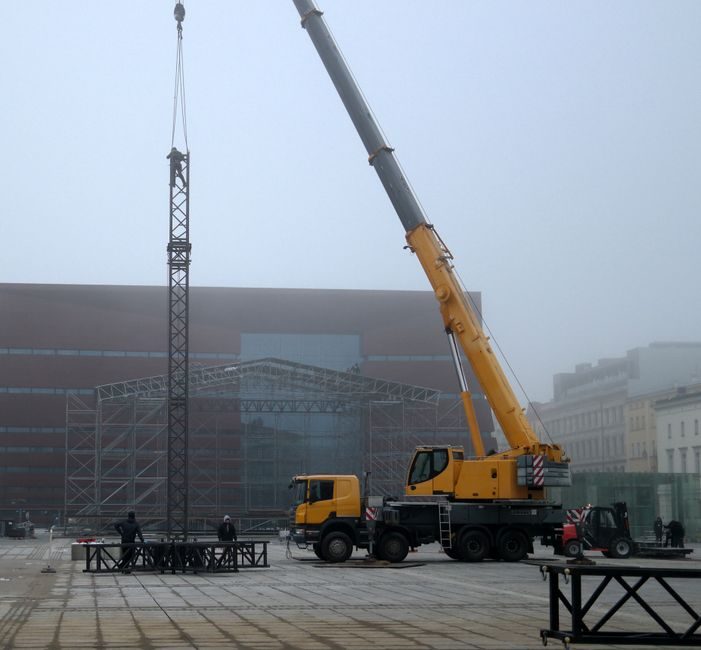
Specifying a truck-mounted crane starts with a 50 t / 39 m / 3-axle envelope defined by the Liebherr LTC 1050-3.1E telescopic, which carries 50 t maximum load, reaches 48 m working height and 39 m horizontal extension on a 3-axle chassis driving at 85 km/h with 243 kW engine power [S1]. That single data set is the de-facto 2026 ceiling for road-going crane carriers in the 50 t class.
The class stretches from 1 t utility cranes built on a 2-ton light-truck chassis — Foton's Foton truck-mounted crane family covers 1 t to 16 t lift capacity on Foton auto platforms for municipal, mining and landscaping work — to the 50 t 3-axle construction segment populated by Liebherr's LTC range and Fassi's F145AS building/lifting/loading configuration [S2][S4]. Sizing therefore means picking the smallest crane that meets the heaviest pick, not the biggest one available.
Four binding spec gates: load, reach, axle, duty
The first gate is maximum load at minimum radius versus maximum load at full radius, because the same machine publishes very different numbers on each chart column. The LTC 1050-3.1E lists 50 t at close radius dropping through a 39 m horizontal reach envelope [S1]; ignoring the radius-vs-load curve is the single most common cause of under-spec'd crane orders in the 30–50 t class.
The second gate is working height plus horizontal reach, both needed simultaneously: 48 m working height and 39 m horizontal reach on the LTC 1050-3.1E define a 4-axle-class construction envelope, while smaller utility machines typically stop at 18–22 m of boom [S1][S4]. The third gate is the carrier: axle count drives both the legal GVW and the in-service stability margin, with 2-axle chassis handling up to ~16 t lift class, 3-axle reaching the 30–50 t band, and 4-axle-plus required above 60 t per the same OEM class structure [S1][S2][S4].
The fourth gate is duty cycle, where telescopic boom machines like the LTC 1050-3.1E trade against knuckle-boom (Fassi F145AS) designs favoured for repetitive loading cycles at lower radius and height [S1][S2]. The article on truck-mounted crane selection for pulp and paper walks through the same four gates applied to a 14 t·m to 250 t load-band, and the Liebherr LTM-class taxonomy on the truck-mounted crane encyclopedia page maps the boom and outrigger geometry that those gates imply.
Load class breakdown: 1 t utility to 50 t construction
1–16 t class on light-truck chassis (typical 2-axle, 4×2 or 4×4, GVW 6–18 t) is the workhorse segment for municipal and logistics use. The Foton 福田随车吊 series sits squarely in this band, with 1 t, 2 t, 4 t, 6 t, 8 t, 10 t, 12 t, 16 t variants on Foton auto chassis for coal-mine, road-works and landscaping deployment [S4].
16–30 t class moves to 3-axle carriers, with knuckle-boom specialists like Fassi F145AS serving building-site, lifting and loading applications, and telescopic machines entering the same band with shorter booms than the 50 t class [S2]. The 30–50 t class is the LTC 1050-3.1E's natural habitat: 50 t max load, 48 m working height, 39 m horizontal reach, 7 t crane superstructure weight, 85 km/h drive speed and 243 kW (330 hp) carrier engine [S1]. Above 50 t, all-road mobile cranes (AT cranes) take over and the "truck-mounted" classification blurs into a 4- to 7-axle all-terrain segment.
Within each class, the comparison axes that matter are: (1) max load at full radius (the published "tip" number, often 20–35% of the close-radius max), (2) number of telescopic sections (3–7 sections is the 2026 norm), (3) outrigger span, and (4) electric or hybrid drive availability — the LTC 1050-3.1E carries an electric, electro-hydraulic option explicitly aimed at cutting greenhouse-gas emissions on construction sites [S1].
Reach and boom geometry: telescopic versus knuckle
Telescopic booms win on raw height and reach. The LTC 1050-3.1E delivers 48 m working height and 39 m horizontal reach, with auxiliary jibs extending the envelope further on the 50 t class [S1]. Multi-section hydraulics let the operator extend under load; the trade-off is crane weight and stowed length on the carrier deck.
Knuckle-boom designs — Fassi F145AS being a current building/lifting/loading example — fold a base boom and a folding knuckle into a compact stow package, which reduces carrier length and lets a shorter wheelbase do the same lifting work at lower radius [S2]. For repetitive pick-and-cycle duty on a logistics yard or a timber yard, the knuckle-boom cycle-time advantage is real; for tower erection or industrial maintenance at 30 m+, the telescopic boom is mandatory.
For 4-axle-plus machines and all-terrain comparison points, the truck-mounted crane encyclopedia entry covers outrigger matrix, jib configurations and the LTM-style roadable envelope. Buyers comparing utility-class machines against the 50 t ceiling should weight reach at full load higher than the headline max-load figure, because reach-at-rating is what fails the pick on a real job.
Carrier, axle and regulatory envelope
Axle count and GVW define what is legal on the road without permits. 2-axle chassis cap out around 18 t GVW (matching the 1–16 t crane class on Foton platforms) [S4]; 3-axle chassis reach the 25–32 t GVW band that supports the 30–50 t crane superstructure like the LTC 1050-3.1E (7 t crane + 25 t carrier mass in the published configuration) [S1]; 4-axle-plus is required for the 60 t+ class.
Drive specifications on the 3-axle 50 t class converge on 240–250 kW (320–340 hp) carrier engines and 80–90 km/h top speeds, with the LTC 1050-3.1E publishing 243 kW (330 hp) and 85 km/h [S1]. Below 16 t lift, the same convergence shows up at 100–160 kW carrier engines and chassis shared with the donor truck maker — which is why the Foton utility line uses Foton auto chassis directly [S4].
For buyers cross-shopping a truck-mounted crane against a truck-mounted concrete pump on a similar 3-axle chassis, the chassis spec (engine power, axle load, wheelbase) is broadly interchangeable; the superstructure is the entire cost difference. A separate but adjacent spec class — the reach truck — is warehouse equipment, not a road crane, and should never be confused with a telescopic boom truck crane in a bid document.
Duty cycle, driveline and 2026 driver trends
Duty cycle dictates boom type more than any other spec. Pick-and-place loading favours knuckle-boom; long-reach infrequent lifts favour telescopic; high-cycle slab work favours a smaller machine in higher utilization. The Fassi F145AS positioning as a building/lifting/loading knuckle-boom machine versus the LTC 1050-3.1E's telescopic 50 t construction role illustrates exactly that split [S1][S2].
Driveline and emission class are the 2026 buying decision. Liebherr's LTC 1050-3.1E is explicitly branded around the climate-revolution push toward lower greenhouse-gas emissions, with the new "compact, electric, electro-hydraulic" descriptor on the latest data sheet [S1]. For specifiers writing tenders, that means battery-electric or hybrid-electric crane drives are now available at the 50 t / 39 m class — not only in the 1–16 t utility band [S1][S4].
For buyers working in salt-air, port and offshore-adjacent environments, the duty cycle and corrosion-protection package overlap heavily with marine-grade aerial work platforms; the boom material, hydraulic seals and outrigger pad selection follow the same spec-first logic, just transferred from a wheeled crane to an elevated-platform chassis.
Failure modes and spec traps to avoid
The most common under-spec is rating at full radius: a 50 t max-load figure assumes the hook is directly over the crane's centreline, with the published tip number at 39 m often closer to 8–12 t on a 3-axle 50 t class machine [S1]. The second trap is omitting outrigger spread: a half-deployed outrigger matrix cuts the load chart by 30–60% depending on configuration, and the published ratings assume full deployment.
The third trap is mixing truck-mounted crane ratings with rough-terrain crane ratings, which share boom geometries but not carrier envelopes. A 30 t rough-terrain crane is not equivalent to a 30 t truck-mounted crane on the road, because the latter must meet axle-load and GVW regulations that the rough-terrain machine bypasses. Buyers who ignore the road envelope get hit with permit refusals and overweight fines at the first weighbridge.
For specifiers comparing across product lines, the same load/radius/axle logic that governs a dump truck body rating or a linear guide life calculation applies: published max numbers are upper bounds under ideal conditions, and the real spec margin is 20–30% below the headline figure.
Selection checklist and sourcing signals
A defensible 2026 truck-mounted crane spec should lock down: (1) max load at the working radius of the heaviest pick, not at minimum radius; (2) working height plus horizontal reach with the jib deployed; (3) carrier axle count and GVW compatible with road permits on the planned route; (4) boom type matched to duty cycle (telescopic for reach, knuckle for cycle time); (5) drive type (diesel, hybrid, full electric) matched to site emission rules; and (6) outrigger spread versus available pad space on the job site. [S1]
Trackable signals to watch through the rest of 2026: Liebherr's electric and electro-hydraulic variants rolling out below the 50 t LTC line, Fassi expanding the F145AS-class knuckle-boom range into the 20–30 t band, and Chinese utility-class makers like Foton adding 16 t-plus variants to the 1–16 t established line [S1][S2][S4]. A specifier who locks the four gates first — load, reach, axle, duty — and only then evaluates vendor shortlists will cut bid evaluation time roughly in half and avoid the radius-rating trap that derails most first-pass orders.